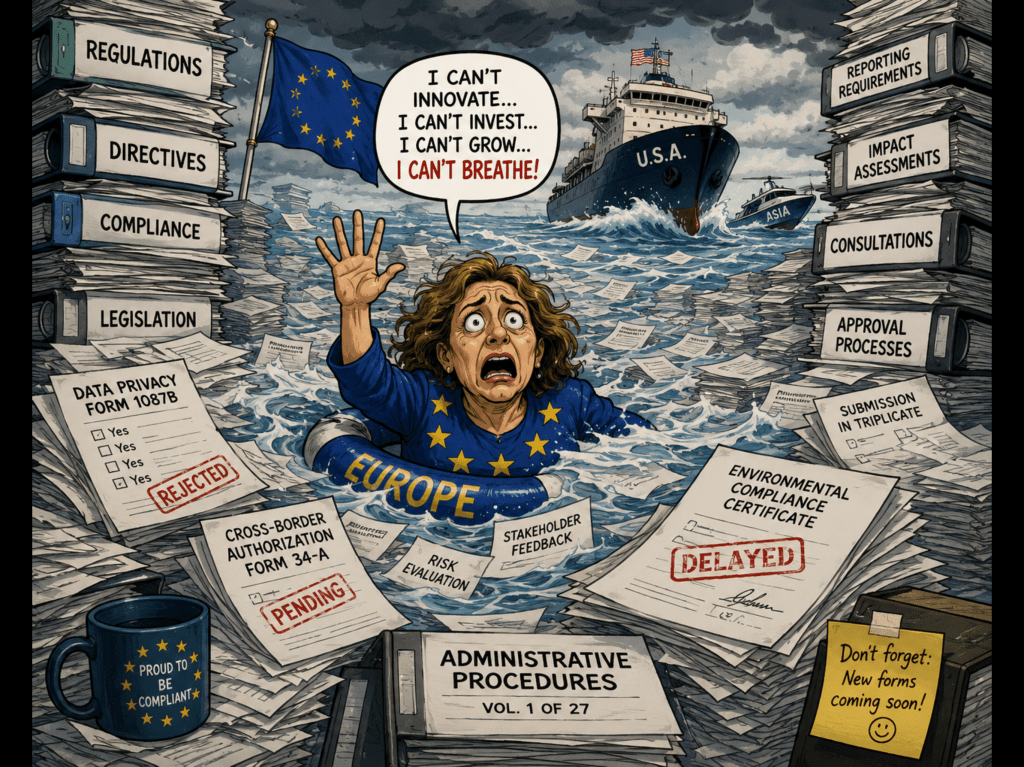
💤📉Europe isn’t falling off a cliff. That would be dramatic. Instead, it appears to be carefully assembling a velvet-lined economic wheelchair while America and parts of Asia bolt jet engines onto the future. The OECD projects euro-area growth of just 0.8% in 2026 and UK growth of 0.9%, while the United States sits around 2%, China at 4.5%, and India at 6.3% for FY2026-27. So yes, the scoreboard is not exactly whispering “European renaissance.”
Brussels Has Invented the World’s First Paperwork-Powered Growth Strategy
🗂️🚲Europe’s great economic trick is hiring more people to produce not nearly enough extra value, then calling the spreadsheet “resilience.” The ECB found that between late 2019 and early 2024, US hourly productivity in market services rose 12.4%, versus 3.8% in the euro area. In information and communications, the gap was even uglier: 27.2% versus 6.5%. That is not a gap. That is a canyon with a café regulation committee at the bottom.
The continent still has brilliant scientists, world-class engineers, and universities packed with brains bright enough to power a small moon. Then, somehow, the miracle happens: the start-up stays small, sells to America, moves to America, or dies gently beneath 27 flavours of tax code and a grant application written by someone allergic to verbs.
Meanwhile, Europe regulates the digital revolution with the confidence of a museum curator dusting someone else’s spaceship. America builds platforms. Asia scales factories. Europe convenes a stakeholder consultation to discuss whether the spaceship’s seatbelt complies with cross-border upholstery standards. 🚀📋
Then comes energy. Europe built a grand industrial model on cheap Russian gas, American protection, and Chinese demand — three legs of a stool now wobbling like a drunk giraffe. The Draghi competitiveness diagnosis points to slowing productivity, demographic pressure, rising energy costs, and global competition squeezing Europe’s long-term prosperity. Translation: the factory lights are expensive, the workforce is ageing, and the future is being manufactured elsewhere.
And the money? Oh, Europe has money. Mountains of it. But rather than feeding the next European tech giant, too much sits politely in bank deposits or wanders abroad like a pensioner on a confused cruise. The Commission says roughly 70% of EU household savings — around €10 trillion — are held as bank deposits, while its own political guidelines warn that €300 billion of European families’ savings goes to foreign markets every year. So Europe is not just losing the race. It is helping fund the winner’s running shoes.
The single market? More like a single market-themed obstacle course. A company trying to scale across Europe doesn’t just expand; it performs a bureaucratic pilgrimage through tax systems, labour rules, licences, forms, committees, stamps, and someone called Klaus who is on leave until Thursday.
Europe’s real crisis is not stupidity. It knows the problem. Draghi knows. The ECB knows. The OECD knows. The IMF knows. The Commission knows. Everyone knows. That is what makes it so magnificently tragic. The diagnosis is sitting on the table wearing a hi-vis jacket, and Europe is still asking whether another working group might help.
Security, stability, regulation, and protection can all be valuable. But when they become a religion, growth becomes heresy. And without growth, the welfare state becomes a luxury catalogue with no payment method. 🧾🔥
🔥Challenges🔥
Here’s the question nobody in the committee room wants shouted too loudly: can Europe still afford comfort without competitiveness?
Is this a necessary defence of social stability — or a slow-motion surrender dressed up as caution, consensus, and “strategic autonomy”? Drop your take in the blog comments, not just on Facebook. We want the fury, the sarcasm, the defence, the counterargument, and the economic truth bombs. 💬⚡
👇 Comment, like, and share if you think Europe needs less managed decline and more industrial caffeine.
The best comments will be included in the magazine. 📝🎯


Leave a comment