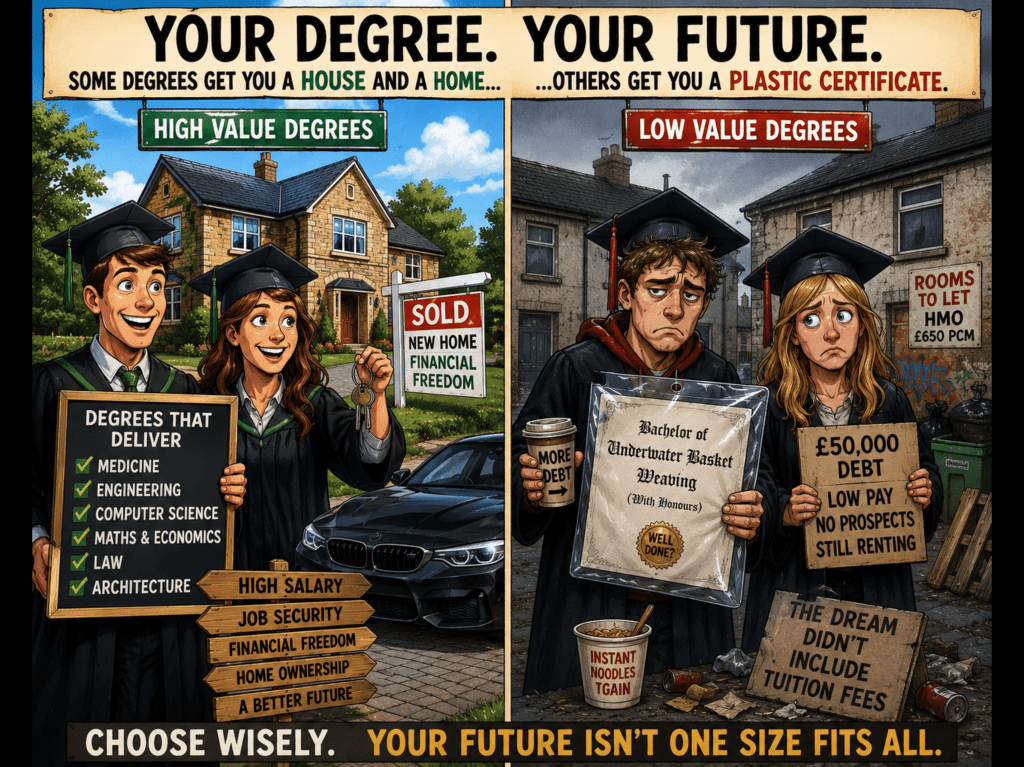
🎓💸Deciding whether to go to university is no longer a simple “follow your dreams” moment. It is now more like walking into a financial casino wearing a school blazer and being told: “Pick wisely, child, because one degree buys you a house deposit and another buys you a laminated certificate of disappointment.” Latest reported figures suggest high-earning routes include economics, medicine and dentistry, maths, engineering, architecture, computing and sciences, while lower-paid outcomes are often linked with education, creative arts, media, agriculture, health and social care, and general studies.
🎓 Welcome to the University Hunger Games, Sponsored by Student Debt
For decades, Britain sold university like it was a golden escalator: step on at 18, wobble about in freshers’ week, emerge three years later as a well-paid adult with a pension, a briefcase, and the faint scent of academic superiority. Lovely little fairy tale. Shame the economy ate it. 🐺📚
The official Longitudinal Education Outcomes system links education records with employment, benefits and earnings data, which means we can now see what many graduates actually earn rather than what the prospectus implied while showing photos of laughing students under autumn trees.
And the picture is brutally uneven. Department for Education figures show median first-degree graduate earnings five years after graduation were £31,400 in 2022/23, with 88.6% of first-degree graduates in sustained employment, further study, or both. That sounds respectable until you remember the debt mountain, rent, tax, food, transport, and the fact that a meal deal now feels like a mortgage application.
Meanwhile, some degrees are practically wearing diamond cufflinks. Economics reportedly reaches long-term average earnings around £70,300, medicine and dentistry around £65,100, and mathematical sciences around £52,700. At the other end, some courses leave graduates wondering whether the “graduate premium” is hidden behind the sofa with the TV remote.
This does not mean creative, caring, teaching, or media degrees are worthless. Society needs teachers, carers, artists, writers, designers and communicators. But society also has a nasty habit of applauding “vital workers” with one hand while paying them in warm compliments and badge lanyards with the other. 👏🪪
Enter Andy Burnham, now Prime Minister since 20 July 2026, with his great hard-hat intervention: maybe Britain has worshipped the university route for too long, and maybe technical education, vocational training and apprenticeships deserve more respect.
And honestly, he has a point. Not every teenager needs three years of lectures, £50,000-plus debt, and a dissertation on medieval spoon symbolism to become successful. Some need a trade, a skill, a paid apprenticeship, a route into engineering, construction, energy, logistics, manufacturing, digital work, or healthcare technology. In other words: something the economy can actually point at and say, “Yes, we need that by Monday.” 🔧⚡
The problem is that Britain spent years sneering at practical skills while shoving everyone through the same academic sausage machine. Then it looked around and discovered we had graduates without jobs, jobs without workers, industries without trainees, and parents quietly Googling “is philosophy employable or have we just bought a very expensive conversation starter?” 🧠🥲
University is not the enemy. Bad advice is. Weak courses are. Snobbery is. Pretending every degree has the same economic value is. Selling teenagers a dream while hiding the repayment terms in the small print is. And worst of all, treating apprenticeships like the consolation prize for people who did not fancy a library card with interest charges.
The real question should not be “university or no university?” It should be: what course, what skill, what job market, what earnings, what debt, and what future?
Because a degree should be a ladder, not a decorative shovel for digging a financial hole. 🕳️🎓
🔥Challenges🔥
Here’s the uncomfortable question for parents, students, universities and politicians: are we guiding young people into opportunity, or selling them prestige wrapped in debt?
Would you rather your child had a lower-paid degree with passion, a high-paid degree with pressure, or a trade that earns from day one? And should universities be forced to show clear earnings outcomes before students sign up?
Drop your take in the blog comments — not just Facebook. The best arguments are probably coming from graduates, apprentices, parents, lecturers, and anyone still paying off a degree they have not used since 2014. 💬🔥
👇 Comment, like, and share. Tell us which degrees are worth it, which are a trap, and whether the hard hat has finally beaten the graduation cap.
The best comments will be included in the magazine. 🎯📝


Leave a comment