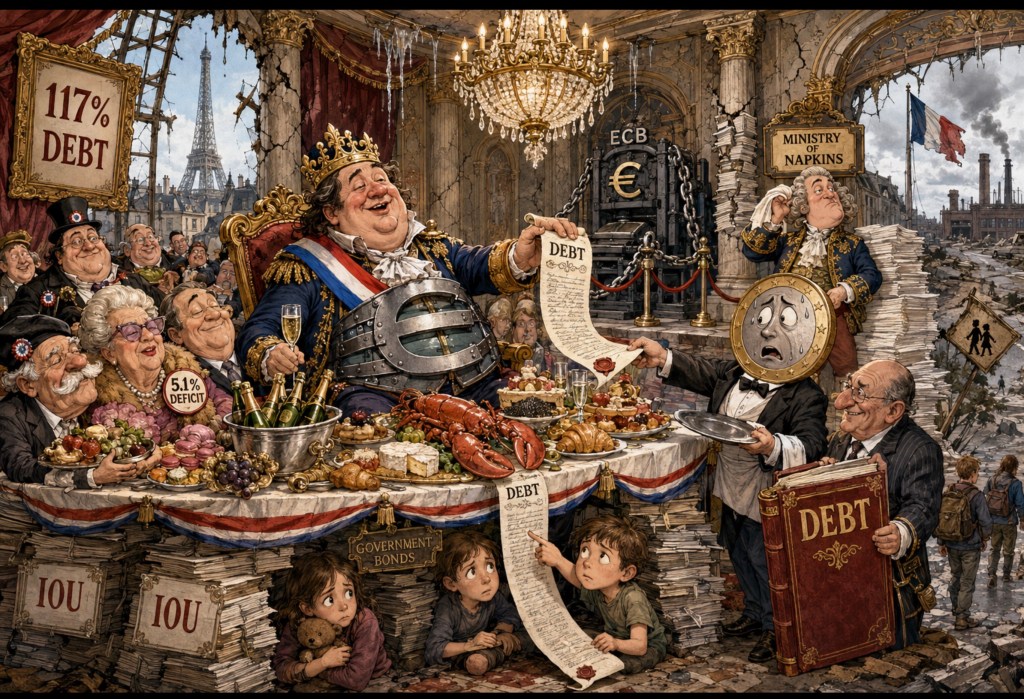
There was once a prosperous kingdom called Francoria, famous for its excellent bread, generous festivals and magnificent public banquet.
Every citizen was promised a seat at the table. The elderly received fine wine, workers were served three courses, public officials enjoyed permanent reservations, and anyone who fell upon difficult times could depend upon the royal kitchen.
It was a generous system, and the people were proud of it.
But maintaining the banquet became increasingly expensive.
The kingdom’s farms were growing slowly. Its workshops faced stronger competition from distant lands. Energy became costly, businesses invested less, and the number of retired diners grew faster than the number of working cooks.
Still, no king wished to reduce the menu.
Whenever the royal treasurer warned that the kitchen was spending more than the kingdom earned, the king would smile and say:
“Put it on the account.”
The kingdom borrowed money to buy meat.
It borrowed money to pay the cooks.
It borrowed money to maintain the dining hall.
Eventually, it even borrowed money to pay the interest on what it had previously borrowed.
For many years, this appeared to work. The wealthy bankers charged very little, and the banquet continued without interruption. Each king claimed the system was successful because the tables remained full.
Then the price of borrowing increased.
The bankers arrived at the palace carrying an enormous ledger.
“Your Majesty,” they said, “your kingdom already owes more than it produces in an entire year. Every year you spend far more than you collect, and renewing your old loans now costs considerably more.”
The king examined the ledger.
“Can we make more coins?” he asked.
“No,” replied the treasurer. “We surrendered the royal mint when we joined the Great Currency Union.”
“Can we reduce the value of our currency?”
“No. The union controls its value.”
“Can we set lower interest rates?”
“No. The Central Banker sets one rate for every kingdom in the union.”
The king looked relieved.
“Excellent,” he said. “Then none of this is my responsibility.”
But the treasurer shook his head.
“The union controls the money, Your Majesty. It does not pay our bills.”
The king summoned representatives of the people.
“We must serve slightly smaller portions,” he announced.
The pensioners protested.
“We were promised the full banquet!”
The public officials objected.
“Our department is essential to supervising the distribution of napkins.”
The wealthy demanded that their private dining rooms remain tax-free.
The workers refused to pay more for their meals.
The politicians declared that every saving proposed by their opponents was cruel, unnecessary and probably illegal.
After several weeks of demonstrations, the king withdrew his proposal and dismissed the treasurer.
A new treasurer was appointed. He inspected the same ledger and reached the same conclusion.
He was dismissed too.
Meanwhile, the bankers began charging Francoria more because they suspected that nobody possessed either the courage or the authority to control the banquet.
More of the kingdom’s taxes went towards interest. That left less for hospitals, schools, roads and defence. The government borrowed again to fill those gaps, which created still more interest.
The banquet continued, but the roof began to leak.
The kitchens became outdated.
The roads carrying food to the palace deteriorated.
Young cooks left for kingdoms where businesses grew more quickly and their wages were higher.
Yet every evening, the king raised his glass and declared:
“Look at these magnificent tables. How could anyone say Francoria is in trouble?”
One day, a child standing outside the palace asked a simple question:
“If the banquet is paid for with borrowed money, who eventually pays the bill?”
The king pointed towards the future.
“The people who live over there.”
The child looked in that direction but saw only other children.
The moral is simple: generosity financed by productive wealth can endure. Generosity financed permanently by debt becomes a promise made by today’s politicians and paid for by tomorrow’s citizens.
And belonging to a currency union does not make the debt disappear. It merely removes some escape routes, shares the consequences with neighbouring kingdoms and gives every ruler someone else to blame when the bill finally reaches the table.


Leave a comment