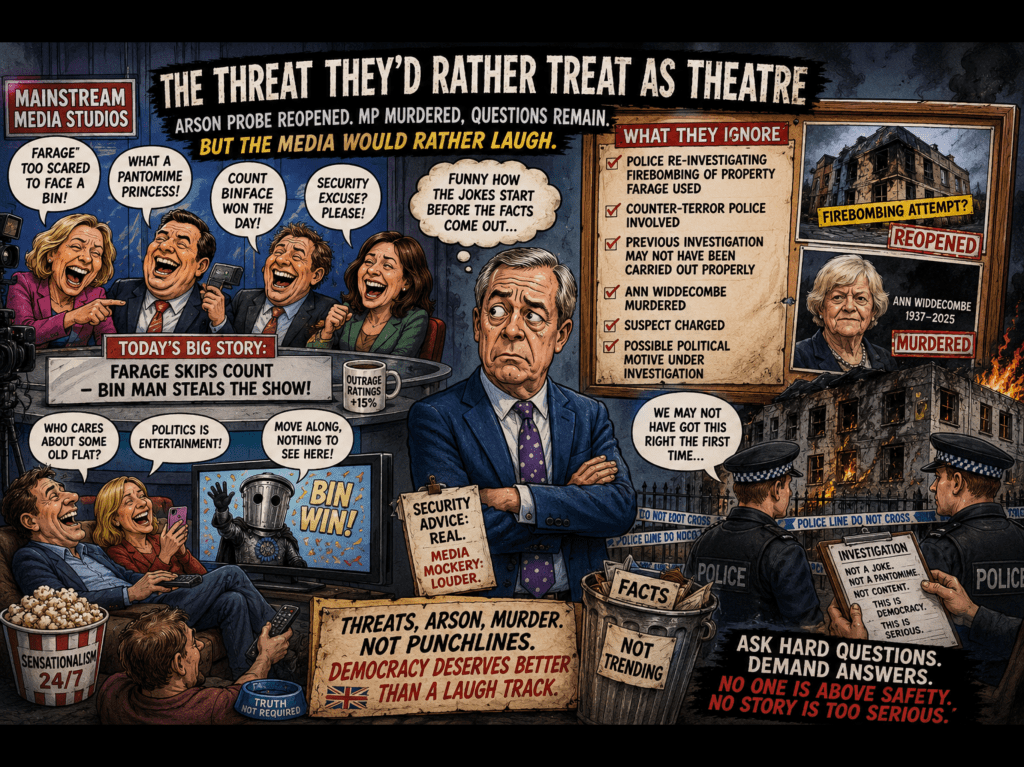
The row over Nigel Farage not attending the Clacton count is being sold as another pantomime episode in Britain’s broken political circus: Farage absent, Count Binface present, cameras everywhere, outrage on tap. But behind the jokes and rolling-news smirks sits a far more serious question: why are possible threats around Reform figures being treated like inconvenient background noise?
When A Firebomb Probe Reopens, Maybe Stop Laughing For Five Minutes 🔥
Here is the uncomfortable bit. Police have reportedly reopened a previous investigation into an incident at a property linked to Farage, originally treated as attempted burglary, now being examined again as part of the Ann Widdecombe murder investigation. That does not prove every claim. It does not mean every rumour is fact. But it does mean the matter is serious enough for counter-terror police to take another look.
And that is where the media tone starts to stink.
If a politician says they avoided a public count because of security concerns, the responsible response is not to turn it instantly into a comedy sketch about cowardice, ego, or bruised pride. The responsible response is: what did police know, what was the risk, what was communicated, and why is a previously closed case now being re-examined?
Because when police reopen a case connected to a suspected attack, it raises an obvious question: was something missed the first time?
That is not a conspiracy theory. That is basic accountability.
The murder of Ann Widdecombe is not a prop in a political argument either. It is a grave crime, and the public deserve a proper explanation through evidence, courts, and police transparency — not smug media half-lines that rush past the hard questions because they don’t fit the preferred joke. A man has been charged with her murder, and police are investigating possible political motivation, but the case still has to be tested properly through the justice system.
The hypocrisy is glaring. If a mainstream establishment politician had faced alleged firebombing concerns, reopened counter-terror inquiries, and a political ally murdered, the media would be running solemn black-and-white graphics, panel discussions on “the toxic climate,” and emotional monologues about threats to democracy.
But because it is Farage and Reform, too many commentators reach for the laugh track before the facts have even sat down.
That is the sickness.
You do not have to like Farage. You do not have to vote Reform. You can oppose everything they stand for and still admit that threats, arson allegations, murder investigations, and political intimidation must be treated seriously.
Democracy is not just damaged when people vote the “wrong” way. It is damaged when violence, threats, or intimidation hover around elections and half the media decides the real scandal is whether the victim looked dramatic enough while reacting to it.
If police are going back over an incident they may not have handled properly the first time, then the story is not “Farage dodged a count.”
The story is: why did it take this long for everyone to stop laughing at the bin and start looking at the fire? 🔥🗳️
🔥 Challenges 🔥
Here’s the question: are the media applying the same seriousness to threats against Reform figures that they would apply to threats against politicians they prefer?
Drop your take in the blog comments. Is this selective outrage, lazy journalism, or proof that political violence only becomes fashionable when the “right” side can benefit from it? 💬🔥
👇 Comment, like, and share if you think threats against any elected politician should be investigated properly — no matter which rosette they wear.
The best comments will be included in the magazine. 🎯📝


Leave a comment