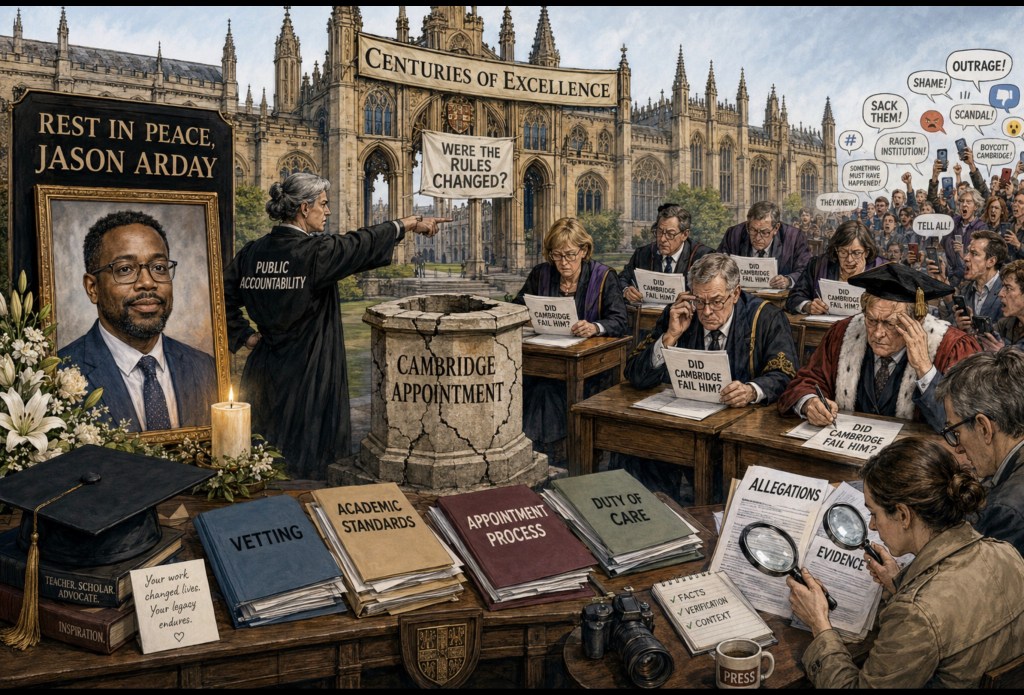
The death of Professor Jason Arday should not become another weapon in Britain’s endless culture war. It should force a serious examination of the institutions that raised him up, the standards they claimed to uphold and the machinery of public condemnation that followed when questions began to emerge.
Arday, aged 41, was found unresponsive at his home in Battersea shortly after resigning from the University of Cambridge. Police have described his death as unexpected but not suspicious. Its precise cause has not been publicly established, so nobody can honestly claim that a particular person, allegation or newspaper directly caused it.
But that does not remove the need for accountability.
It makes accountability more important.
Cambridge Built the Pedestal
Cambridge is not an obscure institution handing out impressive titles above a workshop where Bob the Builder might unexpectedly become Professor of Advanced Bricklaying.
It is one of the most prestigious universities in the world.
Its reputation was built over centuries upon intellectual excellence, demanding standards and the promise that reaching its highest academic positions required exceptional achievement. Students and academics have organised their lives around that promise. They have studied, competed, sacrificed and sometimes accepted painful rejection because they believed Cambridge’s standards were extraordinarily high but fundamentally real.
When Cambridge appointed Jason Arday as Professor of Sociology of Education, it did not quietly employ him and allow his work to speak for itself. His appointment was celebrated as an historic achievement. His race, neurodiversity and extraordinary personal journey became part of a powerful institutional story about progress and inclusion.
Cambridge accepted the applause.
It must therefore accept responsibility for the appointment process behind that celebration.
When a university of this standing appoints a professor, the public reasonably assumes that it has examined the candidate’s publications, checked their qualifications, verified their employment history and assessed the originality and quality of their research.
Arday did not appoint himself.
He did not conduct his own Cambridge interview, approve his own application or issue his own professorial contract. Panels of senior academics and administrators made those decisions.
If the allegations against him were unfounded or exaggerated, the university should have defended him decisively with evidence. If serious problems existed that proper scrutiny should have uncovered before his appointment, Cambridge must explain how its supposedly rigorous procedures failed.
It cannot claim credit for raising him up and then treat him as an unexplained stranger who somehow slipped through the gates.
Were the Rules Quietly Changed?
This raises a larger and more uncomfortable question.
Did Cambridge appoint Arday because it had established that he was an exceptional academic—or did the cultural significance of his personal story influence a judgement that should have remained firmly grounded in academic evidence?
That possibility has not been proved. It must be investigated rather than stated as fact. But the question is legitimate because Cambridge itself made his identity and personal history central to the public celebration of his appointment.
There is nothing wrong with widening opportunity. Inclusion and excellence are not natural enemies. A great university should be capable of finding exceptional minds among people whom older institutions might once have excluded.
The problem begins when representation is allowed to substitute for verification.
Cambridge has spent centuries telling aspiring students and academics that only the very best can reach its highest levels. If it has now altered the meaning of excellence—giving substantially greater weight to identity, biography, representation or institutional cultural objectives—it must explain that honestly.
It cannot privately change the calculation while continuing to sell the old reputation.
Otherwise, two different messages are being delivered:
To the outside world: Only extraordinary academic excellence earns a Cambridge professorship.
Inside the institution: Excellence may now include additional considerations that we do not clearly disclose.
The fools would then be those still competing under the old understanding. They would continue believing that originality, scholarship and intellectual achievement determine advancement without knowing that institutional priorities may have changed.
If Cambridge promoted Arday partly because he represented the modern, inclusive image it wanted to project, while failing to examine the academic foundations beneath that image properly, it did him no favour.
It placed him upon an enormous public pedestal without first testing whether that pedestal could withstand scrutiny.
Scrutiny Was Legitimate—Public Destruction Was Not
The allegations against Arday were serious. Academic integrity matters, especially at Cambridge. Claims involving plagiarism, qualifications or an academic record must be investigated properly.
But investigation and public destruction are not the same thing.
Once the controversy erupted, Arday appeared to stop being treated as a human being. He became a target, a political symbol and an opportunity for commentators, journalists and strangers online to prove a larger point.
His family says he experienced a sustained campaign of misinformation, abuse and harassment that became unbearable. That claim must also be examined seriously. It does not automatically prove that every allegation was false, nor does it establish the cause of his death. But neither should it be dismissed simply because difficult questions existed about his academic record.
A fair university investigation should have established the facts. Evidence could have been gathered, allegations tested, explanations heard and conclusions reached.
Instead, the controversy became a public spectacle.
If journalists and commentators accurately identified genuine academic failures that Cambridge had missed, they were performing legitimate scrutiny. They did not create the underlying weaknesses; they exposed them.
But if sections of the media knowingly exaggerated the evidence, repeated claims they could not support or encouraged personal abuse, they must be held responsible for that conduct.
Scrutiny is not persecution. Equally, accusations of persecution must not be used to silence legitimate scrutiny.
Both principles must survive.
Who Must Answer?
If Jason Arday committed plagiarism or misrepresented his achievements, responsibility for those actions belonged to him.
If Cambridge failed to perform proper checks, appointed him partly for his symbolic value and then left him exposed when the appointment came under challenge, responsibility belongs to Cambridge and everyone involved in that process.
If journalists and online campaigners identified genuine flaws using accurate evidence, their work should not be blamed merely because the outcome became tragic.
But if they turned legitimate questions into relentless humiliation, spread falsehoods or treated a vulnerable man’s destruction as entertainment, they must answer for that too.
There must now be an independent examination of:
- how Arday was recruited and appointed;
- what checks Cambridge performed;
- whether academic standards were applied consistently;
- whether cultural or representational objectives influenced the decision;
- how the university responded when concerns emerged;
- what support and protection Arday received;
- and whether claims circulated publicly were accurate, exaggerated or false.
This is not about choosing between academic integrity and compassion. A genuinely excellent institution should possess both.
Cambridge supplied the pedestal. The media examined what stood upon it. Jason Arday endured the consequences when the entire structure began to shake.
Someone built that structure. Someone approved it. Someone promoted it. Someone failed to anticipate the scrutiny that would inevitably follow.
The people responsible cannot now disappear behind condolences and carefully written statements.
If institutional failures placed Arday in an indefensible position, those institutions must be held accountable. If media organisations or individuals distorted the truth and helped destroy an innocent man’s reputation, they must be held equally accountable.
But if the scrutiny merely revealed flaws that had already been allowed to creep into one of the world’s supposedly greatest universities, then Cambridge must confront a devastating truth:
It may have valued the prestige of appearing culturally progressive more than it valued protecting academic standards—or the man it had chosen to represent that progress.
Jason Arday was not merely a professor, a diversity symbol, a controversy or a headline.
He was a man.
Now that man is dead, and the powerful people who built the pedestal must finally explain why it was never strong enough to hold him.


Leave a comment