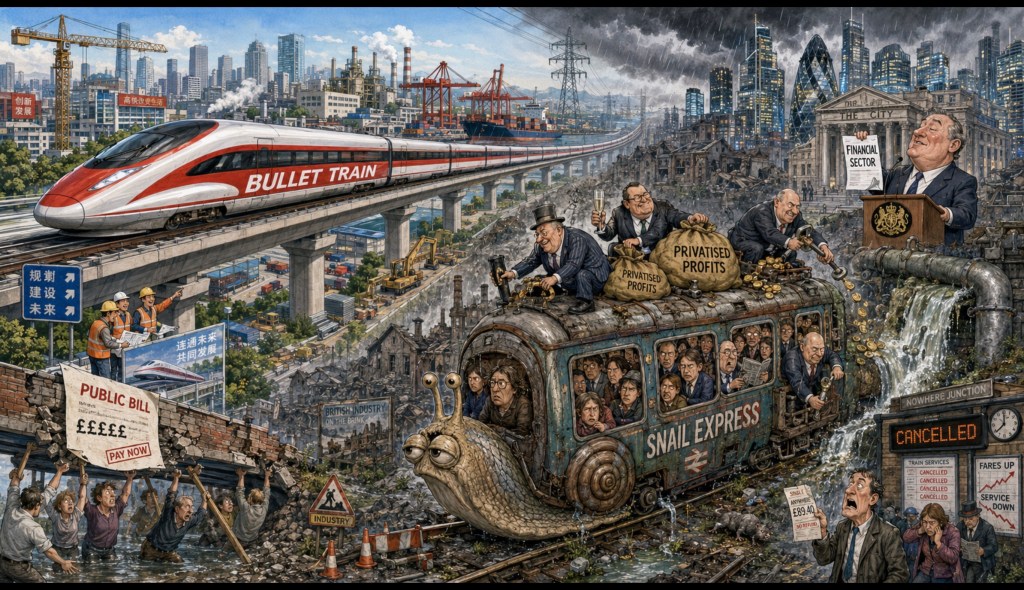
Welcome to the great failure of British deindustrialisation.
While China has spent decades building factories, power stations, ports and a vast high-speed railway network, Britain convinced itself that finance, property and services could support the country forever. We did not need to manufacture things, apparently. We could simply move money around London, sell one another increasingly expensive houses and charge fees for everything in between.
The trouble is that a financial sector cannot repair a railway bridge, manufacture a train or replace a leaking water main.
Britain did not merely neglect its essential infrastructure. Successive governments sold much of it to private companies and investors, promising that competition would produce lower prices, greater efficiency and better services.
But water pipes and railway tracks do not behave like ordinary consumer markets. You cannot choose a different set of pipes when your water company fails. Passengers rarely have three competing railway lines running between the same two places. These were natural monopolies—and Britain transferred control of them without creating a system that consistently forced their owners to invest for the future.
The predictable happened.
Money that should have helped renew infrastructure was diverted into dividends, complicated corporate structures, executive rewards and debt repayments. Investment certainly continued, but too often it was insufficient, delayed or ultimately supported by passengers, customers and taxpayers.
The private sector collected the income while the public remained responsible for the consequences.
When a railway franchise failed, the government stepped in. When infrastructure needed major renewal, taxpayers helped finance it. When water companies failed to prevent leaks or sewage discharges, customers were presented with higher bills to pay for improvements that should have been made years earlier.
That is not really privatisation. It is the privatisation of revenue combined with the nationalisation of failure.
Meanwhile, China treated infrastructure as the foundation of industrial power. Its railway network connects workers, manufacturers, ports and cities at extraordinary speed. Britain argues for years over planning permission, budgets and environmental assessments before announcing that a project has been delayed, reduced or cancelled.
China has bullet trains.
Britain has overcrowded carriages, cancelled services, rising fares and passengers receiving the traditional British announcement: “We apologise for the inconvenience.”
Of course, China’s system is not a perfect model. It has involved enormous public spending, debt, political control and construction on a scale that would be difficult to reproduce in Britain. But it demonstrates something Britain appears to have forgotten: infrastructure is not merely an expense. It creates economic capacity.
A country cannot become more productive if its workers cannot travel reliably, its businesses face high energy costs, its water system leaks and its major construction projects take decades to complete.
The deeper failure was ideological. Britain began treating essential national assets primarily as financial investments rather than public infrastructure. Instead of asking whether the railways, water system and energy network would serve the country in thirty years, policymakers asked whether they could be taken off the government’s balance sheet today.
The assets were sold, but responsibility never disappeared. The public still needs clean water. People still need trains. Industry still needs dependable energy. When the private model fails, the government cannot simply walk away.
Britain did not escape the cost of maintaining its infrastructure. It merely surrendered control, allowed investors to extract returns and postponed the bill.
Now that bill has arrived—with interest.
The lesson is not that every industry must be controlled from Whitehall. Private enterprise can bring investment, innovation and expertise. But essential monopolies must serve a national purpose, and their owners must be compelled to maintain the assets before extracting excessive rewards.
Britain chose the financial fast lane while allowing its physical economy to decay.
China built the Bullet Train.
Britain built the Snail Express—and somehow managed to charge more for the ticket.


Leave a comment