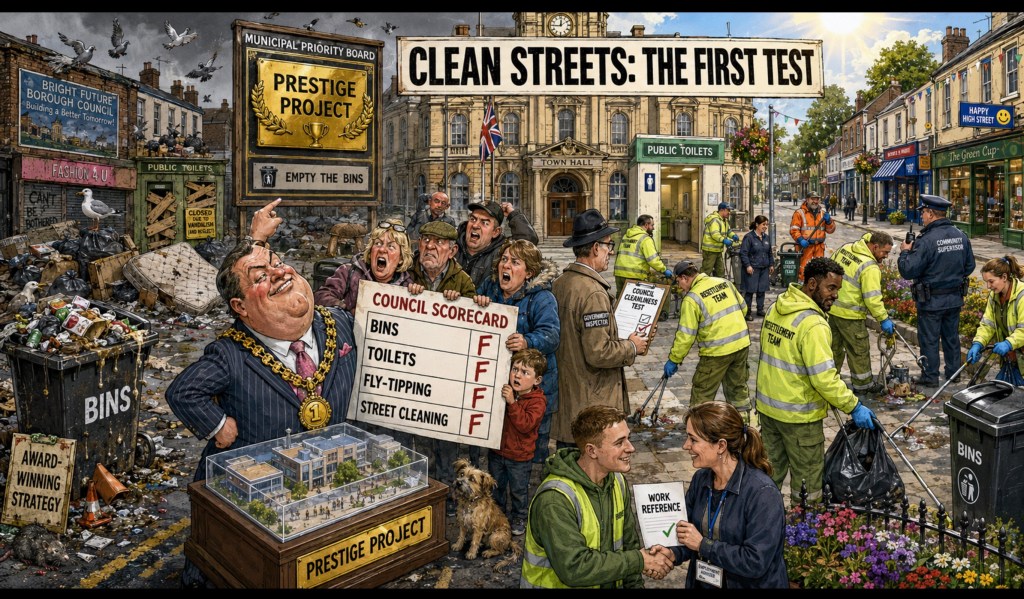
Who is responsible for Britain’s litter?
I am going to say this loudly: the primary responsibility belongs to local councils.
Of course, individuals are responsible when they deliberately throw rubbish onto streets, abandon waste beside bins or treat public spaces as though somebody else will always clean up after them. No shortage of facilities excuses selfish or antisocial behaviour.
But councils are responsible for creating and maintaining the system that prevents everyday untidiness from becoming permanent neglect.
Community cleanliness should be the first test of competent local government.
Before councils spend money on slogans, consultants, publicity campaigns and grand regeneration projects, they should provide the basic services every community has a right to expect:
- Enough bins in the places where people actually need them.
- Regular and reliable rubbish collection.
- Clean and accessible public toilets.
- Properly staffed street-cleaning teams.
- Rapid removal of fly-tipping.
- Enforcement against persistent offenders.
- Clear accountability when these services fail.
These are not glamorous responsibilities. There may be no ribbon-cutting ceremony when a bin is emptied or a public toilet is cleaned. But these basic services determine what it feels like to live in a community.
A clean neighbourhood tells residents that somebody is in charge, that standards matter and that the people living there deserve decent surroundings.
A dirty neighbourhood sends the opposite message.
Overflowing bins, abandoned furniture, littered streets and filthy public spaces create the impression that nobody cares. Once that impression takes hold, neglect encourages further neglect. People become less reluctant to drop rubbish in a street that already looks abandoned.
That is why community tidiness must be treated as a first principle rather than an optional extra.
Businesses should also be required to keep the areas surrounding their premises clean. Landlords must not be allowed to abandon household waste outside properties. Residents who deliberately dump rubbish should face meaningful consequences.
But councils cannot blame every dirty street on irresponsible residents while failing to provide enough bins, public toilets and collection services.
If bins are permanently overflowing, public toilets have disappeared, fly-tipping remains for weeks and street-cleaning teams have been reduced beyond usefulness, that is not merely a failure of public behaviour. It is a failure of local administration.
Central government also has a responsibility.
Councils must receive sufficient funding to provide essential services, but that funding should come with measurable expectations. Every local authority should be independently assessed on street cleanliness, waste collection, fly-tipping, public toilets and the general condition of shared spaces.
Residents should be able to see how their council is performing and how it compares with similar authorities.
Persistent failure must have consequences.
Government should be able to demand an improvement plan, send in outside support and intervene when an authority repeatedly fails to provide basic services. Senior officials and council leaders should not be allowed to hide behind endless reviews while the streets deteriorate.
Financial penalties must be handled carefully because simply fining a council could punish the same residents already suffering from poor services. The real consequences should fall upon the people responsible for the failure—not through higher council tax or further cuts imposed upon the public.
My first rule for every council leader would be simple:
Before beginning the prestige projects, clean the streets, empty the bins and provide proper public toilets.
If a council cannot perform those basic duties, its leaders should not expect to remain in their positions.
A Workforce Currently Sitting in Prison
There is another part of this problem that Britain should be willing to discuss.
At this moment, potentially hundreds of suitable people are sitting inside prisons approaching the end of their sentences. Many will soon be released and expected to return to their communities, find work and rebuild their lives.
I would introduce a structured community-reintegration programme covering the final three months of a prison sentence.
Prisoners who had been individually assessed as suitable and low-risk could leave prison during the day in properly supervised teams. They could collect litter, clear neglected public spaces, remove rubbish and help restore areas that councils are struggling to maintain. At the end of each working day, they would return to prison.
This must never become a humiliating chain gang or a convenient source of free labour for private companies.
Participants should receive proper protective clothing, equipment, training and supervision. They should also receive a modest wage or resettlement credit, together with a formal record of the work they completed.
Most importantly, the scheme must supplement properly employed council workers—not provide councils with an excuse to dismiss staff and replace them with prison labour.
The purpose would be rehabilitation as much as repayment.
A person approaching release needs more than a discharge date and a small amount of money. They need structure, responsibility, recent experience and evidence that they can turn up, work with others and complete a worthwhile task.
A properly designed programme could provide:
- Regular attendance and personal responsibility.
- Experience of working as part of a team.
- Practical skills and employment references.
- Contact with employers and rehabilitation services.
- Pride in completing visible and useful work.
- A chance to make a positive contribution before release.
Councils would gain additional supervised help. Communities would become cleaner. Prisoners would return to society with recent work experience and a stronger daily routine instead of leaving custody with little preparation and being expected suddenly to succeed.
There would need to be strong safeguards.
Every participant would require an individual risk assessment. Victims and vulnerable locations would need protection. The work would require proper supervision and independent monitoring. Prisoners who posed a danger to the public would not be eligible.
The programme should also be connected to employment. If someone proves reliable during the final months of their sentence, councils, contractors and environmental organisations should be encouraged to consider them for paid work after their release.
That would turn litter collection into something more meaningful than a punishment. It could become the beginning of a route back into ordinary life.
The final months of a prison sentence should help prepare someone for freedom. Society is entitled to expect responsibility from those returning to it, but it should also create a realistic opportunity for them to demonstrate that responsibility.
A tidy community will not solve every social problem. But it is the starting point of a place that respects itself—and evidence of a council that respects the people it serves.
Responsibility begins with the person who drops the litter. It continues with the council responsible for providing the facilities and maintaining the streets. It reaches central government, which must establish the standards and ensure they are enforced.
And if a person is expected to become part of the community again, helping to restore that community is a meaningful place to begin.


Leave a comment