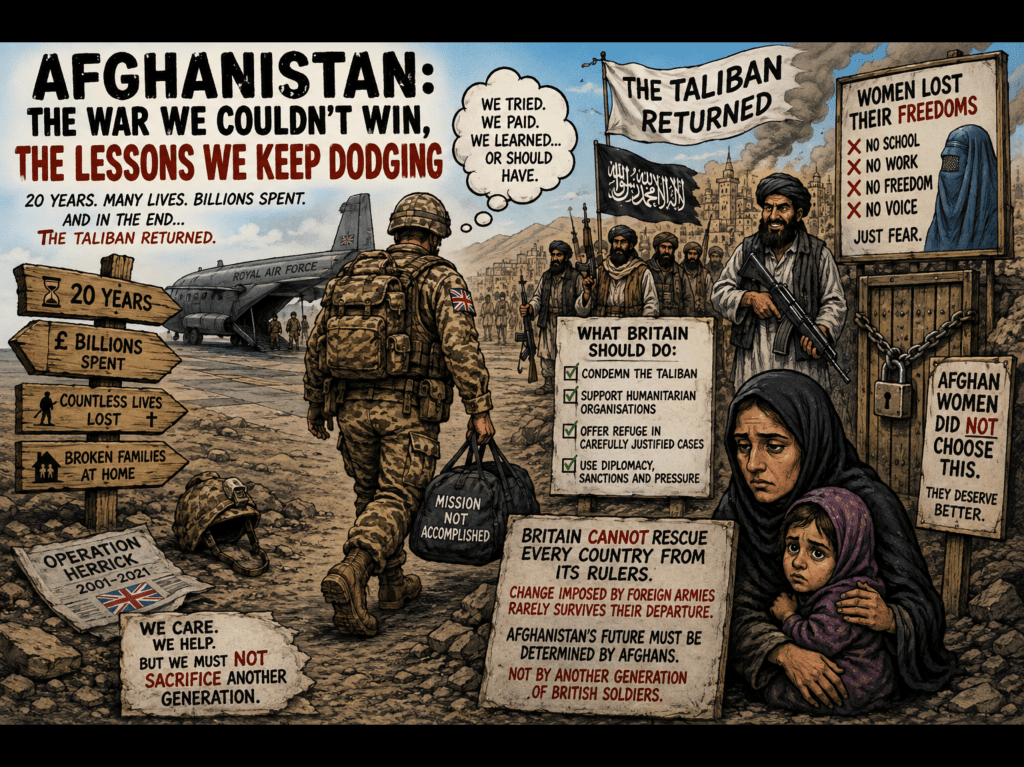
🇦🇫⚔️Afghanistan is back on our screens, and with it comes the familiar chorus of guilt, grief, outrage, and that dangerous little whisper from the policy cupboard: “Should Britain do something again?” After twenty years of blood, treasure, broken families, and young service personnel sent into a conflict with no lasting political victory, Britain has to face the truth nobody wants printed on the commemorative mug: you cannot rebuild a nation at gunpoint and expect it to stand the moment you leave.
The Empire Hangover Nobody Wants to Admit🎖️🧨
Let’s be clear: Afghan women did not choose oppression. They did not vote for their freedoms to be dismantled. They did not ask to be trapped under Taliban rule like history smashed the rewind button with a hammer. Their suffering deserves attention, anger, and real humanitarian support.
But sympathy must not become the emotional crowbar used to prise open another war.
Britain already tried the grand intervention fantasy: troops on the ground, billions spent, leaders promising progress, speeches polished until they gleamed, and strategy documents stacked high enough to build a second Kabul. And after two decades? The Taliban returned. Women’s rights collapsed. The political structure Britain and its allies helped prop up vanished almost overnight.
That is not a reason to shrug at Afghan suffering. It is a reason to stop pretending British soldiers can permanently solve political realities that even twenty years of occupation could not reshape.
We can condemn the Taliban. We can support aid groups. We can offer refuge in carefully justified cases. We can use diplomacy, sanctions, pressure, and humanitarian routes. But sending another generation into the furnace because television images make politicians feel morally theatrical? No. Absolutely not. 🎭🔥
Britain cannot rescue every nation from its rulers. That is not wisdom. That is imperial nostalgia wearing a charity wristband.
And here’s where the conversation gets awkward enough to make Westminster spill its subsidised soup: refuge should mean safety, not the importation of the very attitudes people claimed to be escaping. Britain should offer protection to those genuinely fleeing tyranny, especially women, children, dissidents, interpreters, and those at risk. But anyone who comes here must understand one very simple rule: you do not flee oppression only to recreate its values in miniature on British soil.
No Taliban-lite attitudes. No imported misogyny. No religious bullying. No demands that British society tiptoe around ideas that belong in the ideological skip. 🗑️
This is not about blaming every Afghan, or any entire community. Many people who flee dictatorships are the loudest opponents of the backward systems they escaped. They know better than anyone what extremism does when it is allowed to grow teeth. But Britain should never be guilt-tripped into tolerating intolerance just because it arrived with a tragic backstory and a suitcase.
Compassion without standards becomes chaos. Borders without judgement become theatre. Integration without shared values becomes a polite national nervous breakdown.
The hard truth is this: Afghanistan’s future cannot remain Britain’s military responsibility. We cared. We intervened. We paid a terrible price. And we learned, or should have learned, that change imposed by foreign armies rarely survives once those armies go home.
But Britain’s future is Britain’s responsibility. That means helping where we can, refusing another doomed war, protecting genuine victims, and making it crystal clear that freedom is not a hotel lobby where every ideology gets a welcome drink. 🧨
Here’s the question nobody in polite politics wants to touch: how do we show compassion without becoming fools, and how do we defend British values without turning every refugee into a suspect? That’s the debate worth having — not another round of flag-waving fantasies and military déjà vu.
👇 Comment, like, and share. Should Britain help from the outside, tighten its rules at home, or finally admit that both compassion and boundaries can exist in the same sentence?
The best comments will be included in the magazine. 📝🎯


Leave a comment