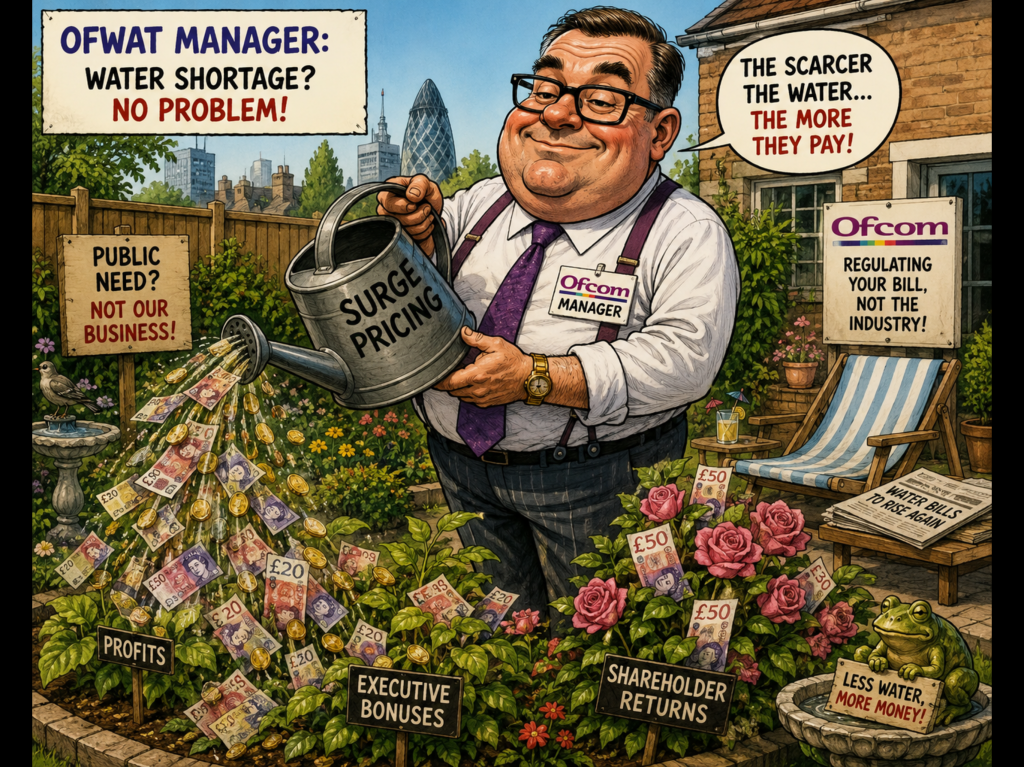
💧🔥Water companies may soon be allowed to charge customers more during droughts under Ofwat plans looking at “surge pricing” and “water scarcity” in bills. Yes, apparently the solution to having less water is to make you pay more for the privilege of not having it. Capitalism has finally looked at a dry tap and said: “Premium experience.”
The Great British Hosepipe Heist🪣🤡
You truly could not make it up. The country gets hotter, reservoirs shrink, hosepipe bans appear, leaks keep gushing underground like secret shareholder fountains, and the grand solution floating down from the regulatory heavens is: charge the public more.
Less water? Higher bill.
Drought? That’ll be extra.
Corporate failure? Please insert debit card. 💳
This is scarcity economics dressed up as environmental responsibility. The public are told to take shorter showers, let the lawn die, and whisper apologies to the toilet before flushing — while water companies continue operating in a system where failure somehow keeps arriving with a price increase attached.
Ofwat has recently approved extra spending for five water companies, with Reuters reporting £3.4 billion in additional investment that could raise bills between 2027 and 2030. The wider sector is already under fire over pollution, leaks, debt, and rising customer charges.
And now we are meant to accept the idea that drought pricing is about “efficiency.” Lovely. Because nothing says “public service” like turning a basic human necessity into an Uber fare during a thunderstorm. 🚕🌧️
The argument, of course, is that higher prices discourage waste. Fine. But here’s a radical thought: maybe start with the companies wasting treated water through leaks before treating households like villains for making a cup of tea. Even political leaders have warned that customers should not be treated like a “blank cheque” while firms demand more money despite years of anger over pollution and leaky infrastructure.
Water is not a luxury handbag. It is not a concert ticket. It is not a hotel room during half-term. It is life. And when private monopolies control life’s essentials, they do not become noble guardians of efficiency. They become toll booths with pipes.
So yes, it is time to ask the forbidden question that makes boardrooms sweat into their bottled mineral water: why are water companies still in private hands?
If a company can pollute rivers, lose water through broken infrastructure, load itself with debt, pay executives handsomely, and then come back to the public demanding more money because the sky didn’t rain enough, that is not a market. That is a hostage situation with direct debit. 🧾🔒
Bring water back into public ownership. Not as some nostalgic slogan, but because the current system has become a parody of itself. The public pays when it rains, pays when it doesn’t, pays when pipes leak, pays when rivers stink, and now may pay more because scarcity has become the newest little profit bonnet on the corporate donkey.
🔥Challenges🔥
Here’s the question: should water companies be allowed to charge more during droughts, or should they be taken back into public ownership before they start billing us for clouds? Drop your view in the blog comments — fury, sarcasm, facts, river-rage, all welcome. 💬🌊
👇 Comment, like, and share. Should water be run for people, or priced like a panic-buying aisle in a heatwave?
The best comments will be included in the magazine. 📝🎯


Leave a comment