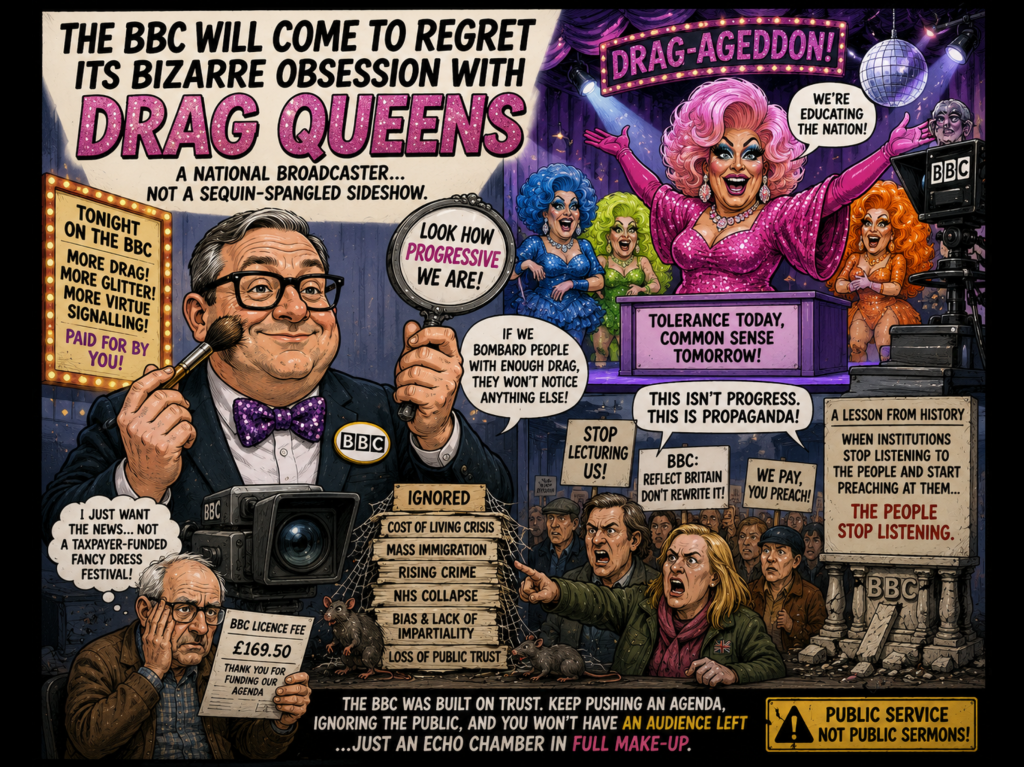
📺👠The BBC seems to believe that every national problem can be solved by adding sequins, a wig, and a studio audience clapping like they’ve just discovered electricity. Apparently, this is progress now: not better journalism, not stronger impartiality, not serious cultural debate — just another round of “look how brave we are” programming wrapped in glitter and funded by people who may not have asked for a taxpayer-subsidised pantomime of enlightenment.
When Public Broadcasting Starts Mistaking Costume for Courage🎭✨
Let’s be honest: drag itself is not new. Britain has had pantomime dames, music hall performers, camp comedy, theatrical exaggeration, and men in frocks on screen long before anyone in a BBC diversity meeting discovered the word “representation” and tried to invoice it.
But that is exactly the point.
Historically, drag was often comedy, satire, theatre, adult entertainment, or social rebellion. It had context. It had edges. It was not treated as a sacred civic lesson that every licence-fee payer must applaud on command while pretending the BBC has personally liberated the nation with a false eyelash.
The problem is not that drag exists. The problem is the broadcaster’s bizarre habit of treating it as cultural medicine — as if the country is one more glitter cannon away from healing its divisions. Meanwhile, people are worrying about bills, immigration, crime, collapsing trust, public services, and whether the news can still tell the difference between reporting reality and massaging fashionably approved opinion. But never mind that, here comes another performer named Lady Fiscal Deficit in thigh-high boots to teach Britain tolerance. 💅📉
And this is where the BBC may come to regret its obsession. Public broadcasters survive on trust. When viewers start to feel lectured, patronised, or culturally managed rather than informed and entertained, they turn away. Not because they are all bigots. Not because they fear a wig. But because they can smell institutional smugness through the television.
There is a lesson from history here: institutions that mistake elite fashion for public consensus eventually discover that the public was not clapping — it was merely being polite.
The BBC can broadcast drag. It can cover drag. It can commission shows involving drag. But when it starts to feel like a fixation, people notice. When it feels like a worldview rather than a programme choice, people notice. When a national broadcaster behaves less like a mirror of the country and more like a missionary for one narrow cultural mood, people really notice. 📡👀
And then comes the backlash, followed by the usual bewildered faces: “How could ordinary people possibly object to our perfectly calibrated progressive virtue pageant?”
Perhaps because ordinary people do not like being force-fed anything, even if it arrives wearing lashes and calling itself brave.
A mature culture can tolerate drag without turning it into a state-sponsored personality test. It can defend adults’ freedom to perform without pretending every performance is a moral sermon. It can respect difference without demanding ritual applause. It can also ask why a public broadcaster seems so eager to provoke half its audience and then act wounded when they complain.
That is not progress. That is programming by self-congratulation.
🔥Challenges🔥
Here’s the question: is the BBC reflecting modern Britain, or trying to drag modern Britain somewhere it never agreed to go? There is a difference between inclusion and obsession — and viewers are allowed to spot it without being shoved into the naughty corner.
👇 Comment, like, and share. Should the BBC focus on broad public service broadcasting, or keep mistaking sequins for national renewal?
The best comments will be included in the magazine. 📝🎯


Leave a comment