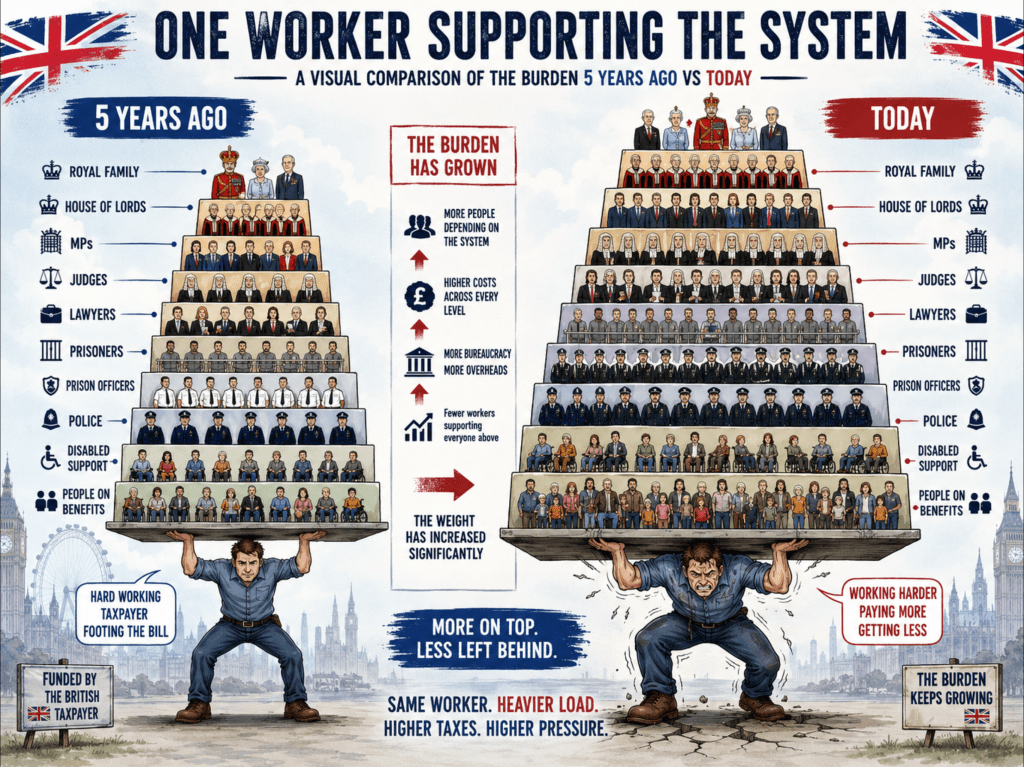
The working man does not need fancy phrases like “fiscal drag” to know what is happening.
He earns the money, tax is taken before he sees it, then more is taken when he spends what is left.
Income tax. National Insurance. VAT. Fuel duty. Council tax. Insurance tax. The list goes on.
Follow the money from what it costs to employ someone, through the deductions on their wages, and then through the taxes on everyday spending, and the total burden can reasonably reach 40% to 50% of the value created by that worker.
That does not mean a 50% income-tax rate.
It means government can end up taking a very large share of the value produced by someone simply going to work.
And the burden keeps getting worse.
Wages rise because food, fuel, housing and bills rise. Tax thresholds fail to keep pace. More of the worker’s pay is dragged into tax.
The payslip says he earns more.
His bank account says otherwise.
🔥 And Where Does All the Money Go?
Most people accept that tax is necessary.
Hospitals, schools, police, pensions, roads and defence all need paying for.
The anger starts when taxpayers are told there is never enough money, while billions disappear into debt interest, fraud, mistakes, failed projects, bureaucracy and spending that many ordinary people never feel any benefit from.
The worker is expected to budget every penny.
Government overspends and sends him the bill.
That is the real problem.
It is not just how much is taken.
It is how much appears to be wasted after it has been taken.
And every time more money is needed, the same person is asked to carry more.
The man who gets up, goes to work, pays his bills and supports his family is becoming the pack mule of the whole system.
At some point, even the strongest mule stops and asks:
How much more are you planning to load on my back? 🫏💷
🔥 Challenges
Do you think the working taxpayer is already giving too much?
Where do you think the biggest waste is, and what would you cut first?
👇 Put your answer in the BLOG comments. Comment, like and share this with someone who looks at their payslip and wonders where the money went.
The best comments will be included in the next issue of the magazine. 🎯📝


Leave a comment