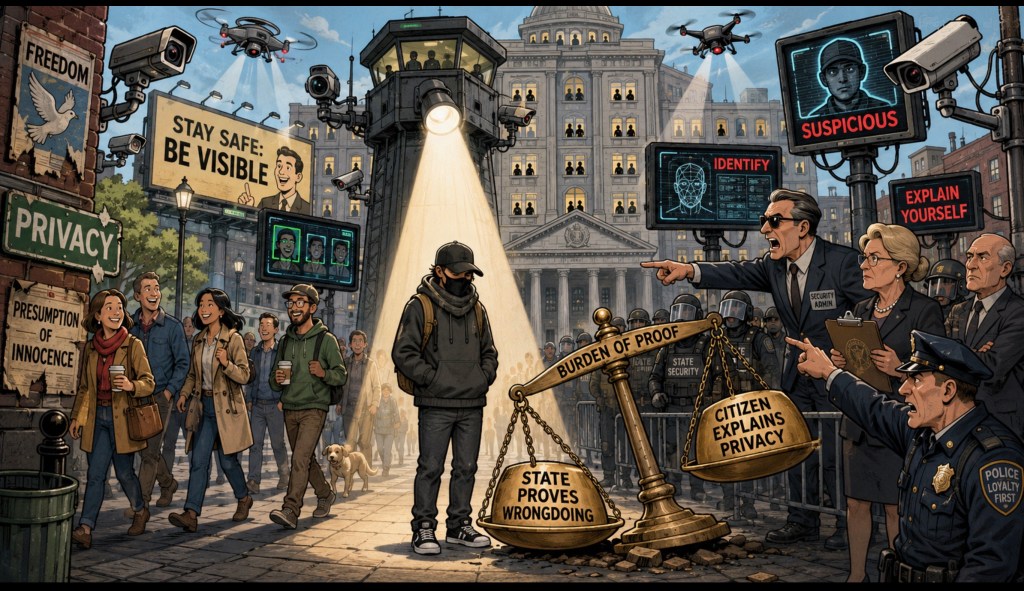
🕶️👤A free society is supposed to work on a fairly simple principle: the state proves you did something wrong; you don’t have to prove you’re harmless. Dressing anonymously, covering your face, or simply not wanting to be identifiable in public should not automatically turn someone into a walking question mark. The danger begins when anonymity itself is treated as evidence—because suddenly privacy stops being a right and starts looking like something you need permission to exercise.
🕵️ Congratulations, Citizen — Your Face Is Now Your ID Card
Apparently, wanting to move through public space without broadcasting your identity could soon be treated like the opening scene of a crime documentary. Hood up? Suspicious. Face covered? Suspicious. Don’t fancy appearing in fourteen CCTV databases before lunch? Extremely suspicious. 🚨
That flips the whole logic of liberty on its head.
In a genuinely free society, authorities investigate conduct. They look for evidence. They establish reasonable grounds. They don’t point at someone dressed anonymously and say, “Well, explain yourself.”
Because once not being identifiable becomes grounds for attention, the burden quietly migrates. The state no longer has to begin with wrongdoing; the citizen begins by defending their desire for privacy.
And what exactly counts as an acceptable explanation?
Cold weather? Fine. Religious clothing? Perhaps. Anxiety about facial recognition? Hmm, bit edgy. Political protest? Now we’re getting interesting. Simply preferring that strangers, companies and government databases don’t catalogue your every movement? Fetch the interrogation lamp. 🔦
The irony is magnificent. We are constantly warned about identity theft, data harvesting and digital surveillance, then potentially treated as suspicious for attempting the revolutionary act of… revealing less information about ourselves.
Privacy cannot mean, “You are free to remain anonymous provided nobody finds your anonymity unusual.” That isn’t privacy. That’s supervised discretion with a dress code.
🔥 Challenges🔥
Here’s the uncomfortable question: when does legitimate policing become a society where ordinary people are expected to make themselves identifiable simply to avoid suspicion?
And once anonymity becomes suspicious in one context, where does that principle stop? Protesters? Journalists? Football crowds? Commuters? Anyone wearing a hood in November? 👀
💬 Drop your view in the blog comments: should authorities need evidence of wrongdoing before questioning anonymous dress, or can concealment itself ever justify intervention?
👇 Comment, like and share if you think the presumption of innocence should apply to clothing too.
The best comments will be included in the magazine. 🎯📝


Leave a comment