Description
Investigate scientifically plausible methods for removing carbon dioxide directly from ambient air that are not currently used at meaningful commercial scale, then identifies the approach with the strongest potential to outperform established direct-air-capture methods.
Governing question
What scientifically credible but currently underused or undeployed method could provide the best overall way of removing CO₂ directly from ambient air when energy demand, capture rate, cost, scalability, materials, regeneration, environmental impact and long-term carbon handling are considered together?
Objective
Identify one genuinely promising approach to atmospheric CO₂ removal that is not already established as a mainstream DAC technology.
The agent should not simply search for obscure technologies. It must determine whether an overlooked physical, chemical, biological, electrochemical, mineral, membrane, thermal, photochemical or hybrid mechanism could offer a fundamental advantage over currently deployed approaches.
The user’s original premise—that a better method may exist but is not being used—should be treated as a hypothesis to investigate rather than an assumption that such a method definitely exists.
Retractable Carbon-Fiber CO₂ Capture Sheet
Working Process Concept
Dry capture • humid release • solar reset
| Concept summary: A porous carbon-fiber sheet is rolled out into dry moving air, where a CO₂-reactive surface captures carbon dioxide. The sheet is then rolled into a sealed cylindrical chamber, exposed to controlled humidity so the captured CO₂ is released, and the gas is collected. The sheet is then rolled back out into hot, dry air and sunlight to reset before the next cycle. |
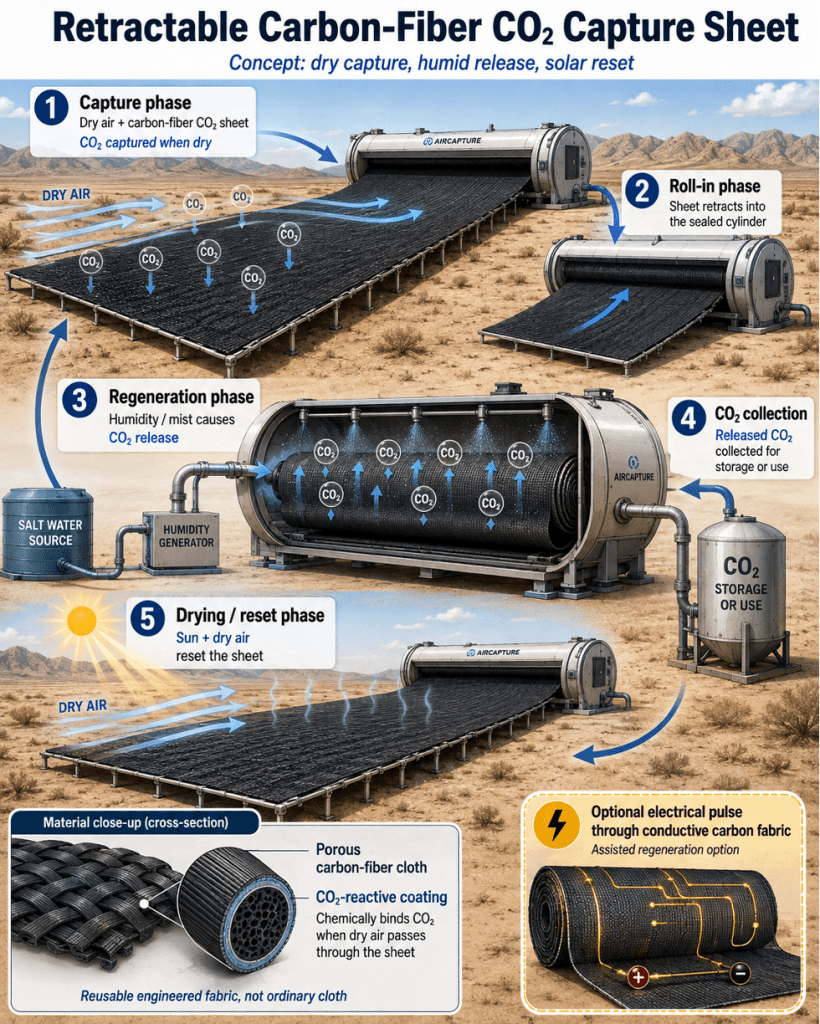
1. How the system works
The system is designed as a repeating capture-and-regeneration cycle. The cylinder acts as both the mechanical storage unit for the sheet and the sealed regeneration chamber. The sheet provides a very large surface area for contact with ambient air without relying on high-powered fans.
Stage 1 — Roll out and capture CO₂
The carbon-fiber sheet is unrolled from the cylinder and spread over a low support frame. Dry ambient air moves naturally across and through the porous sheet. The carbon fibers themselves provide strength, conductivity and surface area, while a CO₂-reactive coating or embedded sorbent performs the actual capture. The intended operating condition is relatively dry air, because the proposed moisture-swing chemistry binds CO₂ more strongly when the material is dry.
Stage 2 — Roll the sheet into the cylinder
After the sheet has reached a useful level of CO₂ loading, it is retracted into the cylindrical unit. The chamber is then sealed. Rolling the sheet into a compact enclosed volume allows regeneration to take place without releasing the captured CO₂ back into the open atmosphere.
Stage 3 — Humid regeneration
Controlled humidity is introduced into the sealed chamber using humid air, water vapour or a fine mist. For a moisture-responsive sorbent, the added water changes the local chemical equilibrium and weakens the material’s affinity for CO₂. The captured CO₂ is therefore released from the sheet as a gas inside the chamber. If salt water is available, it is preferable to use it indirectly through a humidity generator rather than spraying seawater directly onto the material, because salt deposits could clog pores and damage the active surface.
Stage 4 — Collect the released CO₂
Because regeneration occurs in a sealed chamber, the released CO₂ can be drawn off through a controlled outlet. The gas would then require measurement, drying and, depending on its final use, further concentration or compression. It could ultimately be sent for geological storage, mineralisation or another verified long-term carbon-management route.
Stage 5 — Dry and reset the sheet
After regeneration, the sheet is rolled back outside. Hot, dry air and solar heating remove moisture from the material and restore the dry condition needed for the next capture cycle. In a desert environment, natural solar heat and low humidity could provide much of this reset energy.
2. What the sheet would be made from
The working material is best thought of as an engineered fabric rather than ordinary cloth. A plausible architecture is a flexible porous carbon-fiber or activated-carbon textile carrying a moisture-responsive CO₂-capture chemistry.
- Carbon-fiber cloth: provides mechanical strength, flexibility, electrical conductivity and a porous support structure.
- High-surface-area carbon or porous layer: increases the area available for the active chemistry.
- CO₂-reactive coating or embedded sorbent: performs the selective binding and release of atmospheric CO₂.
- Protective treatment: may be required to resist ultraviolet radiation, dust, abrasion and repeated wet/dry cycling.
3. Why a desert location could help
A hot, dry location could provide three useful environmental inputs: strong solar heating for drying, naturally low humidity for the capture/reset phase, and wind for passive air movement. A coastal desert could additionally provide access to seawater for humidity generation, provided the salt is kept out of direct contact with the sorbent.
4. Optional electrical assistance
Because carbon fabric is electrically conductive, a small electrical heating pulse could be used as an assisted regeneration or drying step if humidity alone is too slow or incomplete. This would create a hybrid system: natural airflow and solar drying for most of the cycle, with electrical input used only where it materially improves CO₂ release or cycle time.
5. Main engineering challenges
| Challenge | Why it matters |
| CO₂ concentration | Atmospheric CO₂ is extremely dilute, so very large areas of material may be required. |
| Water management | Humidity must be generated efficiently and most of the water should ideally be recovered and recycled. |
| Gas quality | The regeneration chamber must release CO₂ at a useful concentration rather than simply producing slightly enriched air. |
| Dust and sand | Desert exposure can foul pores, abrade the sheet and reduce capture performance. |
| Material life | The sheet must survive thousands of rolling, wetting, drying and sunlight cycles. |
| Mechanical reliability | Large flexible sheets must withstand wind loads and repeated deployment without tearing or jamming. |
| Net carbon removal | Energy, water, material manufacture, maintenance, compression and storage must all be included in the lifecycle balance. |
6. Prototype test
The concept should first be tested at small scale rather than treated as a proven DAC technology. A practical prototype could use a 5–20 metre retractable sheet connected to a sealed regeneration cylinder. The key measurements should be:
- grams of CO₂ captured per square metre per cycle;
- CO₂ concentration during release;
- energy consumed by deployment, humidity generation, gas extraction and any electrical heating;
- water consumed and water recovered;
- time required for capture, regeneration and drying;
- loss of sorbent performance after repeated cycles;
- dust, UV and mechanical damage.
7. Success criterion
The decisive measure is not simply how much CO₂ the sheet can absorb. The system must demonstrate low external energy use per tonne of concentrated CO₂ produced, acceptable water consumption, long material life and a credible pathway to permanent storage.
8. Concept status
This document describes a conceptual engineering architecture based on known principles of direct air capture, porous carbon materials and moisture-responsive sorbents. The complete retractable desert system described here has not been demonstrated as a validated commercial process. Its value is as a prototype direction to be tested experimentally.


Leave a comment