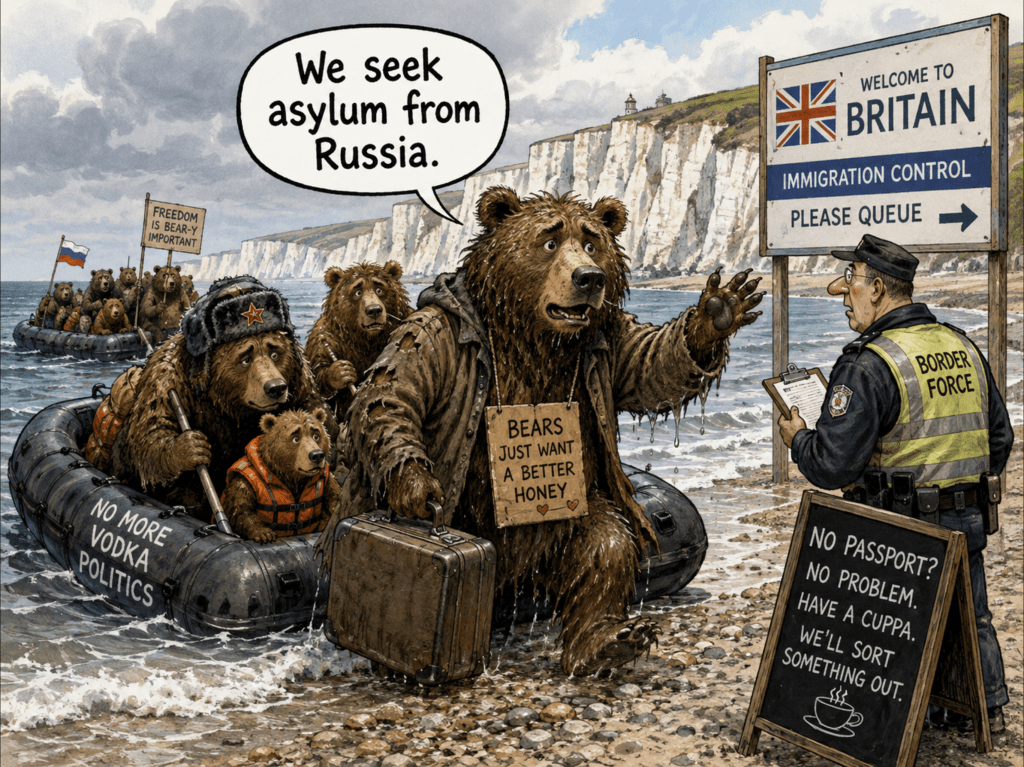
Britain is preparing to help Ukraine produce more long-range missiles, including allowing MBDA to share classified information about British-made components used in the SCALP/Storm Shadow system. Prime Minister Andy Burnham is presenting it as another demonstration that Britain will stand firmly behind Ukraine. Moscow, meanwhile, has already warned Britain about the consequences of becoming more deeply involved.
Supporting Ukraine is one argument.
But here’s another: before you poke the Russian bear again, perhaps somebody in Whitehall ought to check whether we’ve locked the bloody doors. 🐻🚪🇬🇧
🚨 Westminster Plans the First Move — But Who’s Planning Russia’s Second?
This isn’t an argument for surrendering to Vladimir Putin. In fact this is warning, one that needs to be taken seriously. We are going to make Russia mad, and they are probably going to look to retaliate, so we have to make sure Britain is more secure.
It’s a warning to a British government that has repeatedly demonstrated that it is better at announcing policies than preparing for their consequences.
How might Russia respond without firing a missile at Britain?
So where are Britains weak points, its clearly their borders. We have lost all control of our borders and if Russia wanted to get people into this country covertly they would not have a problem, because we are more than willing to help anyone into our country without checking their credentials as long as they say they are seeking asylum.
So why would we assume retaliation would arrive wearing a Russian uniform and waving a flag?
It could come through cyberattacks, espionage and sabotage. It could involve organised criminal networks, compromised supply chains or people gaining legitimate employment inside companies and gradually obtaining access to sensitive systems.
A hostile state could also theoretically attempt to exploit weaknesses in immigration, visa or asylum systems to place individuals inside Britain and this could be devastating for Britain.
It will not matter that we have nuclear weapons, because they may not attack these, it will not matter about our navy and airforce because once inside they could sign up to join these. When you think about it and because we have let our guard down on our borders we are open to infiltration.
That is where this government — like so many before it — deserves scrutiny. Ministers are quick to promise that everything is under control, yet remarkably slow to explain who is responsible when the controls fail.
Because the Trojan Horse didn’t work because Troy had no walls.
It worked because the Greeks found another way through them. 🐴🏰
And that’s the point our politicians seem determined to miss. We’re talking about handing over sensitive missile information while simultaneously assuming that every future Russian response will conveniently take a form we’ve already prepared for.
How very British.
Put the kettle on, issue another strongly worded statement and hope Vladimir Putin observes the Marquis of Queensberry rules. Russia would be under no obligation to respond symmetrically. If Britain helps Ukraine improve its ability to strike Russian targets, Moscow could look for vulnerabilities where Britain is weakest rather than where Britain is strongest.
It could take five years. Ten years.
People establish themselves. They find employment. They acquire trust. Some eventually obtain access to technology, telecommunications, finance, infrastructure or major corporations. The frightening question isn’t whether Britain could identify 10,000 obvious Russian agents marching through Dover.
It is whether Britain could identify ten extremely patient ones who don’t look like agents at all.
That’s what governments are supposed to think about before something happens.
Not afterwards, when everybody appears before an inquiry explaining that the threat was “unprecedented” and “could not reasonably have been anticipated.”
It can be anticipated.
We’re anticipating it right now — and ministers have no excuse for pretending they weren’t warned.
🔥 A Warning to Whitehall: Stop Announcing First and Thinking Later🔥
Here’s what Andy Burnham and his government should answer before they deepen Britain’s involvement:
Have you war-gamed every plausible Russian response inside Britain, and can you demonstrate that the country is prepared for it?
Not merely bombs and missiles.
Cyber warfare. Espionage. Sabotage. Infiltration. Critical infrastructure attacks. Corporate access. Border vulnerabilities. Political interference. Disinformation. The exploitation of criminal networks and weak institutions.
And if the answer is yes, ministers should tell the public what safeguards are in place, which agencies are responsible and what happens when those safeguards fail.
If the answer is no, then this government is not demonstrating strength. It is gambling with Britain’s security while hoping that nobody notices the gaps.
Supporting Ukraine may be the policy Britain chooses.
But choosing that policy without preparing for the consequences would be astonishingly reckless — particularly from a government that has so often shown that planning, competence and accountability are optional extras.
🐻 If you’re going to poke the Russian bear, you’d better know where every door, window and hole in the fence is first.
And to the British government: stop treating warnings as criticism to be dismissed and start treating them as work that needs to be done. You do not get credit for discovering a vulnerability after an adversary has exploited it.
💬 Is Britain adequately prepared for Russian retaliation below the level of conventional war — or are our politicians concentrating so hard on Ukraine that they’re forgetting Britain’s vulnerabilities at home?
👇 Comment on the blog, like the post and share it. If you disagree, tell us why. If you think ministers should already be planning for this, tell them what questions they should be answering. 🔥🇬🇧
The best comments, challenges and arguments will be included in the next issue of the magazine. 🎯📰


Leave a comment