You do not need to be a banker, economist or hedge-fund manager to understand what is happening with gold.
Think of it like this.
If you believed there was a growing chance that the value of money could be damaged by inflation, government debt, political trouble or financial sanctions, would you keep every penny you had in the same place?
Probably not.
You would spread the risk.
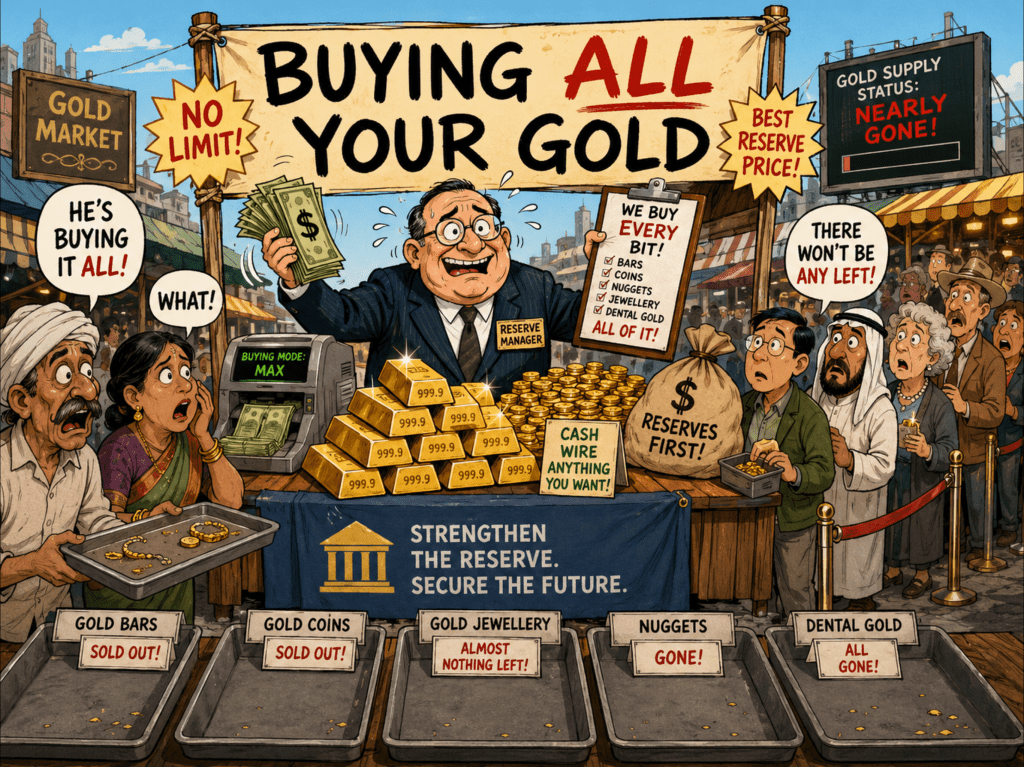
That is essentially what many central banks are doing.
They are not necessarily saying the dollar is about to collapse. They are not necessarily predicting some enormous financial crash.
They are buying insurance.
Gold is that insurance.
Why Gold?
A pound, a dollar or a government bond is ultimately tied to somebody else’s financial system.
Governments can borrow more.
Central banks can create more money.
Currencies can lose value.
Bonds can lose purchasing power if inflation stays high.
Foreign reserves can even be frozen if relations between countries break down badly enough.
Gold is different.
Nobody else’s government has to promise to repay it.
Nobody can print another few trillion ounces of it to pay the bills.
And physical gold held inside your own country cannot simply be switched off by another country’s banking system.
That makes it useful when the world becomes more uncertain.
Think of It Like Your Own Finances
Imagine you had £100,000 saved.
You trust the bank. You trust the pound. You do not think Britain is about to collapse.
But you are worried about inflation, rising government debt, higher taxes and the possibility that your money might buy less in ten years than it does today.
You might decide to keep most of your money where it is, but move £10,000 or £20,000 into something different.
You have not abandoned the pound.
You are protecting yourself in case things go wrong.
Central banks are doing something similar, only with hundreds of billions of pounds.
Debt Is Part of the Worry
Governments around the world are carrying enormous amounts of debt.
That matters because debt becomes easier for governments to live with if inflation stays higher.
Suppose a government owes £1 trillion.
If wages, prices and tax revenues all rise over many years because of inflation, that £1 trillion debt becomes smaller in real terms.
The debt has not disappeared.
The money used to measure it has simply become worth less.
That can help governments.
It is not so helpful if you are the person holding the cash or the bond.
Your £10,000 is still £10,000.
It just buys less.
That is one reason gold becomes attractive when investors worry that governments may tolerate inflation rather than deal painfully with their debts.
Then There Is Politics
There is another risk that has become much more obvious since 2022.
Countries have seen that foreign currency reserves and financial assets can be frozen during serious geopolitical disputes.
That changes the calculation.
If you are a central bank holding billions in another country’s currency, you have to ask yourself a question:
What happens if one day I cannot use it?
Gold held in your own vault does not have that same problem.
That does not mean countries expect war or sanctions tomorrow.
It means they have discovered that the risk exists, so they are reducing their dependence on systems they do not control.
So Are They Dumping the Dollar?
No.
And this is important.
Foreign investors are still holding enormous amounts of American shares, bonds and other financial assets.
The dollar remains the world’s dominant reserve currency and US financial markets remain enormously important.
So this is not a simple story of the world abandoning America.
It is a story about diversification.
Central banks appear to be saying:
We still want dollars.
We still want government bonds.
We still want access to US markets.
But we also want something that does not depend on Washington, the Federal Reserve, another government’s debt or another country’s banking system.
That something is gold.
What Does This Tell the Ordinary Person?
It does not tell you that financial disaster is coming.
But it does tell you that some of the world’s biggest and most cautious financial institutions believe the risks are large enough to insure against.
That is worth paying attention to.
Central banks do not need gold to make a quick profit.
They buy it because it can survive things that currencies and financial assets sometimes cannot.
Inflation.
Currency weakness.
Debt problems.
Political conflict.
Sanctions.
Financial instability.
That is why the rise in central-bank gold buying matters.
It is not necessarily a prediction of disaster.
It is evidence that the people responsible for protecting national reserves believe the world has become riskier.
And when the people managing hundreds of billions start buying more insurance, the ordinary working man is entitled to ask why.


Leave a comment