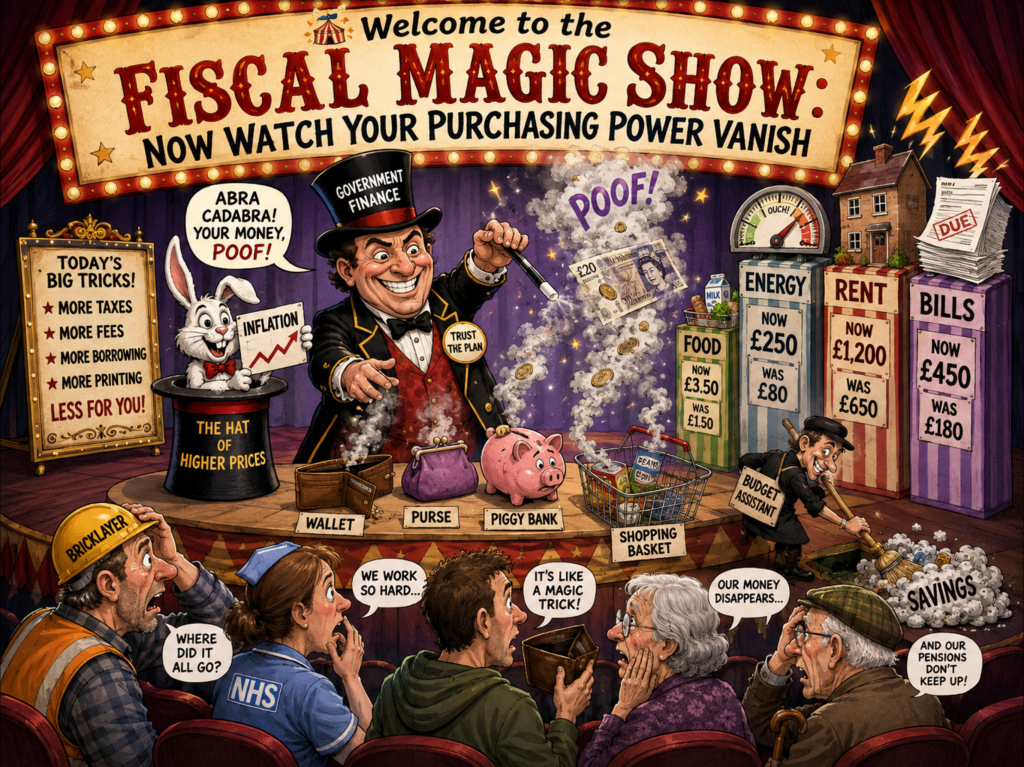
💷🔥🎩Governments drowning in debt probably won’t send households a polite letter saying, “Dear Citizen, we’ve made a financial mess and would now like 20% of your savings.” That would be far too obvious.
Instead, the adjustment can arrive wearing a much smarter suit: inflation, currency weakness, higher taxes, squeezed public services, miserable real returns on savings and eye-watering borrowing costs.
Your bank balance may still say £20,000. Lovely. Unfortunately, the shopping trolley, energy bill and mortgage market may have received entirely different instructions. 📉🛒
🎪 Welcome to the Fiscal Magic Show: Now Watch Your Purchasing Power Vanish
The clever thing about inflation is that nobody has to physically remove money from your account.
If prices rise 20% while your cash remains exactly where it was, congratulations: you still possess every pound you started with. It’s just that those pounds have collectively developed the purchasing strength of damp confetti. 🎉💸
And who tends to feel this first?
Not necessarily the people with diversified portfolios of equities, property, infrastructure, commodities and inflation-sensitive assets. They at least have things that might rise as currencies lose purchasing power.
The real squeeze lands hardest on households spending most of their income on food, rent, heating and transport — because apparently inflation has never heard the phrase “progressive taxation.”
Cash savers can suffer too. So can investors sitting heavily in long-duration fixed-rate bonds. You can receive every penny you were promised and still discover that the promise itself has been quietly shrunk in real terms.
That’s the sinister beauty of financial repression: technically, nobody stole your money. Economically, you may still be poorer. 🪄🏦
And before anyone starts polishing a gold bar and preparing to live inside a bunker, gold isn’t a magical escape hatch either.
A severe sovereign-debt crisis can batter almost everything. Equities can fall. Property can suffer. Bonds can implode. Commodities can swing wildly. Even supposedly defensive assets can disappoint precisely when everyone expects them to behave.
Which is why the sensible question isn’t simply:
“What investment gives me the biggest return?”
It may increasingly be:
“What survives if governments try to reduce debt through inflation, currency depreciation or policies that keep savers earning less than inflation?”
That changes the conversation.
Diversification stops being boring financial wallpaper and starts looking suspiciously like common sense: liquidity for emergencies, productive equities, sensible bond duration, assets with some inflation resilience and perhaps a modest allocation to gold as insurance rather than religious doctrine. 🥇📊
Because betting everything on one heroic asset is still betting everything.
🔥 Challenges: Are Savers Quietly Being Drafted Into the Debt Rescue Squad?
If governments eventually reduce enormous debt burdens through inflation rather than explicit default, ordinary people may discover that the bailout was funded partly through their declining purchasing power — without anybody ever calling it a bailout.
So what do you think?
Is inflation becoming the politically convenient way to make debt smaller while making savings worth less? Are cash savers being punished for prudence? And would you rather hold cash, equities, property, bonds or gold if sovereign debt becomes the defining financial problem of the next decade? 🤔🔥
👇 Comment on the blog, like the post and share it with someone whose “safe savings account” might not be quite as safe as they think.
The best comments, arguments and financial truth bombs will be included in the magazine. 🎯📝


Leave a Reply