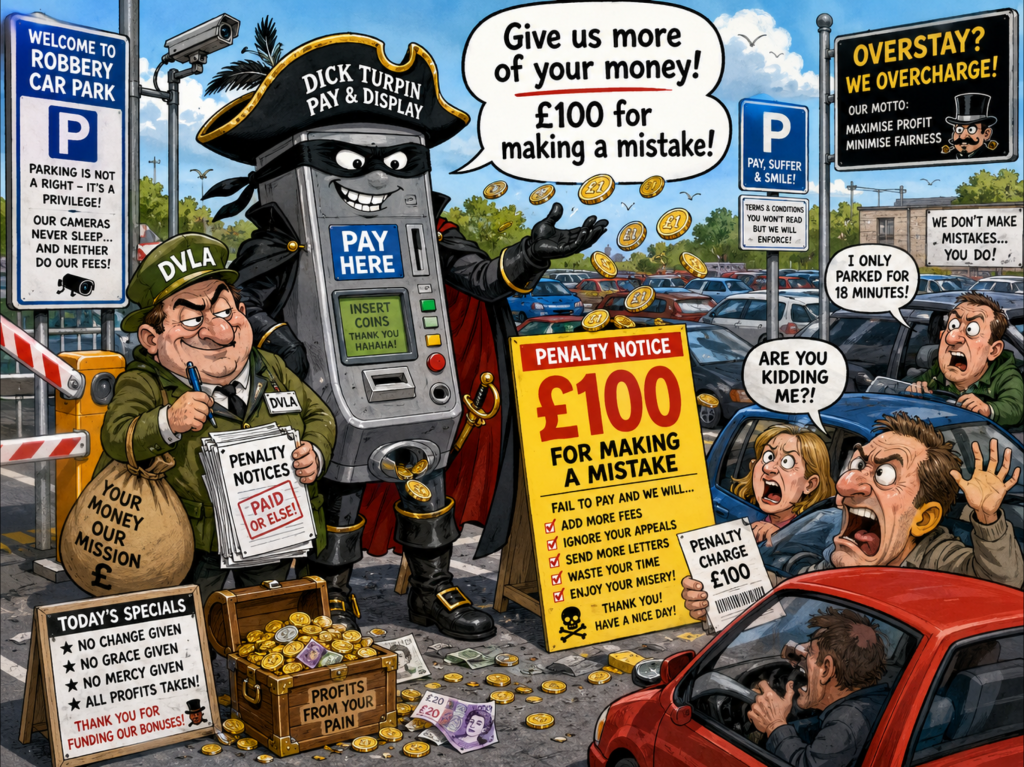
🚗💷Britain has achieved something truly magnificent: we have apparently transformed leaving a car in a rectangle into an industry capable of generating demands theoretically worth almost £1.7 billion a year. 🅿️💰 Analysis of DVLA data suggests private parking operators obtained keeper details on a scale corresponding to a record 16.9 million parking charges in 2025/26 — up from 14.4 million the year before and 6.8 million in 2018/19. At up to £100 per charge, that represents a potential £1.69 billion in demands, or roughly 46,000 notices a day. Strictly speaking, the underlying figures count DVLA keeper-record requests rather than proving that every request resulted in a ticket, but the scale is nevertheless extraordinary. (rac.co.uk)
Apparently, Britain’s newest growth industry isn’t manufacturing, shipbuilding or affordable housing. It’s photographing your Vauxhall entering a retail park and sending you a threatening envelope three weeks later. 📸🚘
🤖 Welcome to the Great British Parking Extraction Machine
To be fair, private parking enforcement has a legitimate purpose. Landowners are entitled to manage their property, stop commuters abandoning cars all day and enforce properly displayed parking conditions. But somewhere along the journey from “please don’t park here for six hours” to “you mistyped one digit into an app, now give us £100,” things appear to have become rather enthusiastic.
You can pay. You can attempt to follow the rules. You can stand beside a payment machine performing the ancient British ritual of pressing the same broken button fourteen times. And still — PING! Congratulations. 🎉 Your £3 parking session has evolved into a £100 administrative adventure.
Perhaps you entered your registration incorrectly. Perhaps the app malfunctioned. Perhaps the machine was broken. Perhaps the signage was clearer to migratory geese flying overhead than to the driver actually using the car park. Perhaps an ANPR camera recorded when you entered and left without possessing the supernatural gift of knowing exactly what happened between those two photographs. Yet somehow the computer has spoken. And the computer would like your money. 💷🤖
The Competition and Markets Authority has now stepped into the sector, citing motorists’ complaints about unclear signage, faulty apps, broken payment machines, appeals and additional charges. In July 2026 it also opened a consumer-protection investigation into Euro Car Parks concerning certain practices and its handling of appeals. That investigation is ongoing and is not a finding that the company has broken the law. ~~~~~~~~~~~~~~~~~~~~~~~~~~~~~~~~~~~~~~~~~~
🔥 Challenges: Before You Feed the Parking Monster…
Here is the important bit: a private parking charge is not automatically the same thing as a council parking fine. A private operator is generally asserting that you parked on private land, accepted contractual conditions and breached them. That does not mean you should throw the letter behind the fridge and hope it develops into compost. But it also does not mean you should immediately sprint towards the payment page like somebody has activated a countdown timer beneath your sofa.
Read the notice. Check the registration. Check the alleged breach. Check the photographs. Check the times. And if something looks wrong, challenge it quickly and keep evidence.
Photograph the entrance. 📷 Photograph the signs. Photograph broken machines. Keep receipts. Save app screenshots. Keep bank transactions showing you paid. Because the parking company has computer records. You should have some too.
And here is where things become especially absurd. If you actually paid for parking but entered your registration incorrectly, industry rules recognise that some cases should result in the charge being reduced to £20 rather than £100. The CMA specifically highlighted this example in its July guidance. (gov.uk)
So imagine paying £3 to park, typing one letter incorrectly and being asked for another £100. That isn’t parking management. That feels like Wheel of Fortune hosted by a number-plate camera. 🎰🚗
Appealing can also be worthwhile. POPLA reported receiving more than 107,000 appeals in 2025, reflecting just how many motorists dispute private parking charges. (popla.co.uk)
And then we arrive in Scotland, where the plot thickens like gravy at a motorway service station. The Scottish Government confirmed in a response published on 19 August 2026 that Section 8 of the Transport (Scotland) Act 2019 — the provision intended to establish statutory keeper liability for certain private parking charges — has still not been brought into force and requires further secondary legislation. (gov.scot)
That does not mean Scottish motorists can park wherever they fancy while laughing through the sunroof. A driver may still be liable under ordinary legal principles. But the distinction between registered keeper and driver matters, and people should think carefully before casually supplying information they have not been legally required to provide.
Then come the debt-collection letters. Bigger lettering. Scarier envelopes. More capital letters. Words like RECOVERY, LEGAL ACTION, SOLICITORS and possibly, one assumes, THE HORSEMEN OF THE APOCALYPSE HAVE BEEN INFORMED. 🐎🔥 But a debt collector alleging that money is owed is not the same thing as a court deciding that it is owed. Never ignore genuine court papers. But equally, don’t confuse an increasingly theatrical letterhead with a judgment from a judge.
And that is really the point. Private parking enforcement should exist to manage parking. Parking should not appear to exist principally to manufacture enforcement opportunities.
When the annual number associated with private parking enforcement rises from around 6.8 million keeper-record requests in 2018/19 to 16.9 million in 2025/26, motorists are entitled to ask what exactly changed. (rac.co.uk)
Did Britain suddenly become two-and-a-half times worse at parking? Did millions of citizens collectively forget what a white line is? Or has technology simply become fantastically efficient at spotting tiny contractual breaches and converting them into demands for money?
Next time the envelope lands on the mat, don’t panic. Don’t blindly pay it. Don’t blindly ignore it. Read it. Check it. Challenge it where appropriate. Photograph everything. Know whether you are dealing with a private company or a statutory authority. And make whoever is demanding the money establish why it is actually owed. 🚗⚖️
👇 Had a ridiculous private parking charge, broken payment machine, impossible appeal or ANPR nightmare? Put the story in the BLOG comments — we want the best examples. 🔥 Comment. Like. Share. Tag somebody who has ever paid £4 to park and somehow ended up owing the GDP of a small island.
The best comments, horror stories and parking-company absurdities will be featured in the next issue of the magazine. 🎯📝


Leave a Reply