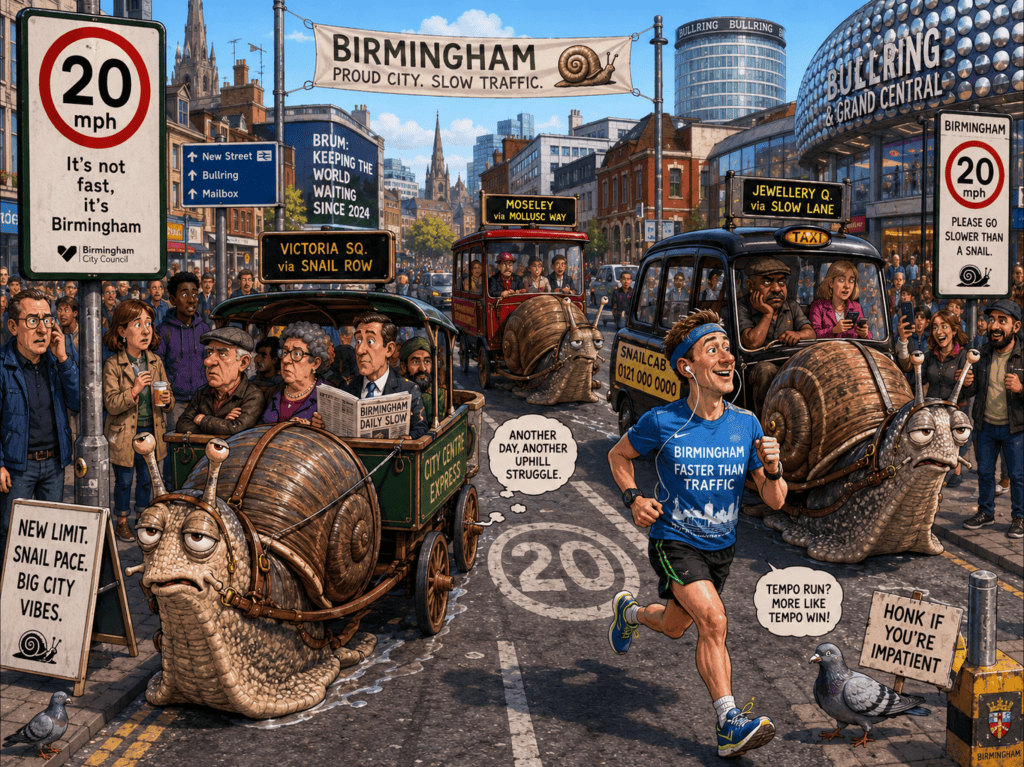
🚗🐌Birmingham once helped define Britain’s motoring age — a city of factories, engines, roads and ordinary people enjoying the revolutionary freedom of going somewhere without consulting a railway timetable. Now the city is considering a very different transport legacy: 20mph limits across almost every road below A-road classification, a move that could make Birmingham England’s first major city with restrictions this extensive. The council says the aim is straightforward: fewer collisions, safer roads, and a city that is friendlier to pedestrians and cyclists. All perfectly reasonable ambitions. But somewhere between “protect children outside schools” and “make almost everything 20mph,” Birmingham appears to have misplaced the concept of moderation. 🔨🚦
🐌 Welcome to Britain’s Slow Motor City
Nobody sensible objects to 20mph zones where they genuinely make sense. Outside schools? Absolutely. Crowded residential streets? Fine. Busy shopping areas? Sensible. But when the answer to nearly every road-safety question becomes 20mph, you begin to wonder whether Birmingham City Council has accidentally bought its transport policy from a shop that only sells one setting.
Factories struggling? 20mph. High streets declining? 20mph. Traffic congestion? Obviously: make the traffic slower. Late for work? You should have left sometime around Tuesday lunchtime. 📅
There is something magnificently British about spending a century improving engines, roads and transport technology only to arrive triumphantly at the conclusion that everybody should travel at approximately the speed of an enthusiastic jogger. Eventually Birmingham could achieve the ultimate road-safety statistic: zero accidents because nobody has reached the junction yet.
Taxi journeys may soon qualify as short-term residential tenancies. Delivery drivers will form deep emotional attachments to traffic lights. Commuters crawling across the city will finally have enough time to appreciate Birmingham’s architecture properly — one brick at a time. 🧱🚕
And what would the industrial pioneers who helped build Birmingham make of it? Their philosophy was simple: Build it. Manufacture it. Drive it. The modern version increasingly feels like: Build it. Restrict it. Walk instead.
Perhaps the council shouldn’t stop at 20mph. Ten around the city centre. Five near particularly vulnerable bollards. Three beside lamp posts that look nervous. And eventually we can revive the Victorian system of somebody walking in front of every vehicle waving a red flag. 🚩 Think of it as sustainable nostalgia.
Britain spent generations developing faster vehicles, better roads and mass car ownership so ordinary people could enjoy unprecedented personal mobility. Birmingham may now be pioneering the next stage: the citizen driver — completely free to go anywhere, provided they have absolutely nowhere to be.
The city may lose its reputation as Britain’s Motor City. But there is still a title available. Britain’s Slow Motor City. 🐌🏁 Progress has rarely moved so cautiously.
🔥 Challenges: Safety Measure or Municipal Sledgehammer?
Here’s the question Birmingham motorists, cyclists and pedestrians should actually be arguing about: where does sensible targeted road safety end and blanket restriction begin? Would city-wide 20mph limits genuinely make Birmingham safer and better to live in — or simply make already difficult journeys longer while doing little to tackle the roads where danger is genuinely concentrated?
Don’t just mutter at the steering wheel. Put your view in the blog comments. 💬🔥 👇 Comment, like and share this post — especially if you think Birmingham’s transport policy deserves either applause or a very slow handclap. The best comments, funniest observations and sharpest arguments will be included in the magazine. 🎯📰


Leave a Reply