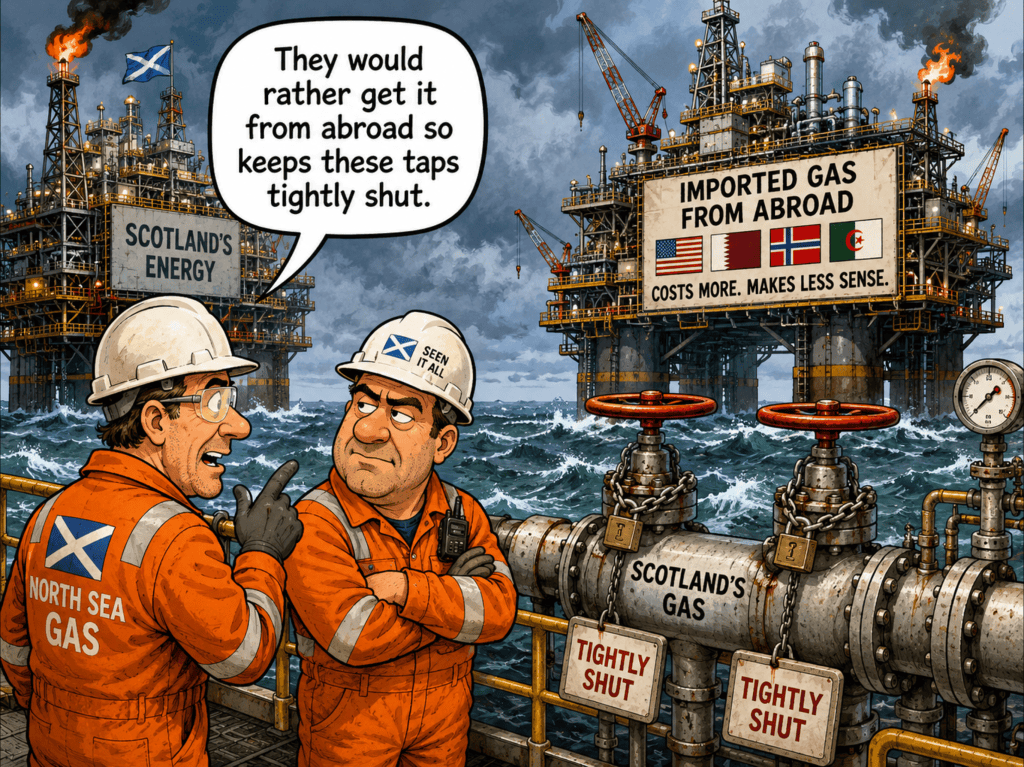
Britain has achieved something quite remarkable. We are an island surrounded by energy, sitting beside one of the great oil and gas provinces of the world, while being told that there is absolutely nothing we can do about the price of energy. Apparently the North Sea is there mainly for decoration.
Sitting out there are Jackdaw and Rosebank — two major energy developments caught in Britain’s favourite industrial process: The Government Decision-Making System. This highly sophisticated procedure involves reports, consultations, court cases, environmental assessments, more consultations, ministers looking concerned on television and eventually somebody announcing that a decision will be made about making a decision. Meanwhile, your gas bill arrives promptly.
Ofgem has just announced another increase from October. Why? Global gas prices. Of course. Britain has become rather like a man sitting on a pile of potatoes complaining that the price of chips in Saudi Arabia has gone up. We are told that producing more North Sea energy wouldn’t necessarily reduce British prices because oil and gas are sold on international markets. Fair point. But here is a revolutionary idea. Change the rules.
Parliament has this strange ability called making laws. If Britain believes domestic energy security matters, government could examine mechanisms requiring or incentivising part of future UK gas production to be supplied into the British market under long-term domestic contracts. Would that require legislation, negotiations and careful design? Certainly. Is it impossible? Of course it isn’t. Governments regulate markets every day. They regulate your pension. They regulate your car. They regulate your boiler. They regulate how much water your toilet uses. But apparently asking whether British gas could preferentially help British consumers is where the awesome power of the state suddenly runs out.
And so we return to the international market. The same international market currently being kicked around by wars, sanctions, tankers, geopolitics and the latest adventure involving our friends across the Atlantic. Donald Duck flaps his wings somewhere near the Middle East and Mrs McTavish in Falkirk gets another £60 on her energy bill. Excellent system.
But there is another part of this argument that tends to disappear behind the climate slogans. Jobs. Real jobs. Engineers. Welders. Fabricators. Offshore workers. Deck crews. Supply boats. Maintenance workers. Apprentices. Hotels. Taxi drivers. Catering companies. Small engineering firms. Whole communities around Aberdeen and the north-east of Scotland have spent decades building skills that the country now claims it desperately needs.
The companies behind Jackdaw and Rosebank argue the projects could involve billions of pounds of investment and thousands of jobs during construction and operation. You can challenge those numbers. You can argue about climate policy. You can argue about how quickly Britain should move away from fossil fuels. Those are perfectly legitimate debates. But pretending there is no economic consequence from shutting down domestic production is nonsense.
Because when an offshore job disappears, the worker doesn’t magically transform into a wind-turbine engineer on Monday morning. Neither does the fabrication yard. Neither does the supply company. Neither does the town that depended on them. There should absolutely be a transition towards cleaner energy. But there is a difference between an energy transition and simply closing one industry before its replacement is ready. One is planning. The other is redundancy with a green leaflet attached.
And this is the part ordinary people understand perfectly well. If Britain still needs gas — and we clearly do — there are two basic choices. Produce some of it ourselves. Or buy more of it from somebody else. Buying it abroad doesn’t make the gas disappear. It simply moves the drilling, the investment, the tax revenue and the jobs somewhere else. Then we put the gas on a ship, sail it to Britain and congratulate ourselves on being environmentally responsible. Brilliant. The emissions are foreign. The unemployment is British. And the bill lands through your door.
Perhaps instead of endlessly explaining why Britain cannot control world energy prices, government should start asking a much simpler question: What parts of our energy supply can Britain control? Use domestic energy while we still need it. Protect the skilled workforce. Build renewables alongside it. Develop storage. Invest in nuclear. Secure long-term domestic supplies. And reduce our exposure to whichever international crisis appears on television next Tuesday.
Because ordinary people aren’t demanding miracles. They are simply looking out into the North Sea and asking: If we’ve got energy out there, workers ready to produce it and families struggling to pay their bills — why does our national energy strategy seem to begin with importing somebody else’s?


Leave a Reply