🔥🥶Britain is heading towards another winter with a familiar national ritual: staring at the thermostat as though it’s a roulette wheel and wondering whether putting the heating on counts as reckless financial behaviour.
And right on cue, Ofgem has announced that the energy price cap will rise another 4% from 1 October 2026, taking the typical annual dual-fuel figure from £1,663 to £1,723 under its updated consumption measure. Ofgem says higher wholesale gas prices linked to the continuing Middle East conflict are the main driver. Gas bills under the cap rise by about 8%, while electricity is expected to remain broadly stable thanks partly to the removal of VAT from domestic electricity bills.
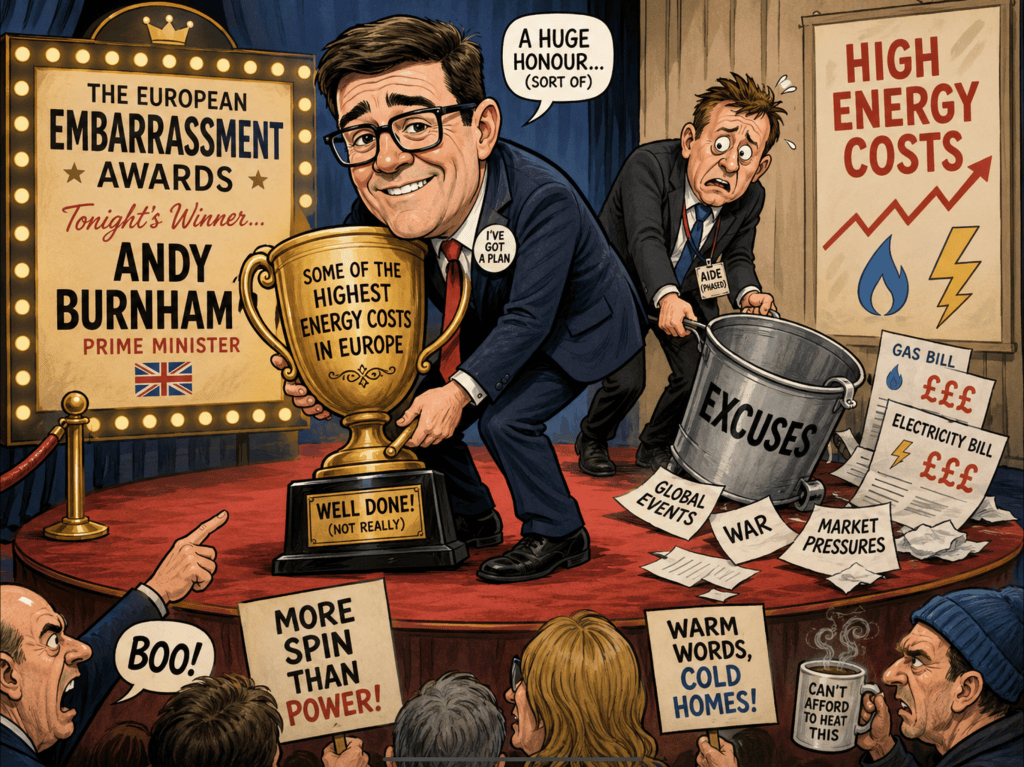
Another glorious British podium finish. 🥉 Not for cheap energy. Not for industrial competitiveness. Not for building infrastructure quickly. But for discovering new and inventive ways to make putting the kettle on feel like a leveraged financial transaction.
🧭Destination: Lower Bills. Satnav Says: Recalculating…
Andy Burnham arrived in Downing Street promising fresh momentum. And something certainly appears to be moving. Unfortunately, it’s the energy bill.
Perhaps the government satnav has malfunctioned: Destination: Lower Cost of Living. Route selected: Higher Bills. Continue for 300 miles via: International Crisis. Estimated arrival: Please consult the next manifesto.
Of course, there are explanations. The Middle East. Gas markets. Ukraine. Shipping routes. Supply chains. Global demand. Storage levels. Weather systems. Tankers. Pipelines. Give Westminster another fortnight and somebody will appear on breakfast television blaming Mercury being in retrograde. 🪐
Some of those explanations are entirely legitimate. Energy markets really are international. Wars really do matter. Wholesale gas prices really do move. But there’s a fairly important distinction between an explanation and a solution.
We didn’t elect governments because we lacked people capable of explaining that difficult things are difficult. We elected them to make difficult things less difficult.
British politics increasingly resembles calling a plumber because your roof is leaking, only for him to arrive with a 94-page PowerPoint presentation entitled: “Rain: Historical Causes and Emerging Challenges.” Meanwhile, the ceiling collapses.
Energy prices? Global markets. Food prices? Supply chains. Housing? Planning constraints. NHS waiting lists? Unprecedented demand. Debt? Previous governments. Growth? Global headwinds.
At this point Whitehall may possess the most advanced excuse-generation technology on Earth. Connect it to the National Grid and Britain could be energy independent by Christmas. ⚡🏛️
The uncomfortable question isn’t whether international crises can push gas prices higher. Of course they can. The uncomfortable question is why a country surrounded by sea, blessed with enormous renewable potential, possessing nuclear expertise, offshore infrastructure and generations of engineering experience can still become nervous every time somebody sneezes near an international shipping lane.
We have somehow globalised the thermostat. Mrs McTavish in Falkirk now needs a working knowledge of Middle Eastern geopolitics before deciding whether to use the tumble dryer.
Perhaps the BBC weather forecast should simply incorporate it: 🌦️ “Cloudy across Scotland tomorrow, brighter spells in the South, and three LNG tankers have successfully reached Europe, so households may boil the kettle between 2pm and 4pm.” Much easier.
Then there is Ukraine. Britain has chosen to continue substantial support for Ukraine, and people can reasonably support that policy while still asking a question democratic governments should never become allergic to: Where does the strategy end?
Supporting a policy cannot mean abandoning the right to ask about objectives, costs, diplomacy or eventual outcomes. At some stage, every conflict requires politics as well as weapons. And every energy crisis requires something more ambitious than explaining the wholesale market afterwards.
Britain doesn’t need another slogan printed behind a minister at a press conference. It needs something far less glamorous: a boring, practical, relentless energy strategy.
⚛️ Nuclear. 🌬️ Renewables. 🔋 Storage. 🔌 Modern grids. 🛢️ Sensible domestic production where appropriate. 🏠 Energy efficiency. 🛡️ Strategic resilience.
And one brutally simple test: Does it produce reliable, abundant and affordable energy? If the answer is no, change the policy.
Engineers do this. Businesses do this. Normal people do this. Politicians, by contrast, announce that the original target was “extremely ambitious” before unveiling another target with a slightly different font.
So yes, global conflicts matter. Gas markets matter. International supply matters. But winter doesn’t care about ministerial speeches. Neither does your electricity meter.
Andy Burnham wanted to bring drive to Britain. Excellent. Perhaps now he can drive us somewhere useful. 🚗⚡
Because bills are rising, winter is coming, and Whitehall’s most dependable renewable resource is already generating at record capacity: the endless recycling of political excuses. ♻️🏛️
🔥Challenges🔥
Here’s the question Westminster would rather you didn’t ask: How many more winters should British households accept “global events” as the permanent explanation for an energy system that never seems quite resilient enough?
Should Britain build more nuclear? Produce more energy domestically? Accelerate storage? Change market pricing? Push harder for diplomacy abroad? Or are we destined to spend every January studying shipping movements while wearing three jumpers indoors? 🧥🥶
Drop your verdict in the blog comments. Tell us what Britain should actually do — not what politicians should announce they’re going to do.
👇 Comment. Like. Share. Challenge the argument. Roast the excuses.
The best comments, counterarguments and truth bombs will be included in the magazine. 🎯📰


Leave a Reply