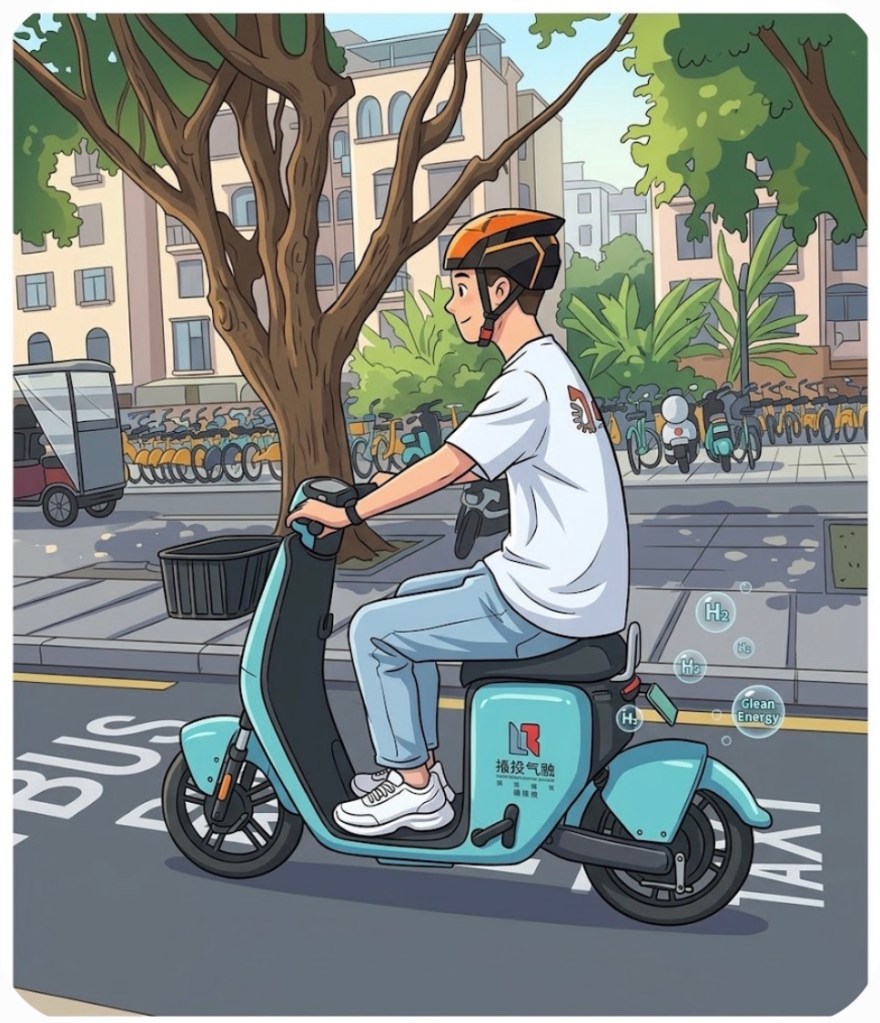
China is putting hydrogen-powered two-wheelers onto real streets, not just technology-showcase stages.
In Baotou, Inner Mongolia, hydrogen mopeds using rare-earth solid-state storage can travel more than 100 kilometres per fill, operate at around −30°C, and produce water rather than conventional exhaust fumes. (Xinhua News)
Dongguan has deployed hydrogen delivery bikes, while Chengdu has introduced thousands of hydrogen “ponies.” (dongguantoday.com)
🛵 While We Debate the Future, China Has Put It on Two Wheels
Hydrogen has spent years trapped in feasibility studies, government committees and conferences near Heathrow.
China’s approach appears simpler:
“Put it on a bike and see if it works.”
And apparently, off it goes. 💨
No petrol engine. No conventional exhaust. No three-hour charging stop.
A fuel cell generates electricity onboard, powers the electric motor and produces:
Water. 💧
So how the hell does a “water moped” work?
💡 How the “Water Mopeds” Work
You cannot pour water into the tank and ride to Tesco.
The bike runs on hydrogen. The water comes out at the other end.
🔩 The Hydrogen Tank
Some models carry roughly 100 grams of hydrogen in a solid-state metal-hydride system. The gas is absorbed into a metal alloy rather than compressed into a conventional high-pressure tank.
One Chengdu system reportedly stores 100 grams at around 2 MPa, compared with 35–70 MPa for many compressed-hydrogen systems. (China Daily Global Edition)
Think less:
miniature Hindenburg beneath your backside
and more:
hydrogen hiding inside a metallic sponge. 🧽⚛️
⚗️ The Reaction
Hydrogen enters the fuel cell, oxygen comes from the air, and their electrochemical reaction generates electricity for the motor.
The main vehicle-level product is:
H₂O — water. 💧
In other words, the moped makes electricity onboard from hydrogen instead of storing all its energy in a large battery.
⚡ Why This Could Challenge Lithium E-Bikes
⏱️ Thirty-Second Hydrogen Swaps
Some deployments use exchangeable hydrogen-storage units. Dongguan has reported swaps taking around 30 seconds. (Metal)
That is less:
“Where’s the charger?”
and more:
“Click. Clunk. Off you go.”
🛣️ Around 100 Kilometres From 100g of Hydrogen
Chengdu hydrogen bikes have reportedly travelled close to 100 kilometres on roughly 100 grams of hydrogen—about twice the range quoted for ordinary shared e-bikes in the same report. Baotou’s newer models are also reported to exceed 100 kilometres per fill. (China Daily Global Edition; Xinhua News)
One hundred grams—about the weight of a chocolate bar—moving a person roughly 62 miles.
That is the sort of statistic that makes engineers put down their coffee. ☕⚡
❄️ And Then There’s Winter
Lithium batteries generally lose performance in cold weather. Baotou says its solid-state hydrogen two-wheelers can operate at −30°C while retaining more than 90% of their normal winter range. (Xinhua News)
Useful in northern China, where winter does not politely arrive with a light frost and a BBC weather warning.
It arrives attempting to kill machinery.
🚀 The Bigger Story Isn’t Really the Moped
The important point may not be whether Britain is riding hydrogen scooters next Tuesday. It is that China is testing hydrogen at ordinary consumer scale:
Little bikes. Delivery vehicles. Shared transport.
Baotou had more than 1,300 solid-state hydrogen two-wheelers operating by July 2026, with plans to promote as many as 10,000 that year. (nmg.news.cn)
Technologies become transformative when they become small, cheap, boring and useful—not merely enormous and impressive.
The personal computer did it. The mobile phone did it. Solar panels and lithium batteries did it.
Now China is asking whether hydrogen can do it too.
🔥 Challenges 🔥
If hydrogen can be stored at relatively low pressure, swapped in seconds, deliver around 100 kilometres and keep working in brutal cold…
should Britain and Europe take small-scale hydrogen transport more seriously?
Or will lithium batteries keep getting cheaper and better until hydrogen mopeds become an ingenious answer to a question nobody needed answering?


Leave a Reply