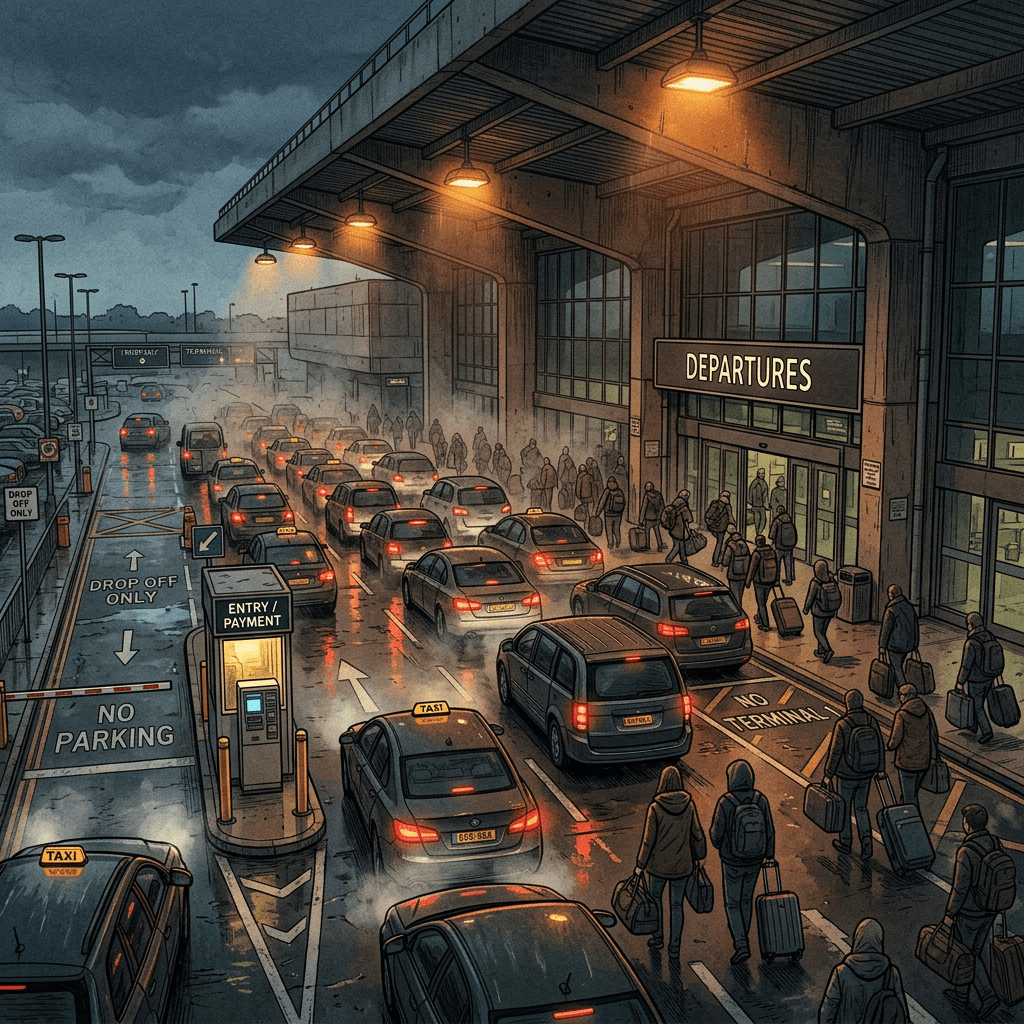
✈️💷There is something deeply odd about the way airport drop-off charges have become normalised in Britain. Perhaps the easiest way to see it is to remove the airport from the story altogether.
Imagine a nightclub where someone suddenly announces that they now control the road outside. Every time you pull up to drop someone at the door, they want £5. You are not parking, reserving a space or receiving any special service. You stop for a minute, your passenger gets out, and you leave.
Now imagine that if you forget to pay that £5, miss the deadline or make a mistake in the process, the demand can later rise towards £100.
If this arrangement were being run outside a nightclub by men in dark suits, we might use rather different language to describe it. Put an airport terminal in the background, however, and it becomes “traffic management”. ✈️
Airport operators argue that these charges reduce congestion, encourage public transport and stop terminal roads becoming clogged with vehicles. There is some logic in that. Airports do need to control traffic. But that still leaves a perfectly reasonable question: at what point does managing congestion become simply monetising access?
The passenger is already paying for the flight. The driver may already have paid road tax, fuel duty and countless other motoring costs. Yet the final few metres of the journey have somehow become another commercial opportunity, monitored by cameras that can turn a brief stop into an invoice.
And it is the escalation that makes the whole system feel particularly unpleasant. A small drop-off charge is one thing. Allowing a minor missed payment or road-use breach to turn into a demand many times larger is quite another. Government policy has contemplated private parking charges of up to £100 outside London for certain airport-road “no stopping” breaches, which raises an obvious question about proportionality.
The usual defence is that many airport approach roads and forecourts are privately controlled. Legally, that matters. Morally, it does not end the argument.
Airports are not obscure private estates visited by a handful of invited guests. They are major pieces of national infrastructure used by millions of ordinary people, and once someone has booked a flight there is often very little practical choice about needing to get to the terminal.
So perhaps the important question is not simply whether there was a sign somewhere explaining the charge. Perhaps it is whether the arrangement itself is reasonable.
Imagine Tesco charging you £5 merely to pull up and let your elderly mother out near the entrance. Imagine a hospital doing it. Imagine a football stadium charging every parent who stopped outside for thirty seconds. Most people would immediately recognise how absurd it sounded.
Yet airports have managed to turn the same basic act — stopping briefly so another human being can get out of your car — into a revenue stream.
That is why this is about more than five pounds. It is about how easily small charges become accepted once they are wrapped in the right corporate language.
Call it a “forecourt access charge”, “terminal traffic management” or “drop-off zone pricing” and it all sounds terribly sophisticated.
Strip away the terminology and the arrangement is much simpler: you stop outside a destination, someone gets out, and somebody wants money for the privilege.
The mafia could only dream of branding like that. 💷
🔥Challenges🔥
So where should the line be drawn? Is charging drivers to drop passengers at an airport a reasonable way to control congestion, or have airports discovered that the kerb itself can be turned into a cash machine?
And even if you accept the initial charge, should a forgotten £5 payment ever be allowed to balloon towards £100?
💬 Tell us what you think in the blog comments, and share this with anyone who has ever paid an airport simply for the privilege of saying goodbye.
The best comments will be included in the next issue of the magazine. 🎯


Leave a Reply