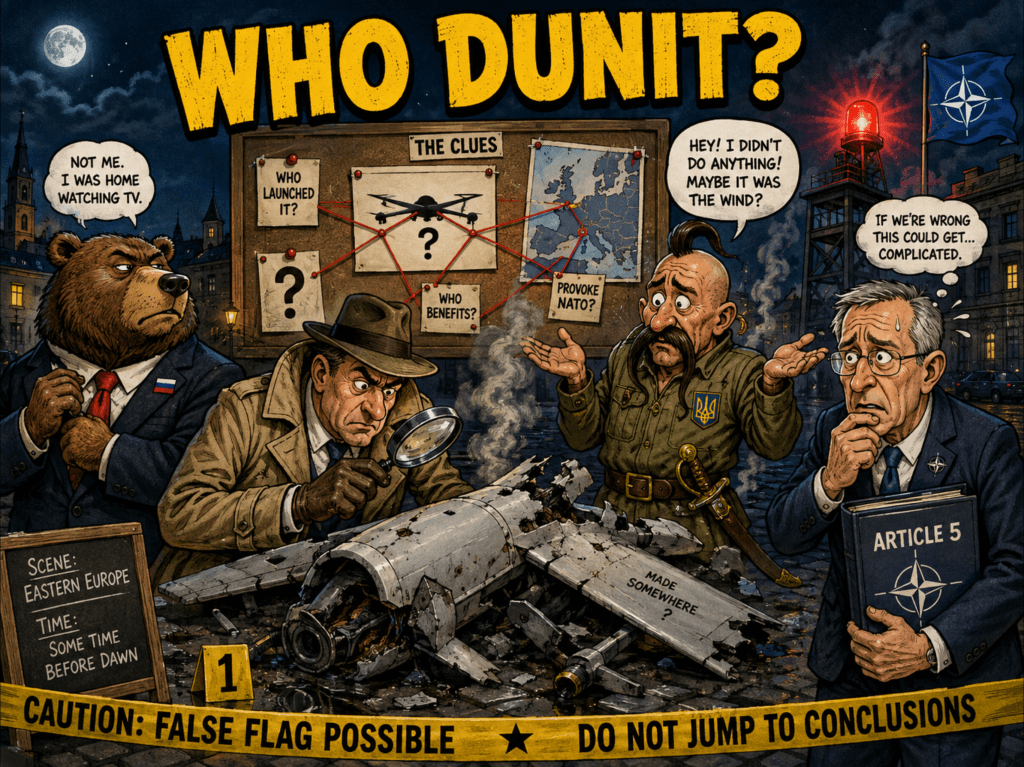
Western intelligence agencies are warning that Russia could potentially stage an attack involving a Ukrainian drone and make it appear that Ukraine had attacked NATO territory.
Russia denies it. Donald Trump says Vladimir Putin does not intend to attack NATO. And CIA Director John Ratcliffe has just returned from an unusual visit to Moscow where, according to Reuters sources, the possibility of Russian operations against NATO was discussed. (Reuters)
But there is another side to this story that deserves examining.
Russia has very little obvious incentive to start a conventional war with NATO. It is already committed heavily in Ukraine. A direct conflict with the full NATO alliance would dramatically increase the military and economic forces ranged against Moscow.
Ukraine, on the other hand, desperately wants continued Western military support and would benefit enormously if NATO became more directly involved against Russia.
That does not mean Ukraine would attack NATO.
It means that if something does happen, NATO cannot afford to decide responsibility simply by asking who it expects the culprit to be.
Imagine a Ukrainian-made drone suddenly strikes an installation in Poland or one of the Baltic states.
Russia says Ukraine launched it.
Ukraine says Russia captured or copied the drone and staged the attack.
Western intelligence says it believes Russia was responsible.
Russia produces evidence claiming the opposite.
Within hours the world could be arguing about whether NATO had just been attacked by Russia — with the possibility of retaliation against a nuclear power hanging over the decision.
That is why the warning itself may actually be useful.
Poland and the Baltic states are already strengthening protection around critical infrastructure because of intelligence concerning a possible Russian false-flag operation involving Ukrainian drones. (Reuters)
By publicly announcing that possibility beforehand, Western governments have effectively told everyone:
We know this trick is possible, and if something happens we will examine very carefully who actually carried it out.
And that warning does not only apply to Russia.
It applies to everybody.
If Russia were contemplating such an operation, it now knows NATO is specifically watching for it.
If somebody inside Ukraine ever believed that provoking a Russian-NATO confrontation might bring NATO directly into the war, they would also know that investigators would immediately examine that possibility.
If a rogue group tried it, the same applies.
In other words, publicly exposing the scenario potentially removes some of the value of carrying it out.
That could actually help prevent escalation.
Trump’s comments make the situation even more interesting. After the CIA director’s Moscow discussions, Trump publicly said Putin would not attack NATO territory. Reuters nevertheless reports that American and European intelligence agencies continue monitoring Russian covert activity and the possibility of a false-flag operation. (Reuters)
So perhaps the most useful message coming out of all this is not:
“Russia is about to attack NATO.”
It is:
“Everybody knows that somebody could try to manufacture an attack on NATO — so don’t assume that the first flag found in the wreckage tells you who did it.”
Because if that principle is established before an incident occurs, NATO governments may investigate first rather than retaliate first.
And if anybody — Russian, Ukrainian or otherwise — was considering engineering an incident to widen the war, knowing that NATO is already looking for precisely that deception might just persuade them that it isn’t going to work.


Leave a Reply