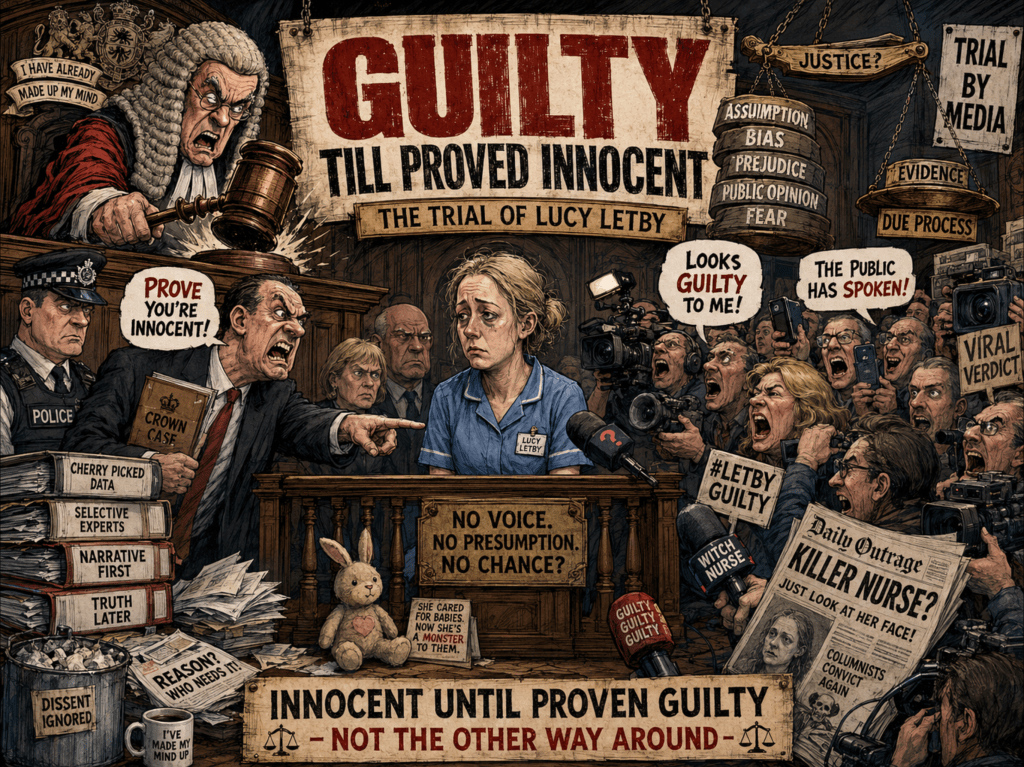
Lucy Letby’s convictions remain in force, and no court has overturned the jury verdicts. But the medical case underpinning those convictions is now facing a level of organised expert challenge that is increasingly difficult to dismiss as fringe noise. In February 2025, a 14-member international medical panel led by neonatologist Dr Shoo Lee said its review of the babies’ cases found no medical evidence of deliberate harm, instead identifying natural disease, infection, prematurity and shortcomings in clinical care as explanations for the deaths and deteriorations it examined. The panel included senior specialists such as Professor Neena Modi.
🧪 Welcome to the Awkward Bit: When the Experts Start Disagreeing With the Experts
For years, the public story sounded brutally straightforward: babies collapsed unexpectedly, doctors could not explain why, experts concluded somebody must have harmed them, and Lucy Letby was the nurse repeatedly present.
Except medicine has now wandered back into the courtroom carrying a very large folder and saying: “About that word ‘inexplicable’…” 📂👀
Shoo Lee’s panel did not merely wave vaguely at “possible alternatives.” It offered case-by-case medical explanations. The experts attributed deaths and collapses to conditions including thrombosis, sepsis, pneumonia, respiratory disease and complications of clinical treatment. Their central conclusion was that they found no medical evidence supporting deliberate injury in the cases they reviewed.
That does not magically acquit Letby. A press conference is not a Court of Appeal, and a retrospective medical review is not a jury trial. Lawyers representing some of the babies’ families have strongly disputed the significance of the panel’s conclusions, and the courts have already rejected previous attempts to overturn the convictions.
But neither is this some bloke on Facebook squinting at a spreadsheet between posts about chemtrails.
These are internationally experienced neonatal specialists challenging the medical interpretation at the heart of one of Britain’s most consequential criminal trials.
And then things get even more uncomfortable. 🫣
The prosecution relied in several cases on alleged air embolism. Shoo Lee happens to be the co-author of the 1989 research discussed during the case. He later argued that the skin appearances described in the babies did not establish air embolism in the manner suggested by the defence challenge. The Court of Appeal considered his proposed evidence and rejected the argument that it undermined the convictions, noting that the prosecution case did not rest solely on skin discolouration as a diagnostic sign.
So, no: “Author disagrees, case over” is not serious analysis.
But the question has since grown larger. Lee did not stop with his original criticism; he assembled a multidisciplinary panel whose conclusions challenged the alleged medical mechanisms across the cases more broadly.
Then comes the insulin evidence — previously one of the parts of the prosecution case that looked closest to a scientific smoking gun. 🧪
Babies F and L produced blood results showing high insulin alongside low C-peptide. The prosecution interpretation was that this indicated insulin originating outside the babies’ bodies.
Powerful. Simple. Apparently objective.
Except science, irritatingly, has a habit of refusing to remain simple once somebody starts checking the footnotes.
In April 2026, J. Geoffrey Chase and Helen Shannon published peer-reviewed work in the Journal of Diabetes Science and Technology reporting that unexpectedly high insulin-to-C-peptide ratios can occur in premature babies who have not been given insulin, and discussing insulin-binding antibodies as a possible mechanism affecting measurements.
That does not prove that the original babies were not poisoned.
It does something legally more awkward: it challenges the proposition that the laboratory pattern necessarily means they were.
Welcome to criminal justice, where the difference between those two sentences is approximately the size of a prison wall. 🧱
The dispute has continued. In July 2026, reporting described a roughly 100-page analysis by consultant neonatologist Neil Aiton and UCL statistician Hilde Wilkinson-Herbots being submitted to the CCRC. It reportedly challenges aspects of prosecution expert Professor Peter Hindmarsh’s insulin evidence and raises alternative interpretations. The document itself has not been publicly released, meaning its detailed allegations should presently be treated as claims submitted for review, not established findings.
And that distinction matters.
Because this case has suffered enough from people converting “an expert argues X” into “X is now indisputable fact.”
The CCRC itself confirmed in February 2026 that its review of Letby’s convictions was underway and that it had received successive expert reports and submissions. It stressed that its role is not to decide guilt or innocence, but to determine whether new evidence or argument creates a real possibility that convictions would not be upheld on appeal. As of the CCRC’s latest publicly listed material through August 2026, no referral decision has been announced.
That is where responsible discussion has to land.
Not “Letby is definitely innocent.”
Not “the jury decided, therefore science may now pack up and go home.”
But something considerably more unsettling:
If crucial medical propositions presented with great confidence at trial are now being seriously challenged by qualified specialists, then those challenges deserve forensic examination rather than tribal chanting from either side. ⚖️🔬
Because a justice system worth defending should not be frightened of another look.
If the convictions remain scientifically and legally sound, scrutiny should strengthen them.
If they do not, scrutiny is precisely how we find out.
And somewhere beneath all the headlines, documentaries, barristers, consultants, statistics and furious online factions are babies who died and families who deserve something much more valuable than certainty performed for television:
They deserve accuracy.
🔥 Challenges 🔥
Here’s the question nobody should be allowed to dodge: how much new expert disagreement should it take before a criminal case this serious receives another full judicial examination? 👇
Chameleon News


Leave a Reply