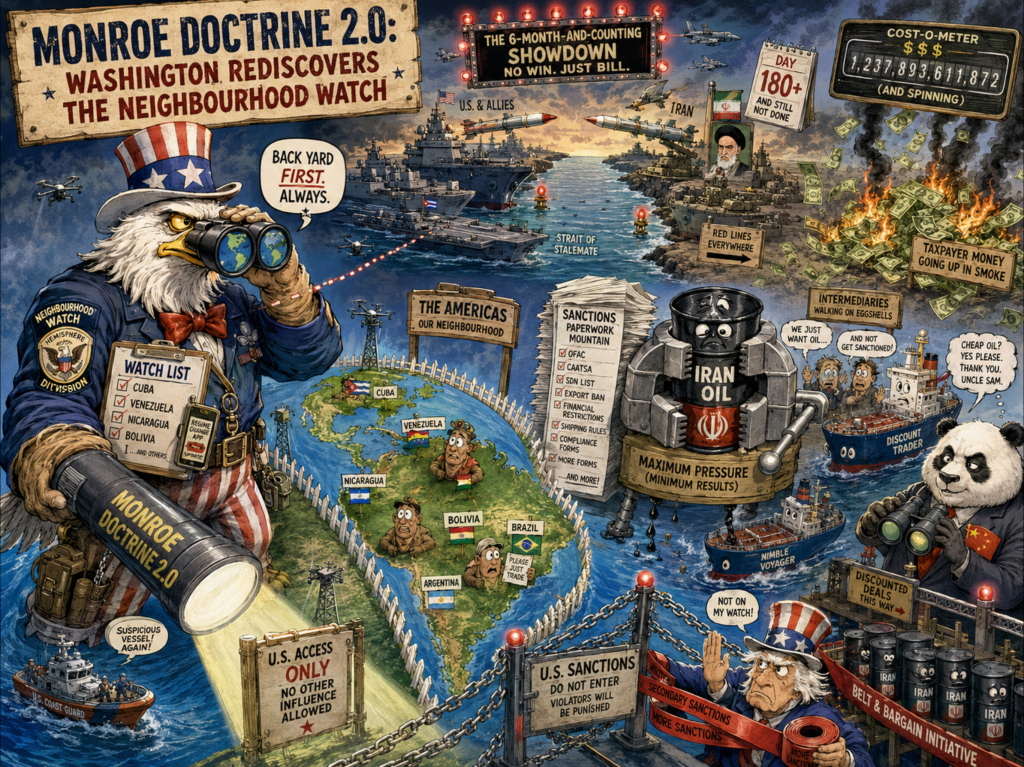
🌎🦅America is pressuring Iran, squeezing its oil revenues and trying to limit China’s access to them. But while Washington is locked in an expensive Middle Eastern stalemate, something arguably more important is happening much closer to home.
Venezuela has flipped.
Maduro is gone, the new government is cooperating with Washington, and the country’s vast oil reserves are moving back into America’s strategic orbit.
Then there’s Cuba. 🇨🇺
🧨 Venezuela Falls, Cuba Feels It
Cuba depended heavily on Venezuelan oil. Once those supplies were cut, and pressure was applied to other suppliers, Havana became far more vulnerable.
That means removing Maduro didn’t just reshape Venezuela. It weakened Cuba’s economic lifeline.
And Washington appears keen to exploit that weakness.
Reports of military planning, intelligence assessments and Trump publicly floating a Cuba operation all point to something bigger than a dispute with Havana.
The real concern is China and Russia.
China does not need to invade Latin America to gain influence. It can do it through ports, telecoms, infrastructure, loans, trade and energy. Russia already has deep political and security ties with Cuba.
From Washington’s perspective, the nightmare isn’t Cuba attacking Florida.
It’s China becoming the dominant economic power in Latin America, Russia preserving military and intelligence footholds, and American influence slowly shrinking in its own hemisphere.
That is where the Monroe Doctrine comes back into view.
For two centuries, US strategy has repeatedly rested on one basic assumption:
Major outside powers should not dominate the Western Hemisphere.
The modern version just looks different.
No gunboats required. No flags planted.
Just contracts, cables, ports, oil and influence. 📡💰
Venezuela may therefore be more than a regime change story.
It may be the opening move in a broader American effort to push rival powers out of its strategic backyard.
And Cuba could be next.
🔥Challenges🔥
Is this sensible national security, Monroe Doctrine 2.0, or old-fashioned sphere-of-influence politics with better branding?
💬 Drop your take in the blog comments. Like it, share it, argue with it.
The best comments will be featured in the magazine. 🎯


Leave a Reply