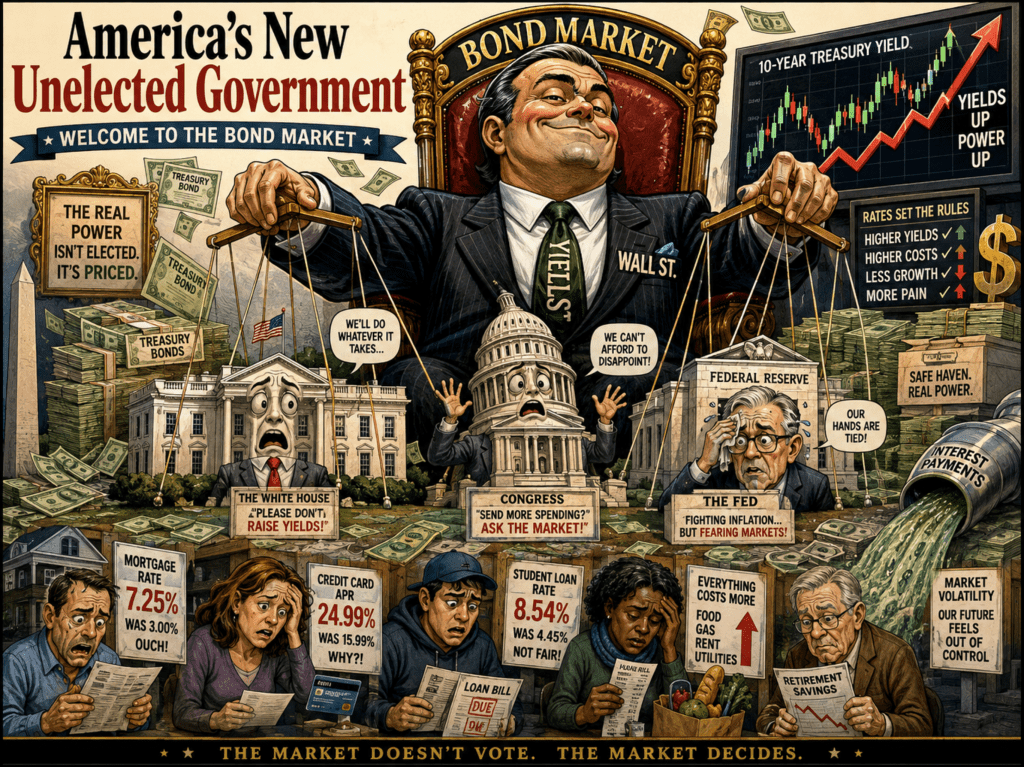
Forget the White House. Forget Congress. And maybe, increasingly, forget the idea that the Federal Reserve gets the final word.
Because when Washington wants to spend, cut taxes, launch subsidies, slap on tariffs or fire another fiscal bazooka into the economy, there’s now a rather awkward character sitting in the corner with a calculator and a raised eyebrow: the US Treasury market.
And unlike politicians, the bond market doesn’t need your vote.
It just demands a higher interest rate. 💰
💣 The Bond Vigilantes Have Found Washington’s Credit Card
Here’s the uncomfortable reality: governments can announce whatever policies they like, but they cannot dictate the price at which investors must finance them.
If bond investors decide that Washington’s plans mean higher inflation, bigger deficits, more borrowing or deteriorating fiscal credibility, they can demand higher yields.
And suddenly the financial plumbing starts screaming.
Mortgage rates rise. 🏠
Corporate borrowing gets more expensive. 🏭
Government refinancing costs climb. 📈
Interest payments consume a bigger chunk of the federal budget. 💸
Eventually, that supposedly mighty government discovers something extraordinary:
Money has a price.
Who knew?
For decades, US policymakers enjoyed the extraordinary privilege of borrowing enormous sums in the deepest sovereign debt market on Earth.
But debt changes the relationship.
A government carrying modest debt can shrug off a temporary rise in borrowing costs.
A government constantly refinancing mountains of obligations while running large deficits has considerably less room for swagger.
Every percentage-point increase in borrowing costs starts behaving like a giant fiscal parking meter attached to Washington.
Tick. Tick. Tick. 🕐💵
And this is where the traditional question — “What will the Fed do?” — starts looking incomplete.
Because the Fed can cut rates.
The government can announce stimulus.
Politicians can promise tax cuts.
But if longer-term Treasury investors respond by demanding significantly higher yields, financial conditions can tighten anyway.
Congratulations, Washington.
You may have discovered the only opposition party that cannot be filibustered. 🥳
The bond market.
Even more interesting is what happens if overseas investors, central banks or institutional buyers become less enthusiastic about absorbing an ever-growing supply of Treasuries.
Washington still needs buyers.
And buyers get to name their price.
That doesn’t mean the United States has suddenly lost control of its currency or that Treasury investors literally run the government.
But it does mean fiscal freedom becomes increasingly constrained by financing costs.
The bigger the debt burden becomes, the louder that constraint gets.
So perhaps the defining economic question of the coming era isn’t simply:
“What does the Federal Reserve want to do?”
It may increasingly be:
“What will the Treasury market allow Washington to get away with?” 👀📉
🔥Challenges🔥
Here’s the question politicians would probably prefer you didn’t ask:
If an elected government cannot pursue its preferred policies without triggering a revolt in the bond market, who really holds the power — voters, politicians, the Fed… or the people financing the debt?
And what happens if Treasury buyers finally decide they want substantially more compensation for holding America’s IOUs?
That’s where this gets interesting. 🍿
👇 Drop your verdict in the BLOG comments — not just Facebook. Are the bond vigilantes becoming America’s unofficial financial government?
🔥 Comment.
👍 Like.
📢 Share it with someone who still thinks governments can borrow forever without consequences.
The best comments, arguments and economic truth bombs will be featured in the magazine. 🎯📝


Leave a Reply