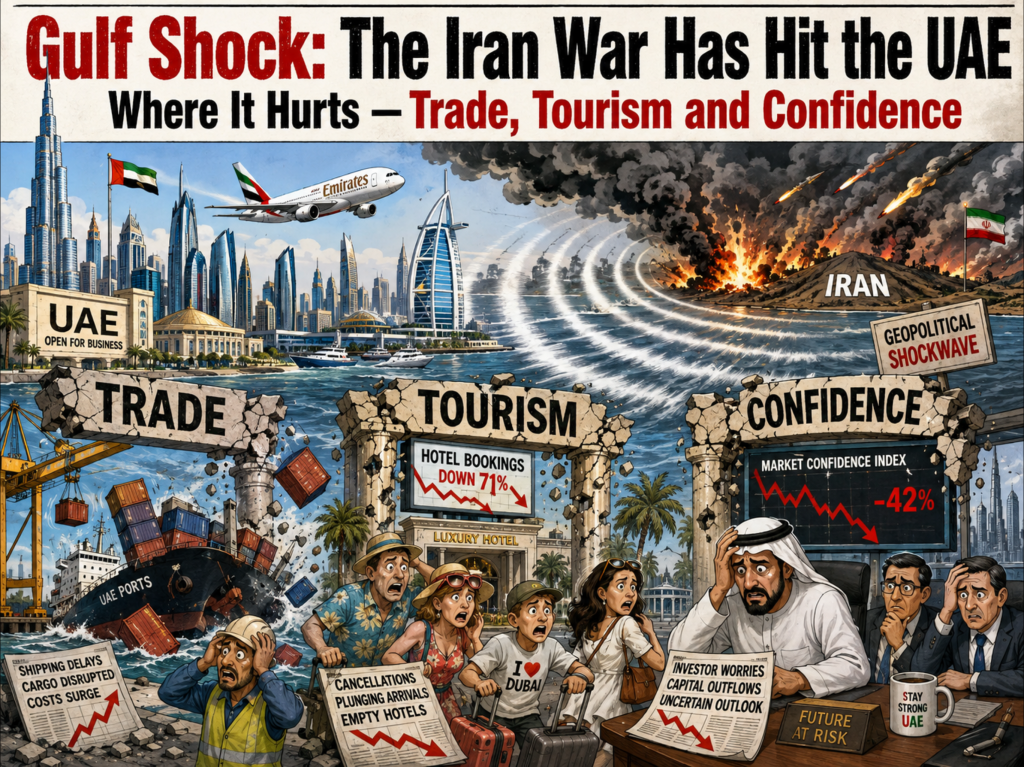
🌍💥Yes — assuming you mean the UAE (United Arab Emirates), the US-Iran war has materially disrupted its economy. But saying the Emiratis are simply “angry with America” goes further than the evidence. The more defensible conclusion is that the UAE has strong reasons to want the conflict ended quickly, even while remaining closely tied to Washington.
The economic damage is already visible. The IMF said in July that the UAE economy had proved resilient, but nevertheless expected overall GDP to be slightly lower in 2026, with tourism, transportation, trade and real estate particularly affected by the conflict and disruptions around the Strait of Hormuz.
Dubai has taken an especially obvious hit. Dubai International Airport handled 31.5 million passengers in the first half of 2026, down 31.3% from the same period in 2025, after cancellations, airspace disruption and higher fuel costs hammered Gulf aviation.
🏗️ Welcome to Dubai — Please Mind the Ballistic Missiles
🚀The UAE spent decades building itself as the place where geopolitics supposedly checked its weapons at the airport.
Come to Dubai! ✈️
Move your company here! 🏢
Buy an apartment overlooking the marina! 🏙️
Connect Europe to Asia! 🚢
And preferably ignore the missile alerts.
That business model becomes slightly less glamorous when Iran is launching weapons toward Gulf states, tankers are worrying about Hormuz and international airlines are wondering whether their next connection should involve Dubai or a considerably less explosive piece of geography.
The UAE government itself has made an important distinction: it says it is not a party to the war and did not permit its territory, waters or airspace to be used for attacks on Iran. At the same time, it says Iranian attacks have forced it into a defensive posture.
That tells you quite a lot.
Abu Dhabi does not want Iran dominating the Gulf. But it also doesn’t particularly benefit from Washington and Tehran turning the neighbourhood into an extremely expensive demonstration of missile technology.
The economic incentives are enormous. Dubai historically functioned as one of Iran’s most important commercial gateways, while the broader UAE depends heavily on aviation, shipping, finance, tourism and its reputation as a safe international business hub. The war has damaged precisely those sectors.
And then there is Hormuz. If shipping through the Strait becomes unreliable, the Gulf suddenly discovers that owning gigantic quantities of oil is less impressive when getting the stuff onto a ship resembles an episode of Mission: Impossible. 🛢️🚢
Your Saudi Treasury point fits into this broader picture too. US Treasury data confirm Saudi holdings fell from $160.4 billion in February to $140.1 billion in April, before recovering to $142.5 billion in June. Interestingly, the UAE’s reported holdings also moved from $120.0 billion in February to $112.5 billion in April and $114.8 billion in June. These movements alone don’t prove political retaliation; they can reflect liquidity management, portfolio decisions and valuation effects.
Meanwhile Saudi Arabia’s PIF signed a July agreement with the US Export-Import Bank creating a framework for up to $15 billion of financing for eligible purchases of American goods and services. So this isn’t a straightforward Gulf rebellion against the dollar or Washington. It is something more complicated: Gulf states still need the American financial and security system while increasingly worrying about the instability American regional policy can generate.
🔥Challenges🔥
So here’s the uncomfortable question: what happens when America’s Gulf allies decide that American protection is becoming almost as economically disruptive as the threat it is supposed to protect them from?
The UAE isn’t abandoning Washington tomorrow. Saudi Arabia isn’t dumping the dollar next Tuesday. But the incentives for diversification, alternative defence relationships and greater strategic independence are becoming much easier to understand.
💬 Do you think the Gulf states will eventually distance themselves from Washington, or are they simply manoeuvring for a better deal? Drop your argument in the blog comments, then like and share the post.
The best comments and counterarguments will be featured in the magazine. 🎯📝


Leave a Reply