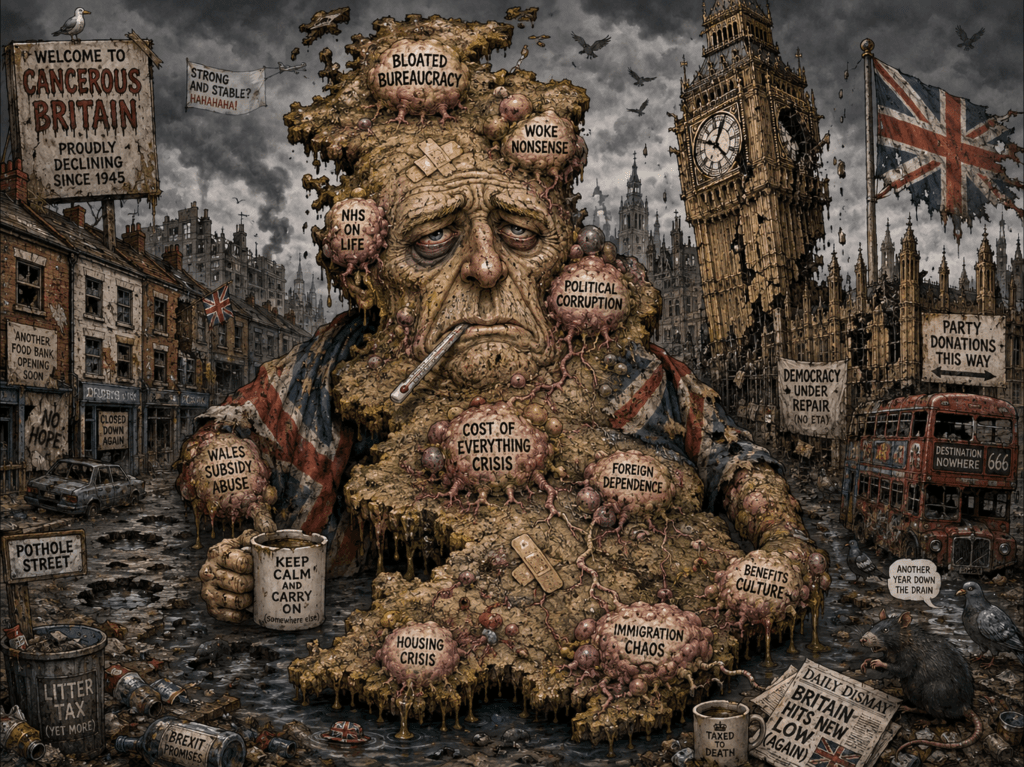
🏛️💷🦠As ordinary people get on with the increasingly difficult business of earning a living, raising a family, paying the bills and trying to keep hold of what they have worked for, government seems to be developing a habit of reaching further into almost every part of life.
Like a cancer, it grows.
It reaches into your pay packet through taxation, into your home through regulation, into your business through compliance, and increasingly into what you can say, what you are expected to believe and how you are expected to behave. Government no longer seems satisfied with administering the country. More and more, it appears determined to administer the individual.
They call it governing. Yet if an organisation outside government behaved in the same way — taking an ever-larger share of your money, restricting your choices, failing to deliver the services it promised and then demanding still more — most people would use a very different word for it.
🏛️ The State That Never Stops Feeding
Britain is hardly short of problems. The criminal justice system is under immense strain. Public services are stretched. Infrastructure has deteriorated. Productivity has stagnated. Governments change, ministers change and slogans change, yet the public is repeatedly handed the bill for failures accumulated over decades.
And when the system fails, the answer from Westminster is usually suspiciously familiar: more government, more regulation, more taxation and another lecture explaining why the public must accept less.
It is an extraordinary business model. Imagine a restaurant that served you cold food, lost your booking, charged you twice and then announced that the obvious solution was to make the restaurant larger, hire more managers and increase the service charge. You would never go back. Unfortunately, with government, there is no competing restaurant next door.
Meanwhile, look at the pace of development elsewhere. China has spent decades building railways, ports, power stations, industrial centres, manufacturing capacity and entire cities at astonishing speed. Britain, the country that helped pioneer the Industrial Revolution, sometimes seems more efficient at producing consultations, impact assessments, regulations and tax changes than it is at producing infrastructure.
Building anything substantial now appears to require a ceremonial pilgrimage through planning departments, environmental reviews, judicial challenges, public consultations and enough paperwork to deforest a small continent. By the time permission is granted, the original project is outdated, the budget has doubled and somebody has launched another consultation to investigate why everything takes so long. 📚🚧
Then there is taxation, the state’s favourite method of maintaining a lifelong relationship with you.
Earn money and it takes a share. Spend money and it takes another. Buy fuel and there is tax. Own property and there are taxes and charges. Invest successfully and there may be more tax waiting for you. And when you eventually die, the government may still want a final helping from wealth that was accumulated using income already taxed during your lifetime.
Apparently death does not automatically cancel your subscription to HMRC. ⚰️💰
The deeper issue, however, is not simply taxation. A functioning country obviously needs revenue, law enforcement, defence, infrastructure and public services. The real question is whether the machinery designed to serve society has gradually become something society is expected to serve.
Government was supposed to be the servant of the public. Increasingly, the relationship feels reversed.
A healthy state should protect its citizens, enforce the law, maintain essential services, provide necessary infrastructure, create conditions for prosperity and then have enough self-restraint to know when to get out of the way. Instead, Britain has allowed government to develop the instincts of an organism that regards expansion as evidence of success.
Every problem seems to require another department. Every failure produces another review. Every review generates another recommendation. Every recommendation requires another committee, another regulator, another budget and another group of well-paid officials whose first task is usually to explain why they require more funding.
The bureaucracy does not merely survive failure. It often feeds on it.
That is the danger of uncontrolled government growth. Institutions naturally seek to preserve themselves, enlarge their responsibilities and increase their budgets. Without constant pressure to justify their existence, they become extraordinarily good at creating reasons why they must continue expanding.
And the public is expected to finance the entire performance.
Perhaps that is why so many people now feel that something fundamental has shifted. Citizens increasingly live under a system in which they are expected to work harder, pay more, comply with more rules and lower their expectations, while government rarely seems expected to become smaller, simpler or more competent.
The country does not need no government. It needs government that remembers what it is for.
The state should be strong where strength matters: defending the country, enforcing the law, maintaining essential infrastructure and protecting the basic functioning of society. But strength is not the same thing as size. A government can be enormous and ineffective just as easily as it can be limited and competent.
The question Britain should be asking is not simply how much government can do, but how much government should do — and whether every new intervention genuinely improves the country or merely expands the machinery governing it.
Because like every uncontrolled growth, eventually the state begins damaging the very body that keeps it alive.
And that body is us.
🔥 Challenges 🔥
So where should the line be drawn? At what point does necessary government become excessive government? How much taxation, regulation and bureaucracy should citizens tolerate before demanding something fundamentally different?
Most importantly, if government keeps becoming larger while many of the country’s biggest problems remain stubbornly unresolved, why should the public automatically believe that another expansion of government is the solution?
👇 Tell us what you think in the blog comments. Agree with it, challenge it, dismantle it or add your own experience. Like the post, share it and get the argument moving. 💬🔥
The best comments will be featured in the magazine. 🎯📰


Leave a Reply