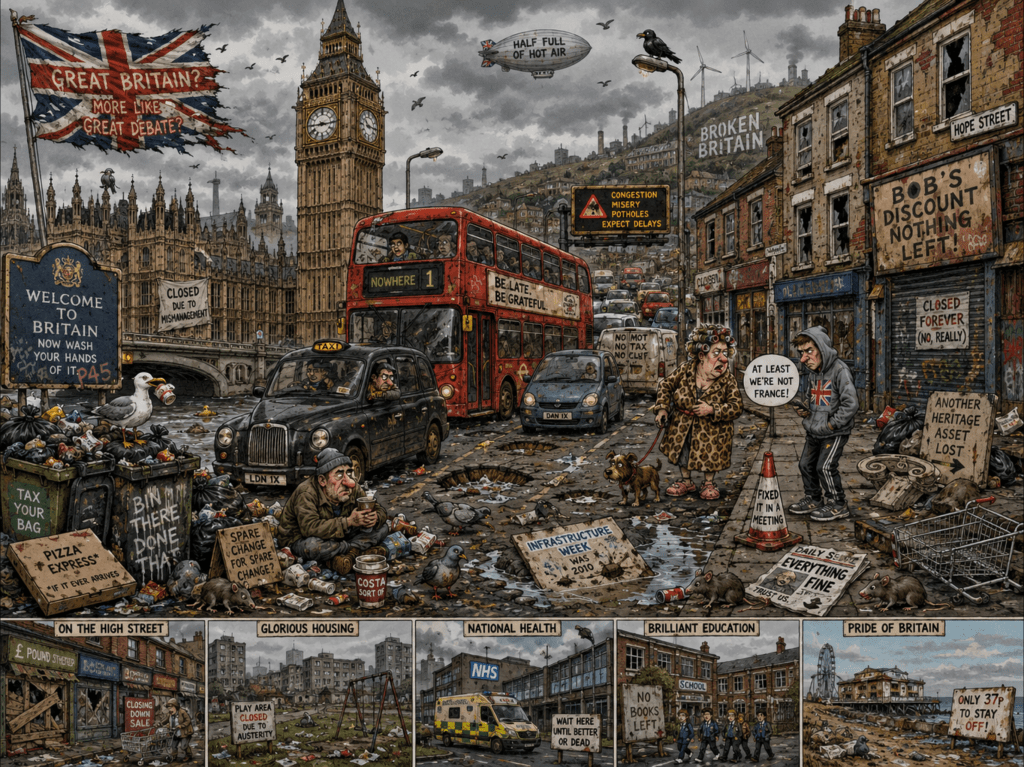
🏭🇬🇧Britain once taught the world how to become rich. Coal, iron, steam, engineering and machinery allowed one worker to produce what had previously required many, transforming the country into the workshop of the world and proving a simple economic truth: productivity makes nations richer.
Then, over the next two centuries, Britain gradually moved away from the very principle that had created its success.
Industrial decline did not happen overnight, and some reform was unavoidable. British factories were often old, investment was weak, management could be poor, industrial relations were chaotic, and Germany, America, Japan and later Asian competitors became formidable. But Britain went further than modernising its industry. It increasingly accepted the idea that if another country could make something cheaper, they should make it instead.
Britain would become a service economy.
There was logic in that. Britain had genuine strengths in banking, insurance, law, accountancy and financial services, and London became one of the greatest financial centres on Earth. But slowly the economic question changed from “How can we make more?” to “How can we make more money from what we already own?”
That distinction matters.
A factory requires machinery, engineers, apprentices, supply chains, technology and years of patient investment. Property, by contrast, can rise dramatically in value without producing anything new. If a house goes from £100,000 to £500,000, its owner is richer on paper, but Britain still has exactly the same house. No extra home has been built. No machine produced. No electricity generated.
Finance is essential, but finance should serve the productive economy, not replace it.
You cannot eat a derivative, build a bridge from a mortgage or defend a country with rising house prices. Every advanced economy still needs energy, steel, food, medicines, chemicals, machinery, electronics, transport and defence equipment.
Somebody has to make them.
Britain increasingly decided that somebody could be somewhere else.
Germany retained a powerful industrial base. Japan and South Korea became manufacturing giants. Then China embraced the very logic Britain had once pioneered: factories create engineers, engineers create technology, technology raises productivity, suppliers gather around industry, universities respond, research follows and exports generate income.
Manufacturing is not simply making objects. It creates entire ecosystems of knowledge.
Britain, meanwhile, enjoyed the immediate benefits of cheap imports. Consumers got cheaper televisions, clothing, appliances and electronics. Inflation stayed lower, companies reduced costs and shareholders benefited.
But industrial knowledge was quietly disappearing.
When a factory closes, the building is the least important thing lost. Skilled workers retire, apprenticeships vanish, specialist suppliers shut, toolmakers disappear and younger people stop entering industries that no longer seem to have a future. Restarting production years later is far harder than closing it in the first place.
That lesson became painfully obvious when global supply chains were disrupted and governments suddenly remembered that medicines, semiconductors, steel, batteries, energy equipment, telecommunications and defence manufacturing might be strategically important after all.
Britain therefore ended up with a strange contradiction. It remained one of the world’s wealthiest countries, yet large parts of the country felt economically abandoned. London prospered while former industrial communities struggled. Property owners accumulated enormous paper wealth while younger generations found home ownership increasingly difficult. Finance became extraordinarily sophisticated while productivity growth weakened.
And productivity is the heart of the issue.
When workers produce more each year, wages can rise, businesses can invest, governments collect more tax and public services become easier to finance. When productivity stagnates, everyone starts fighting over slices of a cake that is barely getting bigger. Workers want higher wages, pensioners need support, hospitals need funding, schools need investment and governments need more revenue, but the economic engine underneath everything is not growing fast enough.
That may be Britain’s greatest economic irony.
The country that pioneered modern productivity growth gradually neglected productive investment. It built factories, then celebrated asset prices. It created enormous industrial towns, then watched many of them decline. It demonstrated how manufacturing could make nations powerful, then watched other countries apply the lesson more aggressively.
The tragedy is that Britain never needed to choose between manufacturing and finance.
It could have had both.
A powerful City of London financing a powerful British industrial economy could have been an extraordinary combination. Instead, finance became the star while manufacturing was increasingly treated as yesterday’s business.
For decades, North Sea oil, cheap imports, credit, property appreciation and financial services helped disguise the weakness. But none of them repealed the economic rule Britain itself once demonstrated:
You cannot live indefinitely from yesterday’s wealth.
You can borrow wealth, inherit it, redistribute it, trade it and inflate the value of existing assets. But eventually somebody has to create something new.
That was the genius of the Industrial Revolution.
And Britain’s great mistake may have been forgetting its own invention. 🇬🇧⚙️
🔥 Challenges: Did Britain Sell the Factory and Keep the Spreadsheet? 🔥
Britain once built the machines that changed the world. Now rising house prices are too often treated as though they were the same thing as economic progress.
So was deindustrialisation unavoidable, or did Britain give up productive capacity far too easily? Did finance strengthen the economy, or did it become a substitute for building one?
👇 Drop your verdict in the blog comments. Comment, like and share — and make the case.
The best comments and counterarguments will be featured in the magazine. 🎯📝


Leave a Reply