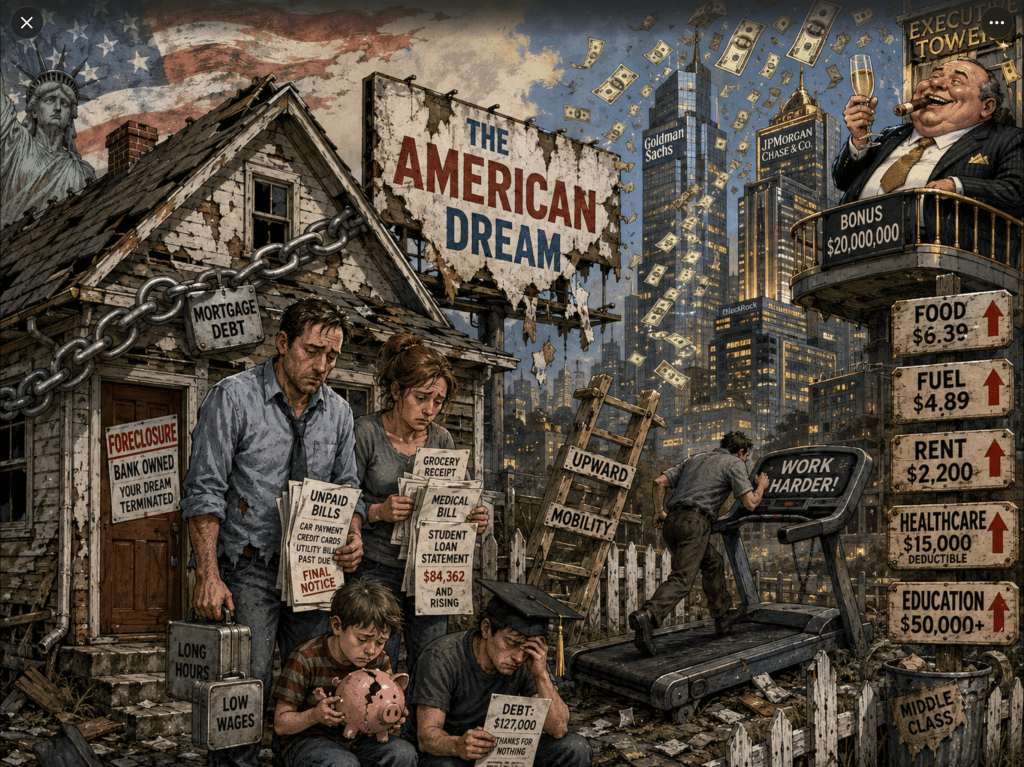
If you’re looking for when the American Dream began to crack, circle 1973 in red ink.
For roughly three decades after World War II, the bargain was simple: productivity rose, wages followed, manufacturing jobs were plentiful, homes were attainable, and one decent income could often support a family.
Then America kept getting richer — while workers stopped receiving the memo.
From the mid-1970s onward, productivity continued climbing, but typical worker compensation increasingly fell behind. The economic pie grew dramatically; executives, shareholders and asset owners simply claimed larger slices.
By 1979–1980, the wobble had become a structural shift.
Congratulations, America — You’re Rich! Unfortunately, You’re Not America
The American Dream was never really about becoming a billionaire.
It was about working hard, earning a decent living, buying a home, raising a family, taking the occasional holiday and retiring without selling a kidney.
Wild stuff.
From roughly 1945 to 1973, that arrangement worked for millions of Americans. Then came oil shocks, inflation, deindustrialisation, declining union power, globalisation, deregulation, outsourcing and a minimum wage that increasingly behaved like an antique decorative object rather than an economic floor.
Manufacturing communities were told not to worry. The factories might disappear, but everyone could apparently become a software engineer, financial consultant or inspirational LinkedIn entrepreneur. 🧑💻✨
Detroit lost production lines. Wall Street discovered derivatives.
Seems fair.
By the 1980s and 1990s, America remained extraordinarily prosperous — but prosperity was becoming increasingly selective.
Cheap credit helped conceal the change:
Can’t afford something? – Borrow.
Can’t afford university? – Borrow.
Can’t afford a house? – Borrow.
Can’t afford healthcare? – Good news: there’s another payment plan.
Meanwhile, executive compensation and investment wealth launched like a SpaceX rocket while ordinary wages waited at the departure lounge, wondering whether their flight had been cancelled.
Then came the 2000s.
China entered the WTO. Manufacturing employment faced further disruption. Housing became not just somewhere to live, but an investment vehicle, retirement strategy and national casino with granite countertops.
Then, in 2008, the casino caught fire.
Millions of households lost wealth while the financial system received emergency life support — because apparently capitalism becomes socialism whenever the important people start losing money.
Housing recovered. Stocks recovered. Banks recovered.
Asset owners recovered magnificently.
First-time buyers were left playing America’s newest national game:
Guess Which Shed Costs $650,000.
Healthcare, university, housing and childcare costs climbed. Wages occasionally glanced upward to maintain plausible deniability.
The crucial point is that America did not become poor.
It became richer than ever, producing Apple, Microsoft, Nvidia, world-leading universities, gigantic financial markets and fortunes large enough to make medieval emperors look financially insecure.
The problem was not wealth creation.
It was distribution.
The economy stopped converting enough of its extraordinary growth into ordinary wages, affordable homes and broad economic security.
That is modern America’s central contradiction: the country can produce artificial intelligence, reusable rockets and trillion-dollar corporations while millions of workers stare at Zillow listings thinking:
“Perhaps my children could inherit this studio apartment if three generations contribute.”
The American Dream was not murdered in one dramatic moment. It was converted into a subscription service.
Around 1973, the free trial began expiring. By 1980, the credit card was firmly on file.
🔥 Challenges 🔥
If America became vastly richer over the last fifty years, why has economic security become harder for so many ordinary workers?
Was 1973 the decisive break — or did deindustrialisation, globalisation, financialisation and soaring housing costs finish the job?
And the biggest question:
If the economy keeps growing while ordinary people struggle to buy homes, raise families and retire securely, who exactly is that growth serving? 🇺🇸💥
👇 Drop your verdict in the blog comments — not just on Facebook. Like it, share it, challenge it, or tell us where you think the American Dream went off the rails.
The best comments, arguments and beautifully savage observations will be featured in the magazine. 🎯📝


Leave a Reply