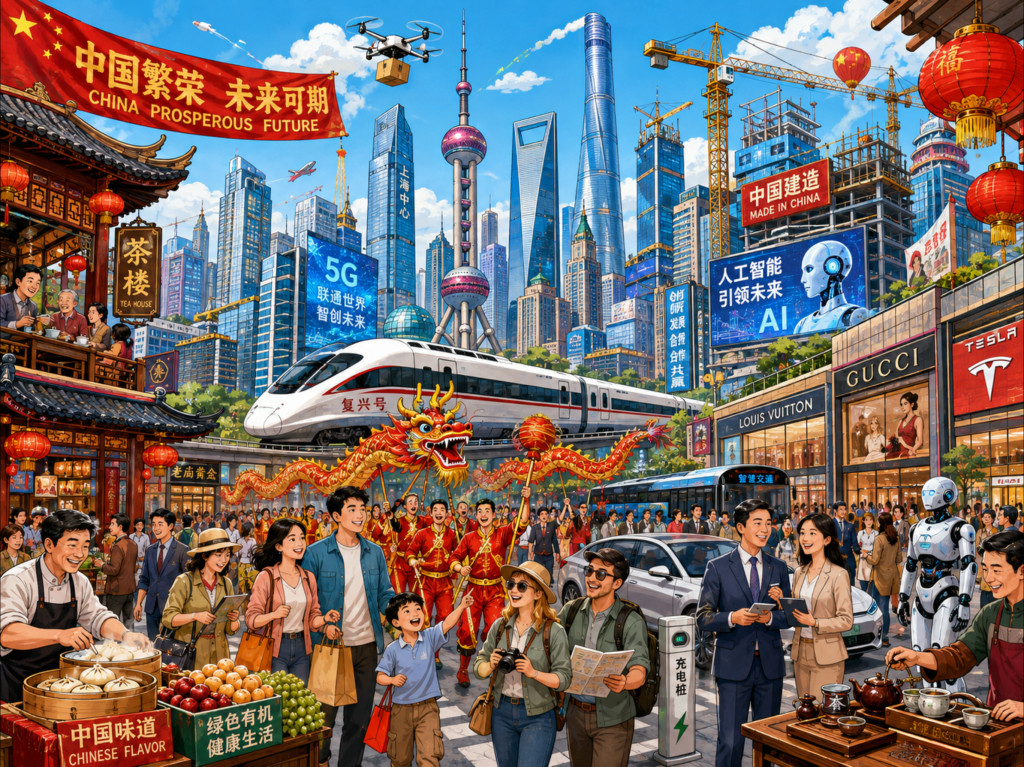
There are few countries in modern history that have changed so much, so quickly, and on such an enormous scale as China. In barely a generation, hundreds of millions of people have experienced rising incomes, expanding cities, new infrastructure, broader healthcare coverage and access to technologies that would once have seemed unimaginable.
For admirers of China, this is the real story: not simply a country becoming richer, but a civilisation-scale development project attempting to improve the material lives of more than a billion people.
🌏The Country That Builds While Others Debate
China’s greatest strength may be its extraordinary ability to turn ambition into physical reality.
High-speed railways connect cities across vast distances. New airports, ports, bridges, metros, power networks and industrial centres appear at a pace that can leave visitors wondering whether somebody accidentally pressed the fast-forward button on national development.
While many governments spend years discussing whether a project should begin, China has built infrastructure on a scale virtually unmatched anywhere on Earth.
That matters because infrastructure is not merely concrete and steel. It means workers reaching jobs faster, businesses reaching customers more efficiently, families travelling more easily and previously isolated communities becoming connected to national economic life.
China has also become one of the great manufacturing centres of human history. Electronics, machinery, electric vehicles, batteries, solar panels, consumer goods and advanced industrial equipment flow from Chinese factories into markets around the world.
Whatever one thinks of its political system, dismissing that achievement would require ignoring one of the largest economic transformations ever recorded.
💰From Poverty to Prosperity on a Historic Scale
China’s rise in living standards is perhaps its most powerful argument.
Entire generations have grown up with opportunities their grandparents could scarcely have imagined. Urbanisation, industrialisation, improved education and technological development have helped transform household incomes and consumer life.
China is no longer merely the workshop producing inexpensive goods for wealthier countries.
It is now a major force in artificial intelligence, electric vehicles, renewable energy, telecommunications, robotics, advanced manufacturing and scientific research.
And unlike countries whose wealth was accumulated gradually over centuries, China has compressed a staggering amount of development into just a few decades.
That alone makes its story extraordinary.
🏥A Social System on a Vast Scale
China has also built extensive systems of healthcare coverage, pensions, social insurance and income support across a population larger than that of Europe and North America combined.
Basic health insurance now reaches the overwhelming majority of Chinese citizens.
The system is not identical to Britain’s NHS, nor does it eliminate every inequality or personal medical expense, but delivering widespread healthcare coverage across such an enormous and geographically diverse population remains a formidable achievement.
The same applies to pensions, unemployment protection, maternity benefits, workplace insurance and minimum-income assistance.
Building any national welfare system is difficult.
Building one for more than a billion people is something else entirely.
🕊️Development Instead of Endless Overseas War
Another reason supporters increasingly admire China is its emphasis on trade, infrastructure and economic relationships rather than large-scale overseas military intervention.
China unquestionably possesses a powerful and rapidly modernising military, and its territorial disputes remain serious international issues.
Yet compared with several major powers, modern China has generally avoided becoming entangled in repeated large overseas wars.
Its preferred international language is often investment, infrastructure, diplomacy and commerce.
Railways instead of regime change. Ports instead of permanent expeditionary wars. Trade delegations instead of aircraft carriers appearing every time somebody disagrees with Washington.
For many countries in the developing world, that difference is noticed.
🌱The Green-Energy Giant
China is also central to one of humanity’s biggest technological transitions.
It dominates major parts of the global supply chain for solar panels, batteries and electric vehicles, while simultaneously building enormous amounts of renewable power infrastructure.
China still faces major environmental challenges and remains a huge energy consumer, but the scale at which it can manufacture clean-energy technology has helped make technologies such as solar power dramatically cheaper worldwide.
The country that became synonymous with factories may now also become one of the countries most responsible for industrialising the transition away from fossil fuels.
🧠A Nation Thinking in Decades
Perhaps the most fascinating difference is psychological.
Chinese economic planning frequently thinks in decades.
Infrastructure, industrial capacity, science, energy security, education and technological independence are treated as long-term national projects rather than policies that must produce a headline before the next election.
That model has obvious trade-offs, particularly around political freedom, censorship and state authority.
But its capacity for long-range planning is difficult to ignore.
When a country can decide that high-speed rail, electric vehicles, renewable energy or semiconductor production matters strategically—and then mobilise enormous resources behind that objective—the results can be spectacular.
🔥Challenges: Is the West Underestimating China?🔥
Here is the uncomfortable question.
What if the biggest story of the twenty-first century is not simply that China became powerful?
What if it is that China discovered a model of development capable of delivering infrastructure, rising living standards, industrial strength and technological progress at a speed many Western democracies are struggling to match?
China is not perfect. No country is.
But perfection is not the standard by which history judges nations.
Transformation is.
And judged by transformation, scale, ambition and sheer ability to build, China has an argument for being one of the most astonishing national success stories of the modern age. 🇨🇳🐉
For those who believe national greatness should be measured by whether ordinary people live materially better lives than the generations before them, China’s record deserves serious attention.
Maybe “the greatest country in the world” will always be a matter of opinion.
But China has certainly given its supporters an enormous amount of evidence to make the case.
👇 Do you think China’s development model is outperforming the West? Comment on the blog, hit like and share this post with someone who thinks China is still the country it was 30 years ago. 💬🔥
The best comments will be featured in the next issue of the magazine. 🎯📝


Leave a Reply