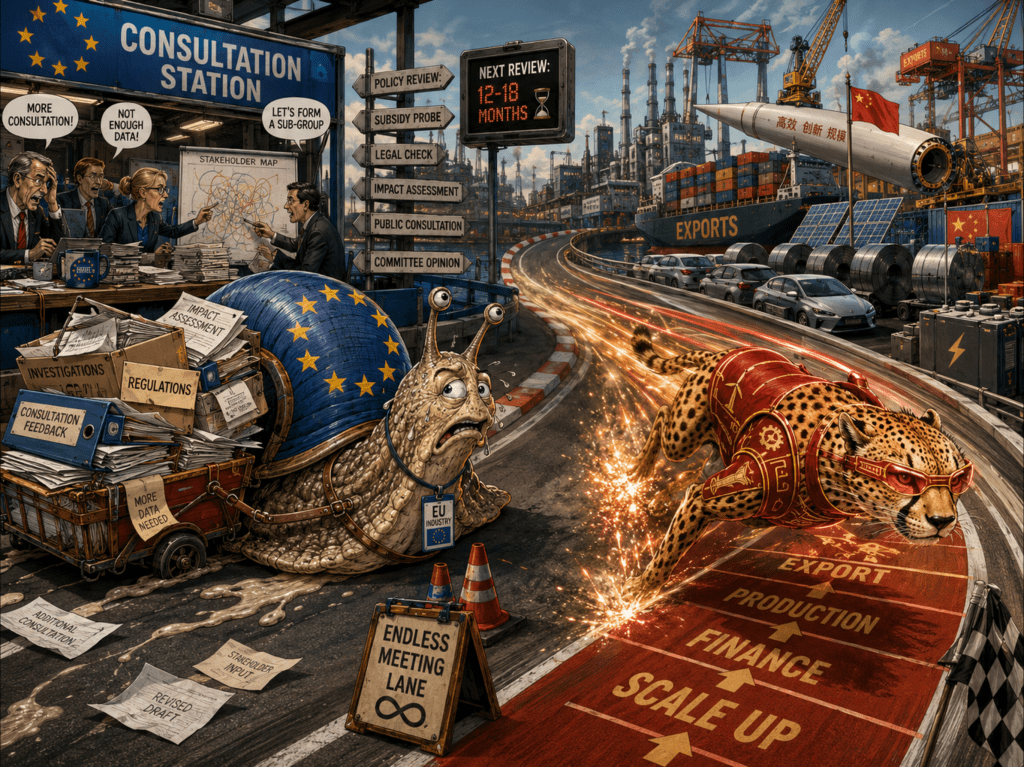
The European is failing in its duty make its citizens richer or better off, with the massive deficit they have with China they have shown that their parliament is running on snail juice while China is running off super fuel.
Europe does not have a China problem because nobody saw China coming.
Europe has a China problem because everybody saw China coming, wrote several excellent reports about it, held a conference, commissioned another report—and then apparently went for lunch. 🍷📚
China can identify a strategic industry, mobilise capital, expand manufacturing, build supply chains and attack export markets at astonishing speed.
Europe can identify the same strategic industry and, with equal determination, schedule a stakeholder consultation for next Thursday.
That difference is becoming painfully expensive.
Only days ago, German industrial leaders were publicly demanding that Chancellor Friedrich Merz take a tougher line on China, warning about state subsidies and unfair competition. Germany’s goods-trade deficit with China reached €89.3 billion in 2025, as imports from China rose while German exports to China fell sharply. (Reuters)
Across the EU, the goods-trade deficit with China reached €359.9 billion in 2025. That is not a rounding error. That is an industrial alarm bell approximately the size of Luxembourg. 🔔💶 (Trade and Economic Security)
⚙️ Beijing Has an Industrial Strategy. Brussels Has a PDF Strategy.
This is where the joke stops being particularly funny.
China is not simply exporting cheaper products. It has spent years building interconnected industrial capabilities: batteries, electric vehicles, solar manufacturing, robotics, electronics, drones, critical-material processing and increasingly sophisticated advanced manufacturing.
Industrial strength compounds.
Build enormous battery capacity and you develop better battery engineers.
Build millions of electric cars and you strengthen motors, power electronics, software, automation, robotics and supply networks.
Build those supplier ecosystems and the expertise does not politely remain inside one industry.
It migrates.
Meanwhile Europe often behaves as though every industrial threat has arrived independently in a small envelope requiring a separate regulatory response.
Chinese EV problem? – Investigation.
Foreign subsidies? – Investigation.
Dumped tyres? – Investigation.
Strategic dependency? – White paper.
Collapse of European industrial competitiveness? – Excellent news—we’ve established a task force.📋🥳
At some point, Europe may achieve the world’s first carbon-neutral industrial decline entirely compliant with all applicable regulations. 🌱📉
And the maddening thing is that European policymakers largely understand the problem.
Mario Draghi’s landmark competitiveness work laid out many of Europe’s structural weaknesses and the scale of investment required to address them.
The diagnosis was not exactly:
“Everything is fine. Perhaps another cookie directive.”
The diagnosis was closer to:
Europe must dramatically improve investment, innovation, productivity and its ability to act collectively—or risk falling further behind.
Yet Reuters reported in January that only around 10% of Draghi’s recommendations had been implemented. (Reuters)
Ten percent.
Europe has apparently discovered the geopolitical equivalent of buying a gym membership, attending once, and wondering why China still has bigger industrial muscles. 🏋️♂️🇨🇳
The Commission’s Spring 2026 forecast now expects EU GDP growth of only 1.1% in 2026, down from 1.5% in 2025, amid a tougher economic environment and renewed energy pressures. (EU Commission Cyprus)
The question is how much more slowly can Europe afford to move when industrial advantages compound over decades?
Because Europe’s greatest vulnerability may not ultimately be Chinese efficiency.
It may be European hesitation.
China does not necessarily have to defeat European industry.
Europe may prove perfectly capable of doing that itself—one consultation, compromise, delayed investment decision and beautifully formatted competitiveness report at a time.
🔥 Challenges 🔥
Here’s the uncomfortable question Brussels would probably rather refer to a subcommittee:
At what point does “free trade” become economic self-harm when one side is pursuing a coordinated industrial strategy and the other side is mainly regulating the consequences?


Leave a Reply