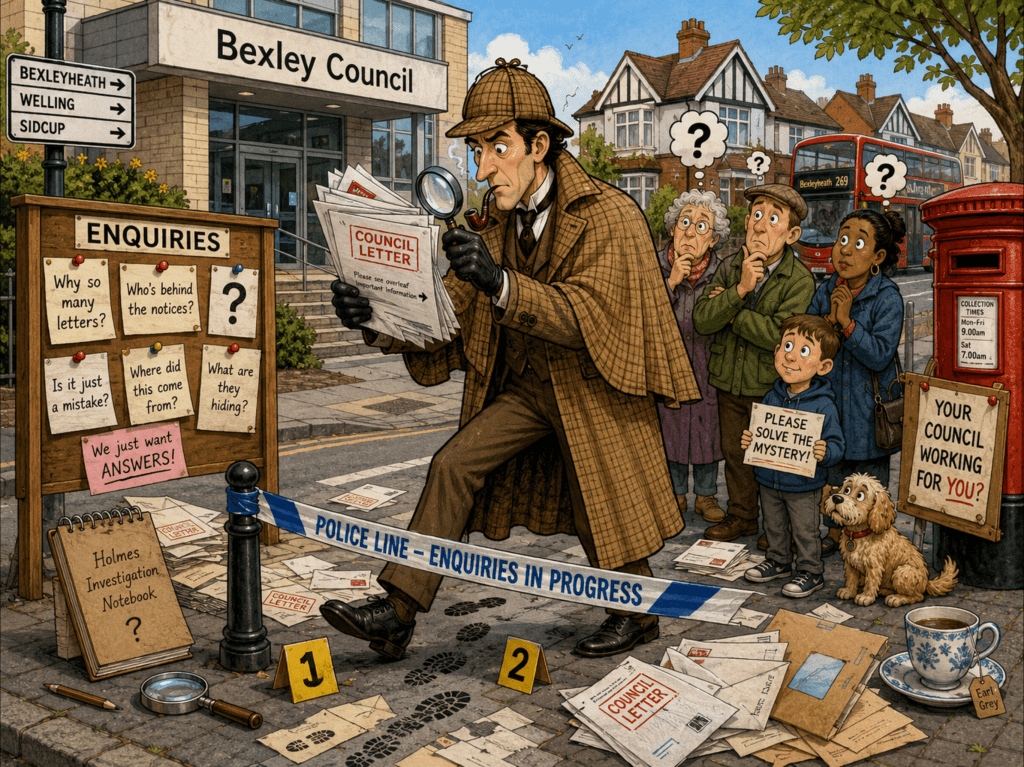
🔎📬Something extraordinary landed on the doormats of residents in Bexley this week. This was not simply another inflammatory Facebook post or anonymous screenshot—it was a physical letter.
Titled “Neighbourhood Notice – New Residential Occupancy,” dated 24 August 2026, the document purported to tell residents that asylum seekers were to be housed locally, describing the supposed occupants as men aged around 19 to 40.
Then came the warnings.
Parents were advised to keep young daughters indoors where possible. Women and girls were told to dress modestly, with long skirts or trousers and covered shoulders. Residents were also warned about dogs, advised to secure pets, cars, windows, bicycles, garden tools and other property.
Those were not rumours added later. They were warnings contained in the letter itself.
The document also looked official. It reportedly carried Bexley Council branding, used the name of a real council officer and contained genuine council email addresses. Most importantly, it was physically delivered through residents’ doors.
One woman who received it decided to check whether it was genuine.
The Phone Call That Changed the Story
She contacted Bexley Council directly.
According to her account, she was initially told that the letter appeared to be from the council and was asked whether she wanted to make a complaint.
Only later was she told that it was a hoax.
That chronology matters.
The letter arrived. She contacted the council. She was initially told it appeared genuine. Later, she was told it was not.
After that came Bexley Council’s public statement saying the document had not been issued by the council and that the matter had been referred to the Metropolitan Police.
The obvious question is simple:
What happened between that first contact and the later conclusion that the letter was not genuine?
At present, that has not been publicly established.
There is no need to invent an explanation. That is something further investigation should clarify.
A Physical Document at the Centre of the Story
Strip away the social-media arguments and one fact remains: a physical document carrying official-looking council information was delivered to homes.
Someone created it.
Copies were produced.
Someone distributed them.
Who did that, why they did it, and whether the creator had any connection to Bexley Council remain unanswered questions.
Bexley Council has publicly denied issuing the letter, but that does not identify who did.
The Police Investigation
The Metropolitan Police has opened a malicious-communications investigation.
Police said the document incorrectly purported to come from the local council and that officers were working with residents. At the latest reported stage, no arrests had been announced.
The investigation now has to establish where the document came from, how many copies were produced, who distributed them and why particular areas were selected.
Until then, speculation is no substitute for evidence.
The Consequences
A document appearing to carry the authority of a council can have serious consequences.
It can frighten residents, create suspicion, direct hostility towards asylum seekers who had nothing to do with the document and undermine trust in genuine council communications.
If residents can no longer easily distinguish between authentic and fabricated correspondence, confidence in public institutions is damaged too.
That is why identifying the source matters.
Waiting for the Evidence
The unresolved questions remain straightforward.
Who created the document?
Who produced and distributed the copies?
Why were those locations selected?
And what established the change between the woman’s initial contact with Bexley Council and the later declaration that the document was a hoax?
Until those questions are answered, the story remains unfinished.
A remarkable letter containing extraordinary warnings was physically delivered to homes in Bexley. A resident contacted the council and was initially told it appeared genuine before later being told it was not. Bexley Council denied issuing it, police are investigating, and the missing piece remains the same:
Who created it—and why?
🔥 Challenges: Bexley Deserves the Full Story
What happened between that first telephone call and the later denial? Who produced the letters? Who delivered them? And what will the police investigation uncover?
Read more at chameleon-news.com


Leave a Reply