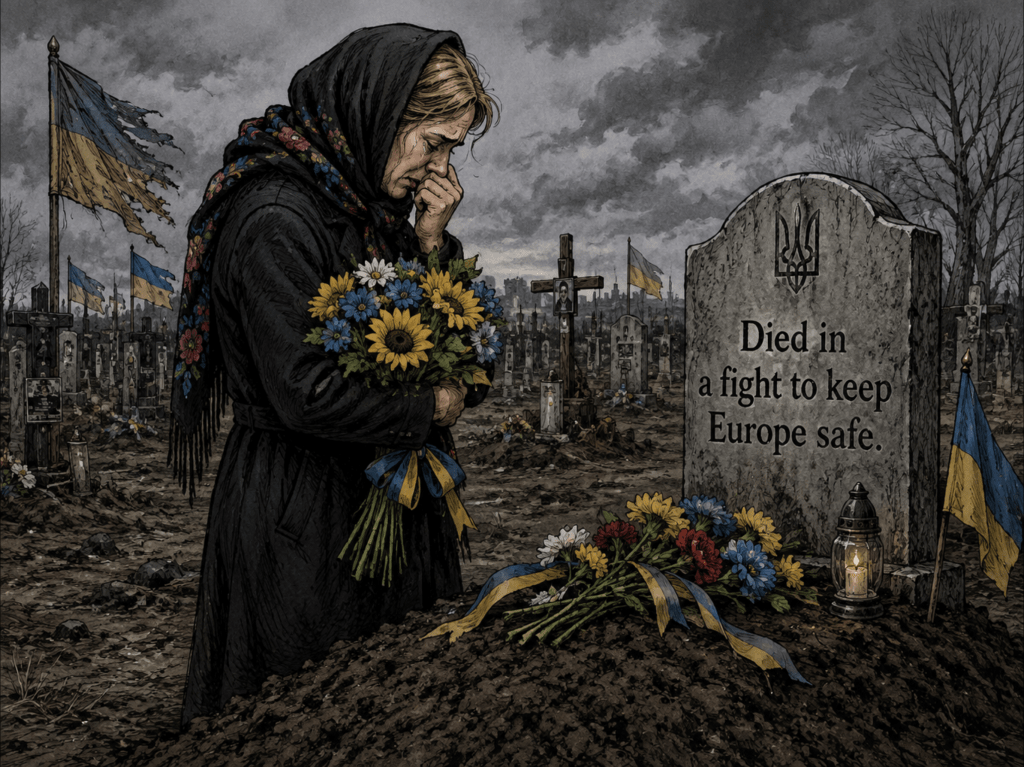
European leaders increasingly say that Ukraine is not merely defending itself.
They say Ukraine is defending Europe.
They say Ukraine is protecting the European security order.
They say Ukraine is holding back Russia.
They say Ukraine’s resistance is buying Europe time.
Fine.
Then here is the question nobody at the polished summit table seems particularly eager to answer:
If this is really Europe’s war for security, why are Ukrainian mothers and fathers still expected to provide most of the sons and daughters who die in it?
That question is not pro-Russian.
It is not anti-Ukrainian.
It is not anti-European.
It is simply the question sitting underneath every speech about “shared security” that suddenly becomes rather less shared when the casualty lists arrive. 🪖
🇪🇺 Europe Wants the Security — But Who Pays the Human Price?
Europe provides billions.
Europe provides weapons.
Europe provides ammunition.
Europe provides training.
Europe provides intelligence.
Europe provides speeches containing the words “solidarity,” “freedom,” “values” and “for as long as it takes.”
Ukraine provides the funerals.
And at some point, somebody ought to ask whether that arrangement has become politically convenient.
If Ukrainian soldiers are genuinely defending Warsaw, Berlin, Paris, Brussels and London, why are European politicians not standing before their own populations and saying:
“This is our fight too, and one day your children may have to fight it.”
Why not?
Because that would change everything.
It is easy to support a war when somebody else’s family receives the folded flag.
It is easy to describe the battlefield as essential to European civilisation when your own children are still planning university, holidays, careers and weekends away.
It is easy to demand courage from people living 1,000 miles east of your own front door.
So how far does Europe’s commitment really go?
Would European governments send their own soldiers into combat?
Would they introduce conscription?
Would they tolerate tens of thousands of European military casualties?
Would European parents accept their sons and daughters dying outside Kharkiv because a politician said the front line there was really the front line of Europe?
If the answer is no, then an awkward question follows:
How can European leaders demand that Ukraine continue making sacrifices they are unwilling to ask of their own populations?
🔥 There it is.
The question buried underneath the diplomatic language.
🕯️ What Does “For As Long As It Takes” Actually Mean?
Politicians love this phrase.
“For as long as it takes.”
Sounds magnificent.
Resolute.
Historic.
Churchillian.
Until you ask:
Takes what?
Another year?
Five years?
Another hundred thousand casualties?
Another generation injured, displaced or traumatised?
Another family receiving photographs instead of a son?
Another child growing up without a father?
Does “for as long as it takes” mean until Ukraine regains every inch of territory?
Until Russia collapses?
Until negotiations begin?
Until Europe decides enough blood has been spilled?
Until the United States changes policy?
Who decides?
European politicians?
American politicians?
Ukrainian politicians?
Ukrainian soldiers?
Or Ukrainian parents?
Because if Europe keeps encouraging resistance while refusing direct military participation, then Europeans should at least be brave enough to acknowledge what that strategy means.
Europe is asking Ukraine to continue carrying risks Europe itself considers too dangerous to carry.
Perhaps there are good strategic reasons.
Direct European intervention could create a wider Russia-NATO war.
That could become catastrophic.
Nobody sensible should casually demand that.
But if direct participation is judged too dangerous for European soldiers, why is continued participation somehow automatically acceptable for Ukrainian soldiers?
That contradiction deserves more than another blue-and-yellow profile picture.
👩👦 Do Ukrainian Parents Really Get a Say?
Here is perhaps the most uncomfortable question of all.
What does a Ukrainian mother actually want?
Not the government.
Not NATO.
Not Brussels.
Not Washington.
The mother.
Does she want her 22-year-old son to continue fighting because European officials believe his sacrifice strengthens European deterrence?
Does a Ukrainian father believe his daughter should risk never coming home because allowing Russia to advance could eventually make Europe less secure?
Perhaps many do.
Perhaps many genuinely believe there is no alternative.
Perhaps many see resistance as the only way Ukraine survives as a sovereign country.
Their agency matters enormously.
But surely they are entitled to ask:
Are our children fighting primarily for Ukraine now — or have they also become the unpaid infantry of Europe’s security strategy?
And if Europe benefits from that sacrifice, what does Europe owe the families left behind?
Money?
Pensions?
Housing?
Education for children?
Permanent financial support?
Citizenship?
Reconstruction?
Or merely another politician arriving in Kyiv, placing a wreath, staring solemnly at the cameras and flying home before dinner? 📸🌹
Because “Europe stands with you” sounds rather different when you are standing beside a grave.
💰 Follow the Money — But Also Follow the Coffins
There is endless discussion about how much Europe is spending.
Billions here.
Aid packages there.
Defence funds.
Ammunition initiatives.
Reconstruction plans.
Military procurement.
Politicians boast about the numbers as evidence of commitment.
But money is not blood.
A missile can be replaced.
A tank can be rebuilt.
A budget can be revised.
A dead 24-year-old cannot be restored by a supplementary spending package.
So perhaps every announcement of another military commitment should come with another figure alongside it:
How many more human lives is Europe expecting Ukraine to risk in order to achieve the political objective attached to that money?
Nobody can predict that exactly.
Which is precisely why the question matters.
Because policy conducted in billions can become dangerously detached from reality measured in funerals.
🪖 If Russia Is Truly an Existential Threat, Where Are Europe’s Armies?
This may be the biggest contradiction of all.
European leaders increasingly speak about Russia as though the future of the continent itself is at stake.
Then behave as though direct confrontation must be avoided at virtually any cost.
Both positions can be understandable individually.
Together, they create a rather large political elephant wandering around Brussels wearing combat boots. 🐘🥾
If Russia is genuinely an existential threat to Europe, why isn’t Europe already on a wartime footing?
Why aren’t populations being prepared for conscription?
Why aren’t leaders openly discussing casualty tolerance?
Why aren’t European armies massing to enter Ukraine?
Why aren’t governments telling citizens:
“Your children may have to die to stop this threat.”
Could it be because European politicians know perfectly well that public support would look very different the moment European body bags started arriving?
And if so, doesn’t that reveal something rather important?
Perhaps the strongest support for war exists precisely where the personal cost remains safely theoretical.
🏛️ Democracy Means Asking Before the Coffins Arrive
European citizens deserve clarity too.
What exactly are they being committed to?
Unlimited military spending?
Permanent confrontation with Russia?
Ukrainian EU membership?
Security guarantees?
European troops after a ceasefire?
European troops during a future Russian attack?
Conscription?
A permanently militarised continent?
These are enormous choices.
Yet too often the debate is reduced to one crude moral test:
Support Ukraine completely, or you’re helping Putin.
That is not serious democracy.
A citizen should be able to support Ukraine’s right to defend itself while still asking:
How does this end?
What is the objective?
What is the maximum cost?
Who bears that cost?
And what happens if the strategy fails?
Questions are not betrayal.
Sometimes questions are what prevent governments from walking confidently into disasters while insisting everyone applaud.
🔥 Challenges: Questions Brussels Would Probably Rather You Didn’t Ask
If Ukraine is defending Europe, why aren’t European soldiers defending Ukraine?
If sending European troops is too dangerous, why isn’t prolonging the danger to Ukrainians equally troubling?
If Ukraine’s war is essential to European security, should Europe financially support Ukrainian bereaved families for life?
If politicians say “for as long as it takes,” should they be forced to define exactly what victory means?
If European governments would never accept the casualty levels Ukraine has endured, what moral authority do they have to encourage Ukraine to continue indefinitely?
If negotiations are eventually inevitable, how many people should die before discussing them becomes respectable?
If Ukrainian lives are protecting European security, does Europe owe Ukraine far more than weapons and reconstruction money?
And perhaps the ugliest question:
**Has


Leave a Reply