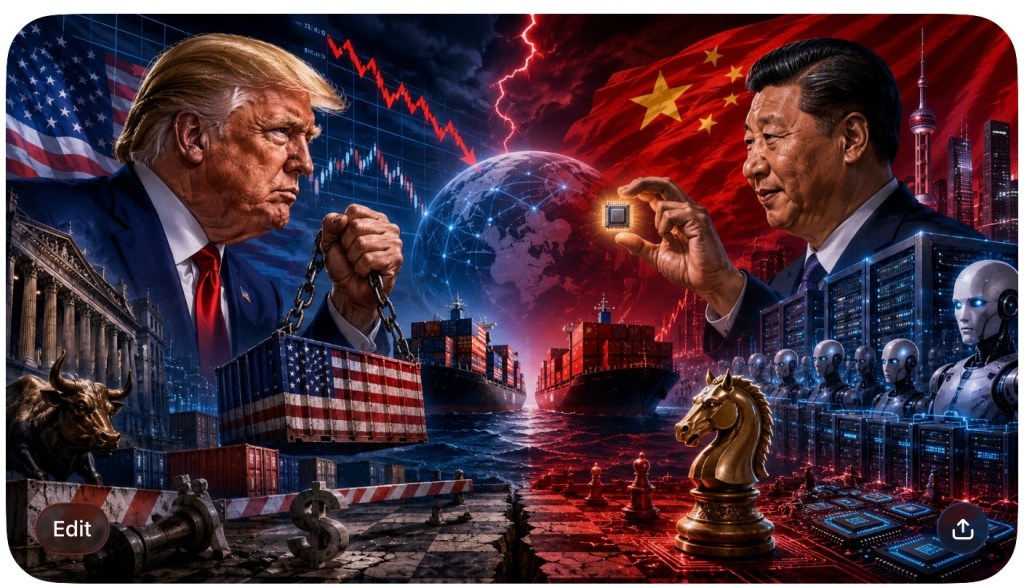
America has spent decades setting much of the pace in technology, finance and global influence. Under Donald Trump, tariffs and restrictions have again become central tools in dealing with China. Washington says it is protecting American industry and national security. Beijing sees a country trying to slow its rise.
That is why the argument about artificial intelligence is so interesting.
China does not need America to collapse. That would damage China too. The two economies are still deeply connected through trade, manufacturing, finance and consumer demand. The more believable possibility is that China wants to reduce America’s ability to dominate the relationship.
AI could help it do that.
The Expensive American Bet
The United States is pouring extraordinary amounts of money into AI. Data centres, advanced chips, power infrastructure and huge corporate investment are all being justified by the belief that artificial intelligence will generate enormous future profits.
That creates opportunity, but it also creates vulnerability.
China does not necessarily need to build better AI. It may only need to build AI that is good enough and dramatically cheaper.
If that happens, American companies can still produce excellent technology and AI can still transform the world. But customers may begin asking why they should pay premium prices when capable alternatives cost far less.
Then the real problem is no longer whether AI works.
It becomes whether the profits justify the vast sums being spent.
History has shown that revolutionary technology does not always produce revolutionary returns for investors. The internet changed the world, yet many companies disappeared after the dot-com boom. AI could also become essential while becoming cheaper and less profitable.
A Different Kind of Retaliation
This is where Trump’s tariffs become relevant.
A trade war does not have to mean one tariff answered by another. If America makes Chinese exports more expensive, China could compete aggressively in an industry where America has placed enormous amounts of capital and confidence.
Cheap AI could become a form of economic pressure.
The aim would not have to be destroying American technology companies. Simply forcing them to cut prices, narrow margins and spend more to defend their position could be enough.
If investors then decide that future AI profits will be smaller than expected, highly valued technology shares could come under pressure.
There is no proof that China is deliberately trying to damage Wall Street through low-cost AI. But Beijing certainly understands the advantage of making its technology cheaper, more widely used and less dependent on American systems.
If that also weakens America’s competitive advantage, China is unlikely to complain.
The Real Contest Is Over Influence
The deeper struggle may not be about destroying one another at all.
It may be about deciding who gets to set the rules.
America has long been accustomed to enormous influence over trade, finance and technology. China increasingly wants a larger voice.
AI is now another arena in that contest.
China does not need to become number one overnight. It only needs to make American dominance less certain. If American companies are forced to charge less, spend more and compete harder, the balance has already shifted.
And if countries around the world begin using Chinese AI because it is cheaper and easier to access, China gains influence without firing a shot.
A Quiet Warning to Washington
Perhaps China’s message is not that America no longer matters.
Perhaps it is that America is no longer the only country that matters.
Trump can impose tariffs. Washington can restrict chips. America can try to slow Chinese technology.
But China can also look for areas where America has overcommitted itself.
AI may be one of those areas.
If America has invested huge sums on the assumption that AI will remain highly profitable, then cheaper Chinese competition could become an effective way of applying pressure without wrecking the wider relationship.
The danger for America may not be that China destroys its AI industry.
It may simply be that China makes AI cheaper, more competitive and less profitable than Wall Street expected.
And if that happens, the technology could still change the world while the investors who paid the highest price discover that being first does not always mean making the most money.
🔥 Challenges
Perhaps this is less about China trying to beat America and more about China trying to rebalance the relationship. If tariffs are intended to remind Beijing of American power, cheap AI could become Beijing’s way of reminding Washington that pressure works both ways.
The real question is whether America has become too confident in the future profits of AI and underestimated what aggressive Chinese competition could do to those expectations.
💬 Leave your thoughts in the blog comments, like the article and share it.
The best comments will be included in the next issue of the magazine. 📝🔥


Leave a Reply