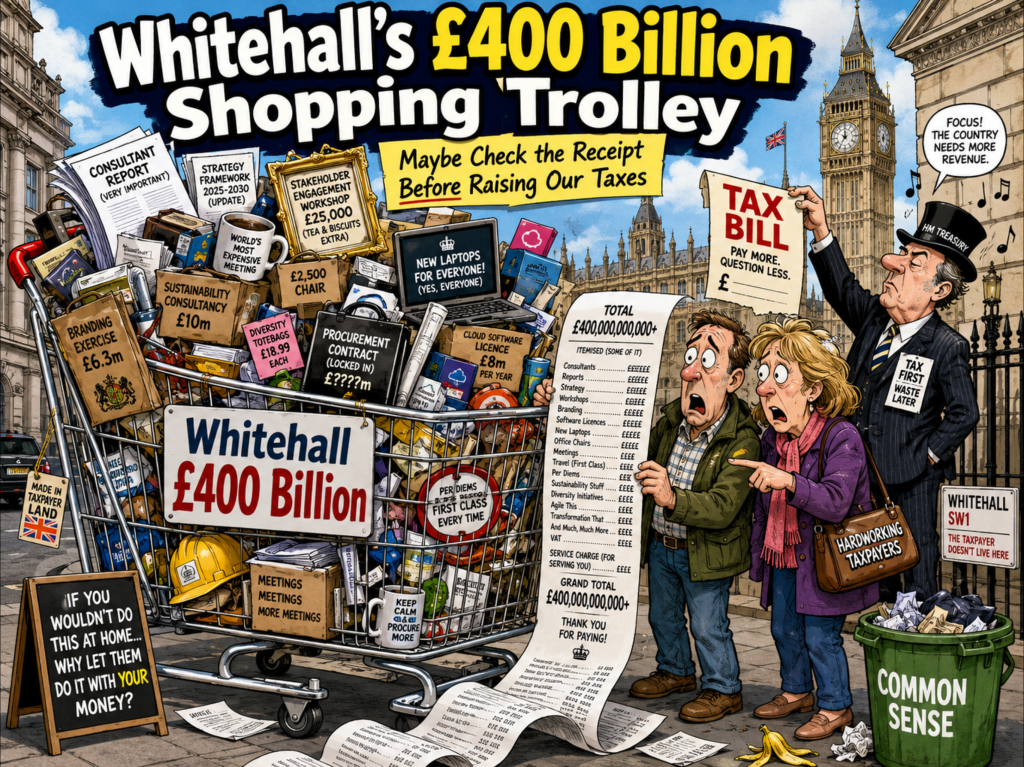
🛒💷Before the government reaches into the public’s pocket for another tax rise, perhaps it could try something truly revolutionary: checking what it already spends.
Britain’s public sector buys hundreds of billions of pounds’ worth of goods and services every year. Much of that spending is essential. But spread it across departments, agencies, quangos, contractors, consultants and enough procurement teams to populate a small principality, and something rather predictable happens.
One department pays one price. Another pays more. Somebody renews a contract nobody can properly justify. Five departments buy five versions of the same software. Consultants become permanent furniture. And somewhere in Whitehall, an invoice sails through because apparently “that’s what we paid last year” now counts as economic strategy. 📑🤡
The answer? A national Procurement Control System.
🤖 Let the Algorithm Ask the Awkward Question: “Why Are You Paying THAT Much?”
Every significant government purchase should feed into one central system showing what is being bought, who is buying it, what it costs, which supplier is getting paid, what comparable departments are paying, when contracts expire and whether government already owns something that does the same job.
Then let AI loose on the data.
Not to replace ministers. Not to sack procurement staff. Not to let ChatGPT order aircraft carriers from Temu. 🚢📦
Its job would be far simpler: spot obvious nonsense before the money disappears.
If one department pays £500 for something another buys for £300, flag it.
If five departments separately license the same software, suggest one national deal.
If a consultancy contract keeps getting renewed while its “measurable outcomes” remain as mythical as a competent train timetable, challenge it.
If invoices suddenly creep above agreed rates, catch them.
If one branch of government is about to buy a system another branch already owns, wave a giant digital red flag before taxpayers fund Version Two of Something We Already Have. 🚨
Humans would still make the important decisions. The machine simply provides something government procurement has traditionally struggled to achieve at scale: comparison, visibility, memory and the ability to ask, “Hang on, why?”
And crucially, this is not austerity.
Nobody needs to cut pensions. Nobody needs to slash benefits. Nobody needs to cancel an operation, close a ward or tell a nurse that efficiency means sharing one biro between twelve people.
This is about government behaving like Britain’s biggest customer instead of thousands of unrelated shoppers wandering around with the same taxpayer-funded credit card.
On procurement of roughly £400 billion a year, a 2% improvement would represent around £8 billion. A 5% improvement would be around £20 billion.
Should ministers promise those savings immediately? Absolutely not.
That would be classic Whitehall: announce the miracle before building the machine. 🎩✨
Instead, build it. Measure it. Publish the numbers. Show which contracts improved, which duplications disappeared and what money was genuinely saved.
Then let the evidence speak.
🔥Challenges🔥
Here’s the question ministers should have to answer before demanding another penny from working people:
If government cannot explain why it is paying the price it pays, why should taxpayers automatically be asked to cover the difference?
Would a national AI-powered procurement watchdog save billions — or would Whitehall simply invent a £900 million consultancy programme to investigate why the £500 stapler cannot be replaced with the £300 stapler? 😏
Drop your verdict in the blog comments. Tell us where government procurement goes wrong, where national purchasing could work, and which contracts you think deserve a much brighter spotlight. 💬🔦
👇 Comment, like and share this post. If taxpayers are footing the bill, taxpayers deserve to see the receipt.
The best comments, sharpest arguments and most savage observations will be featured in the magazine. 🎯📝


Leave a Reply