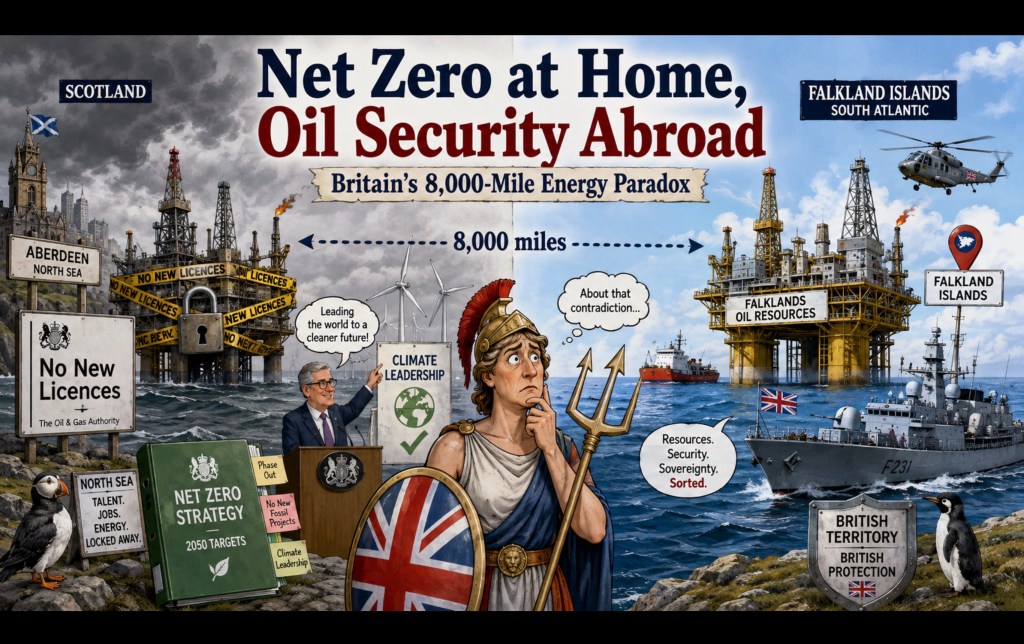
🛢️🇬🇧Britain’s energy politics have stumbled into the sort of contradiction a satire writer usually has to invent. At home, new North Sea oil and gas development faces an increasingly hostile political and regulatory climate, wrapped in arguments about climate responsibility, transition, and leaving hydrocarbons behind. Yet thousands of miles away in the South Atlantic sits British territory whose surrounding waters contain potentially substantial oil resources — territory Britain would unquestionably be expected to defend if Argentina ever tried to seize it by force.
The point is not that Britain would “go to war for oil.” The legal and political justification would be defending British territory and the Falkland Islanders’ right to determine their own future. But once energy enters the picture, the optics become magnificently awkward.
🛢️Apparently Oil Gets Greener the Further South You Sail
🌍Britain: “We need to move beyond North Sea oil.”
Argentina: “Excellent. We’ll have the Falklands, then.”
Britain: “Steady on. Nobody touches that oil.” 🚢💥
And suddenly geography appears to have developed its own climate policy.
A barrel extracted near Aberdeen is apparently a moral emergency. A barrel extracted roughly 8,000 miles away in waters Britain might ultimately defend with destroyers, aircraft and troops? Well, presumably that barrel has completed some sort of carbon absolution ceremony while crossing the equator.
Perhaps emissions now operate on airline-miles logic. ✈️🌱
The further your hydrocarbons travel from Westminster, the less guilty everyone feels about them.
Of course, the serious issue underneath the joke is much sharper. If policymakers believe producing additional oil is environmentally unacceptable because it is oil, then the location shouldn’t magically change the ethical argument. Carbon dioxide does not stop at the Scottish border, check its passport and politely become somebody else’s problem.
Yet Britain risks creating an energy policy in which domestic production is politically discouraged while overseas resources remain strategically valuable enough to sit beneath territory protected by British military power.
That is less “energy transition” and more “energy relocation with a naval escort.” ⚓🛢️
You can oppose new North Sea drilling. You can support it. You can argue that declining domestic production is necessary for climate targets. All perfectly legitimate positions.
But it becomes considerably harder to explain why extracting oil beside Scotland is presented as environmentally backward while extracting oil beside the Falklands can coexist comfortably with maintaining the military capability necessary to defend the territory surrounding it.
Maybe the UK’s new energy doctrine is simply:
Don’t drill here. Drill somewhere dramatically more complicated. 🤡
🔥Challenges🔥
So here’s the question nobody should be allowed to dodge: if a new barrel of oil is environmentally unacceptable in the North Sea, why does that moral argument change when the same barrel comes from the South Atlantic?
Is Britain genuinely reducing its dependence on oil — or merely making sure somebody else produces it somewhere further away?
Drop your take in the blog comments. Is this sensible climate strategy, unavoidable geopolitics, or one of those contradictions Westminster hopes nobody notices until somebody draws a map? 🗺️💬
👇 Comment, like and share — especially if you think energy policy should survive contact with basic geography.
The best comments will be included in the magazine. 🎯📝


Leave a Reply