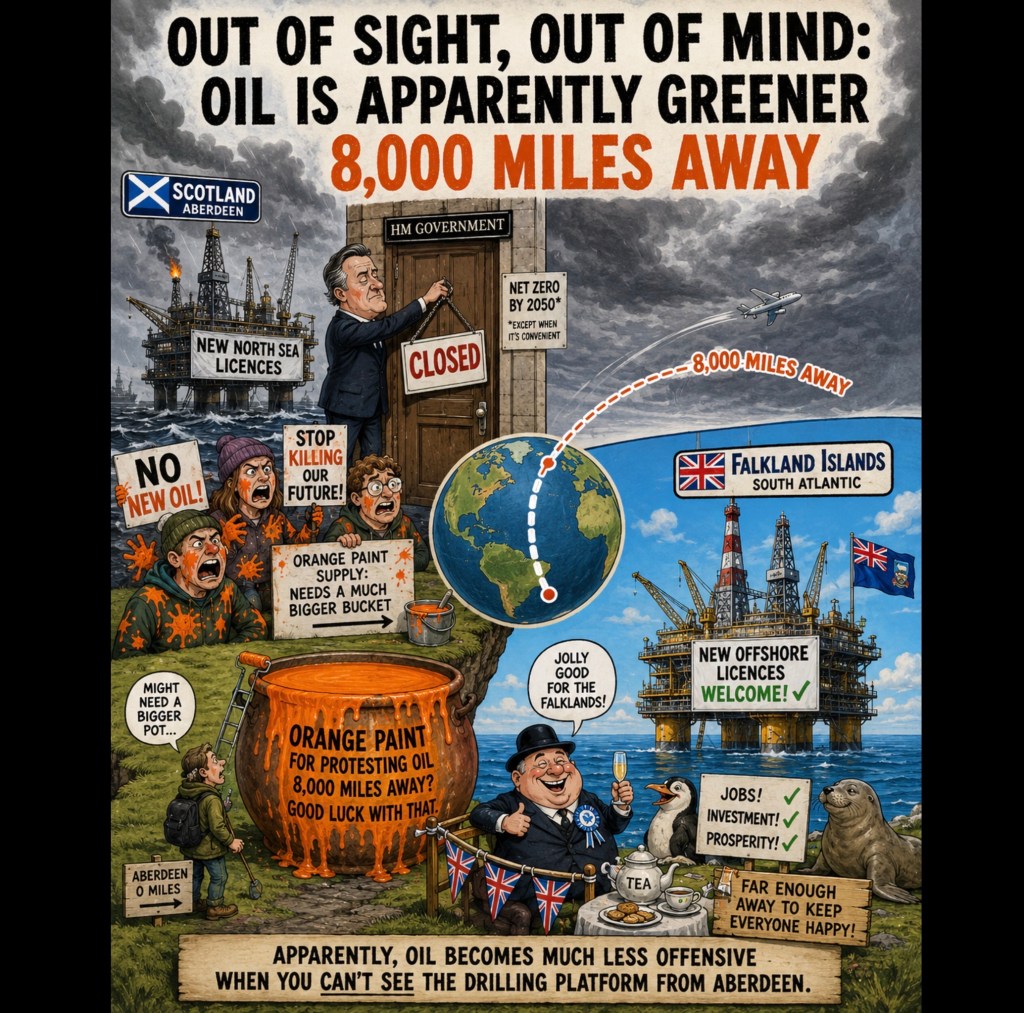
The Falklands are getting increasingly serious about offshore oil while back in Scotland the UK government is closing the door on new North Sea exploration.
Well, I suppose the Falklands are far enough away that Just Stop Oil would need a considerably bigger pot of orange paint.
Apparently, oil becomes much less offensive when you cannot see the drilling platform from Aberdeen.
The UK government has committed itself to issuing no new licences to explore new North Sea oil and gas fields, arguing that Britain should move towards cleaner energy and demonstrate climate leadership. Existing fields can continue producing, but the direction of travel is clear: less new exploration around Britain. (GOV.UK)
Meanwhile, thousands of miles away, the Falkland Islands have substantial offshore oil ambitions of their own, most notably the Sea Lion development.
And suddenly the conversation sounds rather different.
Oil near Scotland?
Climate emergency.
Oil near the Falklands?
Strategic economic opportunity.
Perhaps carbon dioxide has finally learned geography.
Maybe a barrel produced beside Aberdeen is environmentally irresponsible, but if you sail it several thousand miles south into the Atlantic first, it acquires an entirely different personality.
The strangest part is that Britain is not actually going to stop using oil and gas simply because we stop looking for more of it beneath British waters.
The government itself acknowledges that oil and gas will remain part of the UK’s energy mix for decades. (GOV.UK)
So the question becomes wonderfully simple.
If we still need it, where exactly would we prefer it came from?
Because refusing to explore for oil does not make the demand disappear.
It can simply mean somebody else produces it.
Then we buy it.
Then we transport it halfway around the world.
Then we congratulate ourselves for reducing domestic fossil-fuel production.
That is a particularly sophisticated form of environmental accounting:
don’t produce the carbon here — import the product instead.
Scotland, of course, might reasonably look at all this and ask another question.
What about the jobs?
What about Aberdeen?
What about the offshore engineering companies, supply vessels, fabrication yards, technicians, geologists and thousands of workers whose expertise was built around the North Sea?
The government says those workers will transition towards offshore wind, hydrogen, carbon capture and other future industries.
Perhaps they will.
But workers cannot pay today’s mortgage with tomorrow’s hydrogen economy.
Meanwhile, somewhere near the Falklands, people are discussing oil development with considerably more enthusiasm.
Perhaps that is the new British energy policy:
North Sea oil — dirty.
South Atlantic oil — apparently far enough away not to count.
And there may be one additional advantage.
If protesters decide to glue themselves to the road outside the drilling operation, somebody should probably remind them to pack sandwiches.
It is a very long walk from London.
Out of sight.
Out of mind.
And apparently, possibly, out of the carbon calculation too.


Leave a Reply