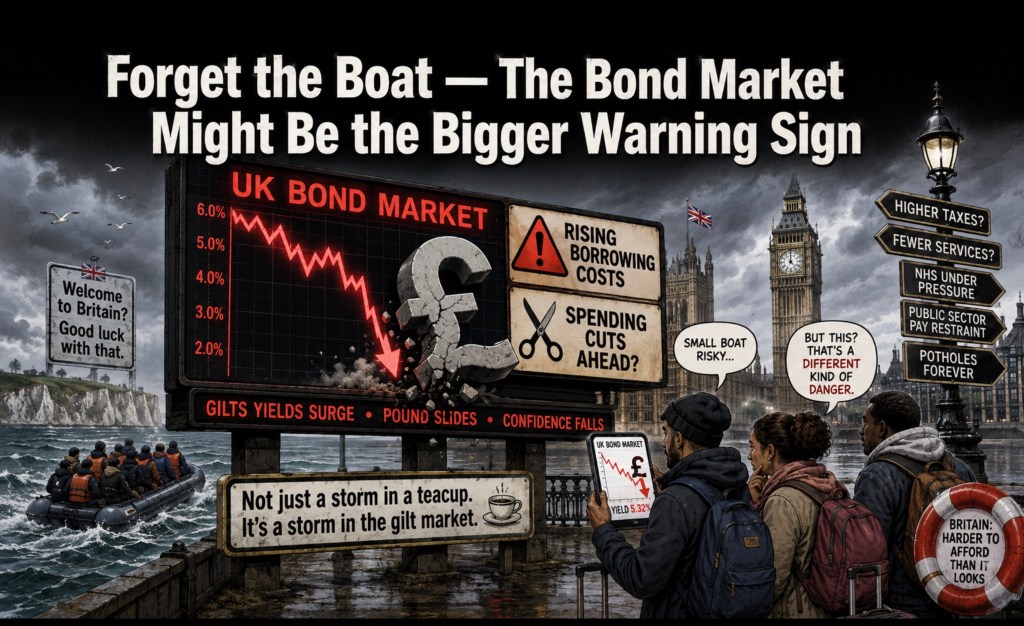
Migrants considering coming to the UK may be looking at something far more important than the dangers of crossing the Channel.
They may be looking at the money.
The political argument in Britain is obsessed with boats, borders and deterrents, but anyone paying attention to the UK’s financial position can see another risk building in the background.
If the bond market is signalling trouble, borrowing is becoming more painful and the government is under increasing financial pressure, then the conclusion is not particularly difficult to reach:
the money is going to have to tighten.
And that matters.
💷 The Real Warning Might Be Coming From the Markets, Not the Channel
Imagine somebody considering coming to Britain and watching the situation from abroad.
They do not just see the pictures of small boats.
They see the government under pressure.
They see borrowing costs causing problems.
They see politicians arguing over money they increasingly do not have.
And they can work out what comes next.
Cuts.
Not because ministers suddenly discover a passion for financial discipline.
Because eventually the numbers stop asking politely.
When a government is in crisis, it cannot keep promising unlimited spending forever. Something has to give, and once markets start applying pressure, politicians tend to discover the phrase “difficult decisions” with remarkable speed. 📉
That is where the calculation for some migrants could change.
The danger is no longer simply:
“Can I survive the journey?”
It becomes:
“What exactly am I arriving to?”
A country where public spending may be reduced?
A government forced to tighten support?
Services under even greater pressure?
A political environment where every pound suddenly becomes the subject of an argument?
That is a very different proposition.
For years, Britain has acted as though migration decisions are made in complete isolation from economics.
As though people planning to come here somehow never read the news, never watch what governments are doing and never notice when a country begins to look financially unstable.
Apparently, according to Westminster logic, somebody can plan a journey across half a continent but cannot look at a bond chart. 📱📊
That assumption may be badly wrong.
If people believe that Britain is heading towards spending cuts because the government is losing financial room to manoeuvre, then the attraction changes.
Why take enormous risks to reach a country where the government itself may soon be deciding what it can no longer afford?
And this is the irony Westminster may not want to discuss.
Politicians have spent years trying to invent deterrents.
The bond market may be doing the job for them.
No slogans.
No new legislation.
No minister standing beside a podium announcing another “tough new plan”.
Just investors looking at Britain and effectively saying:
“We’re going to need a bit more interest if you want to keep borrowing like that.” 💷
And suddenly the government has a problem.
Because once borrowing becomes more difficult, political promises become much easier to make than to fund.
That is the real issue.
A government in financial crisis eventually has to decide where the money stops.
And people outside Britain can see that coming just as clearly as people inside it.
Perhaps the ultimate deterrent was never the danger of the boat crossing.
Perhaps it is arriving at the other side and discovering that the country you risked everything to reach is already preparing to tighten the purse strings. 🎒📉
🔥 Challenges 🔥
So here is the question:
Could Britain’s bond-market problems start influencing migration decisions before any new border policy does?
If migrants believe government spending is going to be cut because the financial pressure is becoming too great, does the UK suddenly become a much bigger gamble?


Leave a Reply