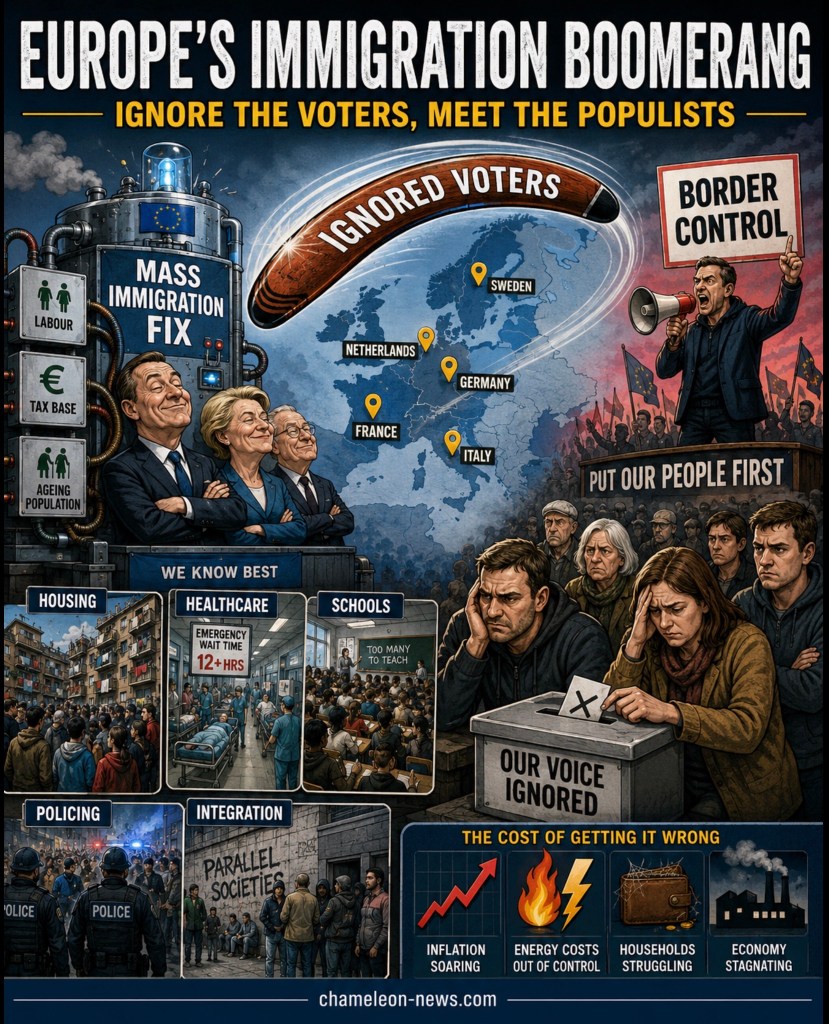
For years, much of Europe’s political establishment treated large-scale immigration like a multifunctional economic gadget: plug the labour shortage, patch the ageing population, keep the tax base humming, and apparently nobody would ask too many awkward questions.
Except voters did. Loudly. 📢
The argument now gaining traction is brutally simple: when governments increase migration while housing, healthcare, schools, policing and integration systems are already groaning, public enthusiasm can evaporate faster than a manifesto promise after election day.
And when mainstream parties appear unwilling—or unable—to tighten migration policy, some voters start shopping elsewhere politically. Enter the populists, stage right, carrying a border-control pledge in one hand and a megaphone in the other. 🎤🚧
🚨 The Political Establishment Built the Ladder — Then Complained About Who Climbed It
Germany offers one of the clearest examples of the argument.
The right-wing parties have increasingly benefited from anger over asylum policy, border management and dissatisfaction with the political establishment, particularly in parts of eastern Germany.
The irony is difficult to miss.
Mainstream politicians spend years warning voters that supporting right-wing parties would be irresponsible, while some voters respond: “Fine—but who else is actually listening to us?”
Across Europe, variations of the same political drama have played out in Italy, the Netherlands, Sweden and France, where right-wing parties have gained substantial electoral influence by promising tighter borders, stricter asylum policies and tougher integration requirements.
Apparently, repeatedly telling voters that immigration concerns are exaggerated is not quite the electoral masterstroke somebody thought it was. 🤷♂️
But immigration alone does not explain Europe’s political earthquake.
Economic anxiety is throwing petrol on the bonfire. Inflation, energy costs, stagnant wages and industrial decline have left many communities wondering why their governments seem capable of designing continent-wide policy frameworks but struggle with the exotic administrative challenge of keeping living standards rising.
Democracy, but with increasingly complicated seating arrangements.
Meanwhile, mainstream parties have noticed something extraordinary: voters complaining about migration may actually expect politicians to change migration policy.
Germany’s CDU/CSU and SPD, along with governments elsewhere in Europe, have consequently moved toward tougher measures—including stricter asylum rules, temporary internal border controls and faster deportation procedures.
Which raises the obvious question:
If these policies are sensible now, why were people demanding them previously so often treated as though they had arrived at the debate wearing Viking helmets and carrying pitchforks? 🪓
Europe’s political establishment may ultimately discover that populism is not defeated merely by condemning populist parties.
Sometimes you have to address the conditions that made people vote for them.
🔥 Challenges 🔥
Here’s the uncomfortable question: did Europe’s mainstream parties accidentally manufacture their own populist opposition by refusing to respond quickly enough to public concerns over migration, integration and living standards?
That argument is only getting louder—and the next elections across Europe could make it impossible to ignore. 👀🗳️


Leave a Reply