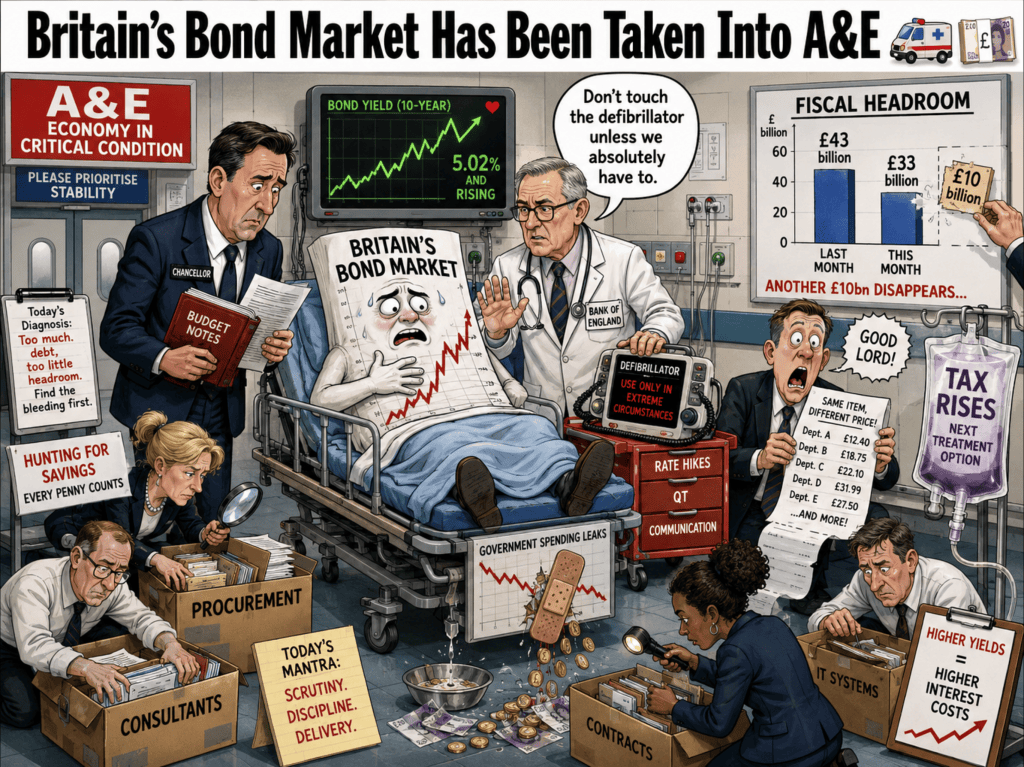
Britain’s bond market has developed chest pains.
The government says everything is under control, the Chancellor is checking the notes, and the Bank of England is standing beside the emergency trolley saying:
“Don’t touch the defibrillator unless we absolutely have to.”
First, they will avoid emergency treatment. The Bank of England can buy government bonds if markets become seriously dysfunctional, but it is unlikely to intervene simply because investors are charging Britain more interest.
Next comes reassurance. The Chancellor tells the bond market:
“Borrowing is under control. Debt is under control. Nothing to worry about.”
Meanwhile, somebody quietly removes another £10 billion from the fiscal headroom chart.
Then comes the search for savings.
Departments are told to find efficiencies. Consultants, contracts, procurement and IT systems are reviewed. Somebody may even discover that five government departments have been buying the same thing at five different prices.
This is the stage where ministers discover the revolutionary concept of checking the receipt.
If that does not produce enough money, the next treatment is taxes.
They may be called “revenue measures”, “fiscal adjustments”, “closing loopholes” or “ensuring everyone contributes fairly”.
But if more money leaves your pocket and enters the Treasury, most people will recognise the medical terminology:
Your wallet has been operated on.
If bond yields keep climbing, the treatment becomes serious.
Higher yields mean Britain pays more interest to borrow. More interest means less money for everything else.
That can mean higher taxes, spending cuts, cancelled projects and wonderful new government programmes suddenly developing a condition called “no longer affordable”.
The bond market does not care about political speeches, manifestos or whether spending is described as “investment” or “transformation”.
It asks one question:
If I lend you money, am I confident you can pay me back without destroying the value of what I lent you?
If the answer becomes less convincing, investors demand more interest.
The sensible emergency treatment is therefore simple:
Before raising taxes, find out where government is wasting money.
Before cutting frontline services, find out why departments are paying different prices for the same things.
Before asking taxpayers for another pound, find out where the last pound went.
Fix procurement. Cut duplicated systems. Reduce unnecessary consultancy. Control contracts. Stop paying premium prices simply because the customer is the government.
There are two ways to treat Britain’s bond-market patient:
More tax. More cuts. More painkillers. Hope for the best.
Or:
Find the bleeding first.
And if gilt yields keep rising towards genuinely dangerous territory, one thing becomes clear:
The Chancellor may technically write the Budget.
But the bond market will be standing over his shoulder holding the pen.


Leave a Reply