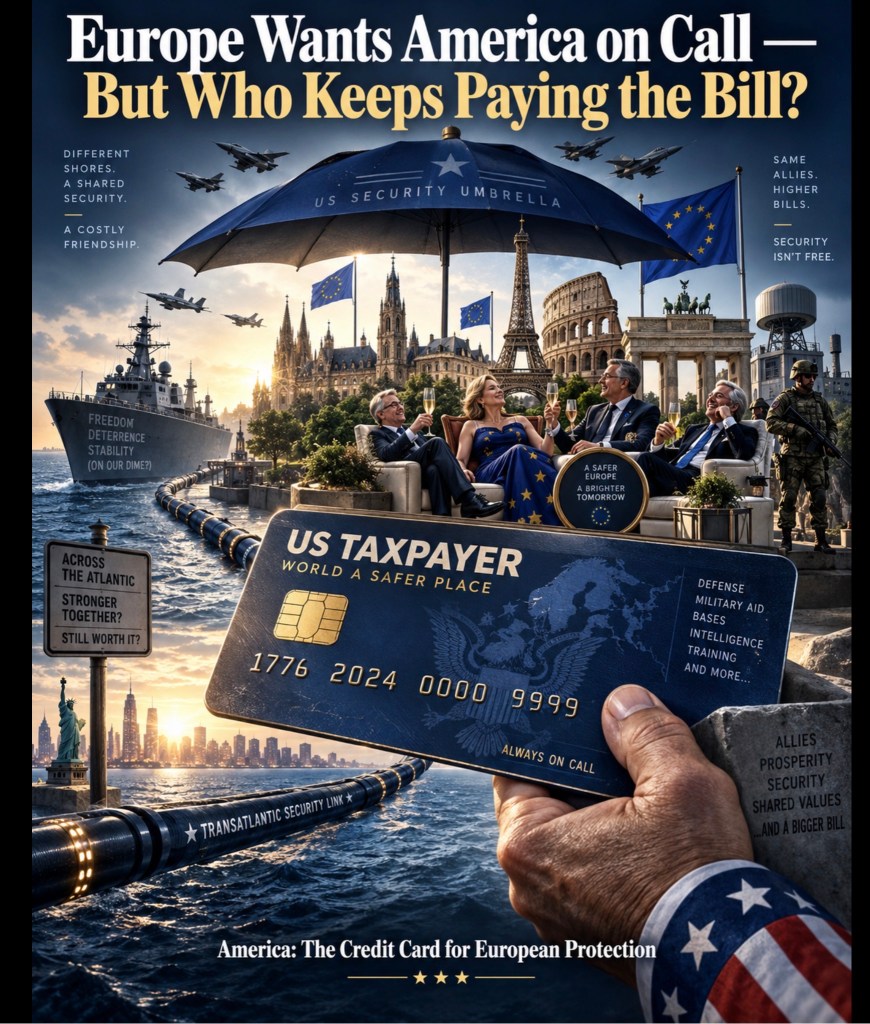
🇺🇸💵🇪🇺There is a question sitting underneath the latest argument between America and Europe that politicians on both sides of the Atlantic would probably rather avoid: how long is the American taxpayer expected to keep underwriting European security when Europe increasingly wants to decide for itself when solidarity with America is convenient?
This is bigger than one president. It is about the ordinary American who gets up, goes to work, pays federal taxes and is repeatedly told that maintaining the security of some of the richest countries on Earth is part of America’s permanent responsibility.
For decades, American taxpayers have helped finance troops, aircraft, naval forces, intelligence networks, logistics systems and nuclear deterrence across Europe. That protection has become so familiar that it is easy to forget the obvious: somebody pays for it.
That somebody is the American taxpayer.
The Pentagon does not run on good intentions. Aircraft carriers do not sail on summit statements, fighter jets are not fuelled by speeches about solidarity, and nuclear deterrence does not appear because Brussels issued another communiqué. Defence costs money, and much of that money comes from people thousands of miles away from Europe.
💸 Uncle Sam’s European Direct Debit
That is what makes the argument over Iran and the Strait of Hormuz so revealing. When Europe faces a serious security problem, there is little confusion about what America is expected to do. Washington must remain committed, deter Russia, support NATO, back Ukraine and never send a signal that could weaken European security.
But when America asks European allies to support a dangerous strategic confrontation affecting one of the world’s most important shipping routes, the language suddenly becomes foggier. There are calls for more meetings, more clarity, more consultation and more time to consider how complicated military involvement can be.
From the kitchen table of an American family, the contrast is hard to miss. When Europe needs American strength, urgency and solidarity are essential. When America asks for something in return, hesitation suddenly becomes a virtue.
That same family is helping finance Europe’s defence while European governments increasingly talk about strategic independence from Washington. Fine. Be independent. But independence normally comes with one awkward detail: eventually, you have to pay your own bills.
That is where Europe’s argument starts to wobble. Strategic independence can sound suspiciously like wanting freedom from American influence without freedom from American protection. Europe wants to make its own decisions, pursue its own foreign policy and refuse involvement in conflicts it regards as somebody else’s problem. Those are legitimate rights, but the American taxpayer is equally entitled to ask why their money should continue guaranteeing the security of governments that treat their obligations to America as optional.
That is not isolationism. It is arithmetic.
The transatlantic alliance has spent decades wrapped in grand language about shared values and shared security, but beneath it all is the less glamorous question of who pays for the ships, missiles, bases, aircraft, troops and ammunition. For generations, the United States carried a huge share of that burden while many European governments enjoyed the luxury of spending elsewhere.
It was a very comfortable arrangement, especially if you were not paying the largest premium.
Of course America benefited from NATO. It gained bases, intelligence relationships, strategic reach and geopolitical influence. But those benefits do not erase the cost. Try telling your electricity company that it has benefited from having you as a customer, so you have decided to keep using the power while reconsidering your contribution. See how long the lights stay on.
For years, Washington considered the deal worthwhile. The real question is whether American voters will continue to agree.
That becomes especially awkward when European leaders talk about strategic autonomy. Genuine autonomy means building stronger armies, expanding fleets, producing ammunition, funding missile defence, creating the logistics to sustain a major conflict, paying troops properly, strengthening intelligence capability and confronting the question of nuclear deterrence.
That is what independence looks like in the real world: expensive, difficult and politically uncomfortable.
Strategic autonomy funded indirectly by somebody else’s taxpayer is not strategic autonomy. It is strategic pocket money.
Europe has spent years enjoying the remarkable privilege of criticising American power while relying upon it. Washington can apparently be too dominant and absolutely indispensable at the same time. You have to admire the flexibility. 🇪🇺🎩
The roots of this arrangement go back generations. After the Second World War, America did not simply go home. It helped rebuild Western Europe, kept troops on the continent, helped contain the Soviet Union and placed American military and nuclear power behind NATO.
Europe recovered, became wealthy and built some of the world’s largest economies, yet the American taxpayer remained an essential part of its defence.
At some point, it is reasonable to ask when dependence stopped being temporary and became a lifestyle choice.
Every dollar Washington spends on overseas commitments begins somewhere far less glamorous than a NATO summit. It comes from a worker, a business, a household and ultimately a tax bill.
Those taxpayers are entitled to ask whether an alliance built around mutual defence still contains enough of the word mutual.
If European security is always a shared Western responsibility while American security challenges are matters for European governments to consider at their leisure, the relationship starts looking less like an alliance and more like an insurance policy where one customer pays the largest premium while everyone expects full coverage.
Trump may be voicing that grievance loudly, but the danger for Europe is not one angry president. It is millions of ordinary Americans eventually asking the same question:
Why are we still paying so much for this?
Once that question takes hold, no summit declaration or diplomatic dinner will make it disappear.
Europe may eventually discover that the American security guarantee was never a natural resource. It was something Americans chose to fund and sustain.
And choices can change.
Perhaps that is the real significance of the Iran dispute. Europe has spent decades asking what America owes Europe. It may be time Europe started asking what it owes the American taxpayer.
After eighty years of carrying a very large share of the tab, Uncle Sam may eventually reach for the bill and notice something awkward.
Everybody else seems to have left the restaurant. 🇺🇸🧾
🔥 Challenges
If European governments want the freedom to treat American strategic problems as optional, how long should American workers be expected to keep carrying such a large share of Europe’s security bill?
Imagine you are the person paying. Does the arrangement still look fair?


Leave a Reply