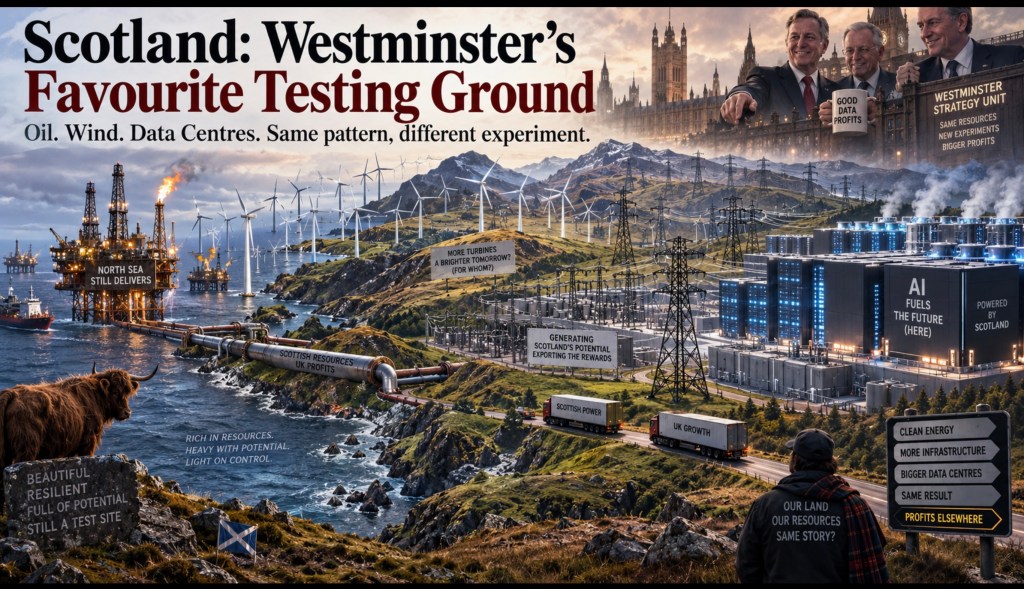
Whenever Westminster comes up with a grand new idea about energy, infrastructure or the future of the economy, Scotland somehow seems to end up being the place where the experiment is carried out.
We had North Sea oil first.
For decades, oil from Scottish waters was treated as a national resource, feeding the Treasury and helping power the UK economy. Then, after years of benefiting from it, politicians decided oil had become an environmental problem. Fair enough, perhaps, if the intention was genuinely to move away from using it.
Except that is not really what happened.
Britain still needs oil, still uses oil and is still quite prepared to import it from abroad. So instead of producing more of what we need closer to home, we increasingly seem happier buying it from somewhere else and pretending that somehow makes the environmental argument cleaner.
Apparently emissions become more acceptable if the oil has travelled a few thousand miles first.
Then came wind power.
Scotland, with its geography and weather, was naturally going to play a huge part in the renewable revolution. Turbines appeared across the landscape and offshore, accompanied by all the usual promises about clean energy, energy security and a greener future.
The trouble was that building the turbines was only half the job.
You also need a grid capable of moving the electricity from where it is generated to where it is needed.
That part somehow did not receive quite the same urgency.
So we ended up in the bizarre position where turbines can be capable of producing electricity, but because the transmission network cannot always cope with it, they are sometimes asked to reduce output and companies are compensated through the electricity market.
It is difficult to explain that to the average person without it sounding ridiculous.
We build renewable generation because we desperately need more electricity, then discover we cannot always move that electricity, so we pay generators when they are told not to produce it.
And these are the same people constantly assuring us that Britain’s energy future is being carefully managed.
Now we arrive at the latest great revolution.
Artificial intelligence.
AI needs enormous computing power, and enormous computing power means enormous data centres. These are not little server rooms hidden behind an office block. The largest developments can consume extraordinary amounts of electricity and require major infrastructure around them.
And suddenly Scotland is once again looking extremely attractive.
Land is available. Renewable generation is available. Grid connections are being expanded. So naturally the next big idea is to start placing large data centres across Scotland.
You can almost see the thought process.
We have already filled parts of Scotland with turbines.
We are already planning more pylons to move the electricity around.
What should we do next?
Perhaps introduce some of the biggest electricity consumers imaginable before the transmission problem has even been fully solved.
What could possibly go wrong?
The supporters will, of course, talk about investment, jobs and economic growth, and some of that may well be true. Scotland should not automatically oppose data centres or AI infrastructure. If the AI revolution becomes as important as many expect, Scotland could benefit enormously from being part of it.
But that is exactly why the public should be asking much harder questions before every proposal is waved through under the banner of progress.
How many permanent jobs will actually be created?
How much electricity will these sites consume?
Who pays for the necessary grid upgrades?
What pressure will they put on local infrastructure?
Will communities receive anything meaningful in return?
And perhaps most importantly, will Scotland own any meaningful part of this new economy, or will it simply provide the land and electricity while the real profits flow elsewhere?
That is the part that feels strangely familiar.
Scotland provided the oil.
Then Scotland provided the wind.
Now Scotland may provide the electricity and physical infrastructure required to power the AI revolution.
There is nothing wrong with Scotland hosting major industries. Quite the opposite. Scotland should be competing aggressively for investment, technology and high-value employment.
But there is a huge difference between hosting an industry and benefiting from it.
If we are going to cover parts of the country with turbines, pylons, substations and enormous data centres, then Scotland should be getting something substantial back beyond another press release about investment and a photograph of politicians wearing hard hats.
Otherwise the pattern continues.
The resource is Scottish.
The infrastructure is Scottish.
The disruption is Scottish.
And somehow the real economic prize always seems to end up somewhere else.


Leave a Reply