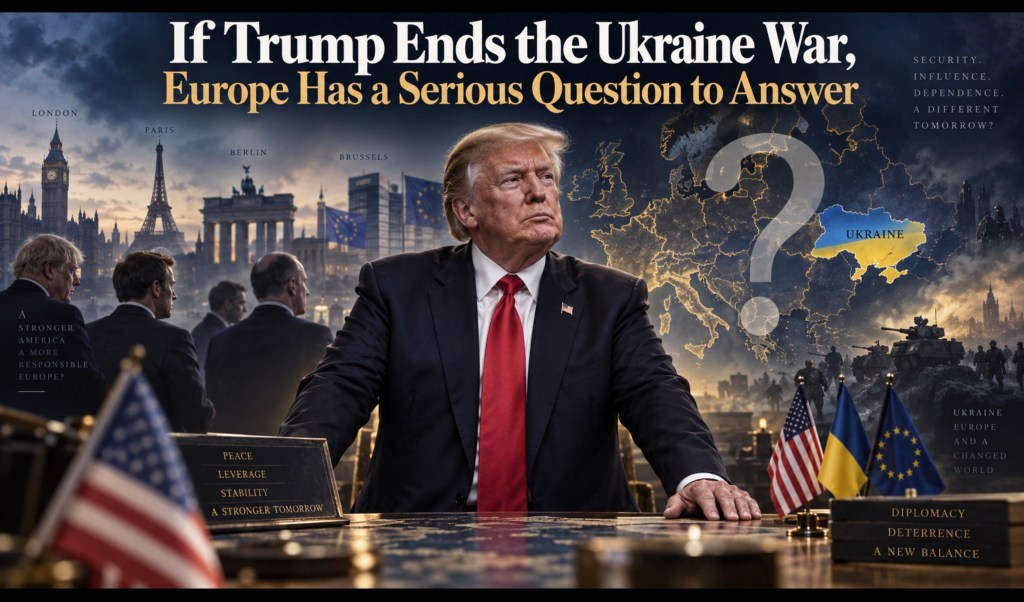
🇺🇸🇪🇺An uncomfortable possibility is emerging around the war in Ukraine. If Donald Trump eventually brokers an agreement that stops the fighting and produces a durable peace, European leaders may have to ask why they could not achieve the same result themselves.
For years, Britain, France, Germany and the European Union have treated the war as a defining European security crisis. They have supplied weapons, imposed sanctions and provided financial support while insisting that Ukraine must shape its own future. Yet Europe’s claim that this is fundamentally a European problem contrasts with its limited ability to influence the war’s outcome without decisive American involvement.
Trump’s approach differs from that of most European leaders. While Europe has focused on supporting Ukraine and isolating Russia, Trump appears more willing to accept that someone will eventually have to negotiate with Vladimir Putin. That does not excuse Russia’s invasion or justify forcing Ukraine into an unacceptable agreement. It does, however, recognise a basic reality: wars usually end through decisive victory or negotiation.
The United States also has leverage over both sides that no European country can easily match. Washington can pressure Moscow through sanctions, financial restrictions, energy policy, military power and diplomacy. It also retains significant influence over Kyiv through American weapons, intelligence and strategic support. That gives a US president bargaining power that Europe struggles to reproduce while acting through multiple governments and competing national interests.
This is where the idea of European strategic autonomy becomes uncomfortable. European leaders have long argued that the continent should defend its interests without relying so heavily on Washington. Yet Ukraine has provided the greatest test of that ambition in generations. The largest war in Europe since 1945 has unfolded on the continent’s doorstep and has been repeatedly described as a direct threat to European security. If the final settlement is shaped mainly by Washington, Moscow and Kyiv, Europe will have to reconsider how much geopolitical independence it truly possesses.
Europe has played a major role in sustaining Ukraine, and that contribution should not be dismissed. But supporting a war is not the same as possessing enough influence to determine how it ends. If the decisive diplomatic breakthrough comes from across the Atlantic, Europe’s strategic limitations will be difficult to ignore.
Nor should Trump receive automatic credit for producing a ceasefire or securing signatures. A temporary pause could be presented as peace while leaving the conflict’s underlying causes unresolved. If Russia were allowed to rebuild, Ukraine remained permanently vulnerable or the agreement merely postponed another invasion, the celebration would soon look misplaced. The real test would be whether the settlement endured and whether violating it carried consequences strong enough to deter renewed aggression.
A credible agreement would require more than handshakes and speeches. Ukraine would need reliable security guarantees, Russia would need to accept that the settlement could not simply be overturned, and Europe’s security framework would need to become more stable. If Trump achieved that, the consequences for Europe would extend far beyond Ukraine.
The deeper lesson may be that Europe wants the influence of a major strategic power without yet possessing the unified military, diplomatic and political strength to act like one. Britain, France and Germany each have influence, while the European Union has enormous economic weight. But influence divided among capitals is not the same as concentrated strategic power. Europe can issue declarations and commit substantial resources, yet Washington still appears to hold greater leverage when an outcome must be imposed.
The debate, therefore, should not be reduced to whether Trump is a hero or a villain. The more important question is what a successful settlement would reveal about Europe. If the United States brokers a durable peace in a war European leaders have described as central to their security, Britain and the rest of Europe may have to confront the gap between their ambitions and their actual geopolitical power.
🔥 Challenges
If Trump ends the war and the settlement lasts, would that expose a failure of European diplomacy, or prove that only the United States had enough leverage to bring both sides to an agreement? The answer goes beyond Trump, Putin or Volodymyr Zelenskyy. It concerns whether Europe can shape its own security or whether Washington remains the power everyone turns to when the stakes are highest. 💬🔥
Join the discussion in the blog comments, like the post and share it with someone who sees the argument differently.
The best comments and counterarguments will be included in the next issue of the magazine. 🎯📝


 Chameleon Magazine
Leave a comment