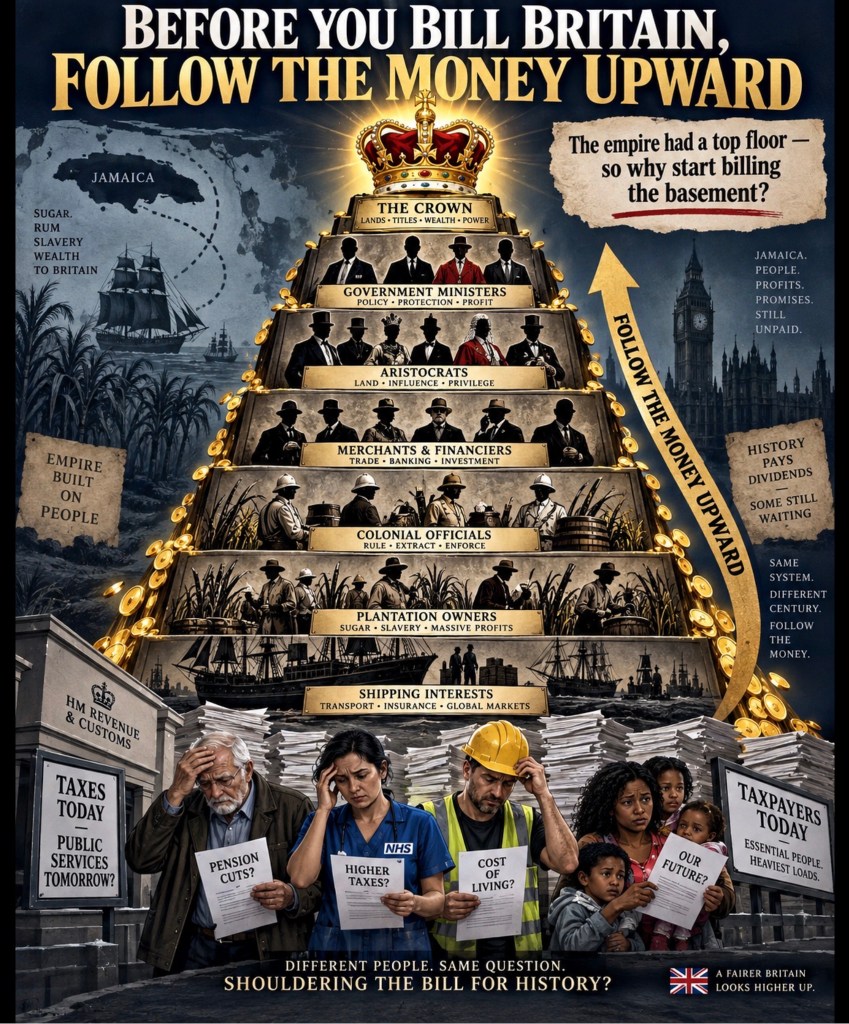
If Jamaica wants to pursue Britain over slavery reparations, then before anybody starts calculating what today’s British taxpayer supposedly owes, there is a fairly obvious question to ask: who actually sat at the top of the system? It wasn’t the pensioner in Newcastle, the nurse in Glasgow, the builder in Birmingham or the family paying tax today. They didn’t own plantations in Jamaica, grant colonial monopolies, appoint governors or accumulate fortunes from enslaved labour.
Yet reparations debates can perform a remarkable historical magic trick. 🎩✨ Centuries of political power, plantations, merchants, financiers, governors, aristocrats and imperial institutions disappear in a puff of smoke, and somehow the bill lands on whoever happens to be standing nearest the modern tax office. Convenient, that.
👑 The Empire Had a Top Floor — So Why Start Billing the Basement?
Britain’s imperial system had a hierarchy. The Royal Family, governments, ministers, colonial administrations, plantation owners, merchants, shipping interests, financiers, landowners and investors. Sitting at the summit of Britain’s constitutional order was the Crown.
That does not mean every slave ship sailed because a monarch personally ordered it, or that every plantation owner received instructions written on royal stationery. History is more complicated than that. But complexity should not become camouflage. For much of the period in which Britain developed and expanded its colonial slave economy, monarchs exercised substantial executive and constitutional power. The Crown appointed ministers and colonial governors, granted charters, sanctioned legislation and stood at the top of the political structure through which imperial authority operated.
So if reparations are genuinely about historical responsibility, perhaps the investigation should begin somewhere slightly more relevant than the pocket of a modern care worker buying groceries. 🛒💸 The sensible approach is to follow the authority, follow the money, follow the property, follow the inheritance and follow the institutions that survived.
Britain itself demonstrated at abolition that it understood the principle of financial compensation. There was just one grotesque problem: slave owners were compensated, while the enslaved received nothing. Imagine stealing someone’s liberty, losing your legal right to continue doing it, and then being handed money for the inconvenience. Even satire struggles to compete with reality. 🤡
If money was historically transferred to slave owners, and parts of that wealth later passed through estates, investments, companies, trusts, businesses and inherited fortunes, why should today’s argument begin automatically with general taxation? Why not trace identifiable historical benefit first? If an estate survived, like the royal estates, investigate it. If a fortune survived, trace it. If a company inherited assets linked to slavery, examine it. If merchant families, shipping interests, insurers, banks, trusts or landholdings benefited from slave-produced wealth, follow the documentary trail.
The same principle should apply to the monarchy. If royal institutions accumulated wealth, property, commercial advantage or political influence through an imperial system in which slavery formed a major part of colonial economics, then those links deserve examination too. No institution should receive a velvet rope around its history simply because it comes with crowns, carriages and ceremonial gold. 👑✨
There is also a rather spectacular contradiction in celebrating centuries of royal continuity when discussing coronations, titles, estates, traditions and inherited constitutional status, while suddenly deciding continuity is terribly complicated when historical responsibility enters the conversation. Apparently continuity lasts hundreds of years when discussing crowns, but when discussing accountability it becomes: “New palace, who dis?” 📱🏰
You cannot endlessly celebrate institutional inheritance while pretending institutional history evaporates whenever the inheritance becomes awkward. If continuity matters, investigate the institution. If inherited wealth matters, investigate the wealth. If property survived, investigate the property. If estates survived, investigate the estates. If companies or successor institutions inherited assets connected to slavery, investigate those connections. And if the Crown stood at the top of the political hierarchy, then the Crown belongs in that examination too.
That is not collective punishment. It is the opposite. It is refusing to pretend historical responsibility works like hereditary council tax. The apprentice electrician whose parents rented a council house did not own a Jamaican plantation. The care worker buying groceries did not grant colonial charters. The boiler engineer did not appoint colonial governors. The single mother paying VAT on school shoes did not sit at the summit of the British Empire.
Ordinary British citizens do not inherit personal guilt simply because they were born centuries later under the same flag. But institutions can possess continuity. States can possess continuity. Monarchies can possess continuity. Estates, trusts, companies and property can possess continuity. And monarchies, rather famously, make continuity one of their biggest selling points. 🏰
So perhaps the uncomfortable question is not simply, “Should Britain pay?” Perhaps it is, “Which part of Britain should be examined first?” Who held the authority? Who accumulated the wealth? Who inherited it? Which institutions survived? Which estates survived? Which fortunes survived? Which organisations can demonstrate continuity from that period into the present? And above all, who sat at the top of the political tree while Britain’s imperial system operated?
Before anybody sends the bill to the taxpayer, follow the trail all the way upward. Follow the authority, the money, the property and the inheritance. If reparations are intended to correct historical injustice, then the remedy should be connected as closely as possible to the injustice itself.
Otherwise we arrive at a wonderfully absurd arrangement: the powerful inherit the estates, the institutions inherit the assets, the monarchy inherits the ceremony, and the public inherits the invoice. 🧾💥
🔥 Challenges: Who Should Face the Questions First?
Here’s the question worth arguing about: should ordinary taxpayers contribute first, or should the Crown, surviving institutions, inherited estates and traceable fortunes face scrutiny before the public is asked to pay? Agree with it? Tear it apart. Got evidence? Bring it. Think the argument misses something? Say so. The point is not to nod politely and move on; it is to follow the argument wherever the evidence leads.


Leave a Reply