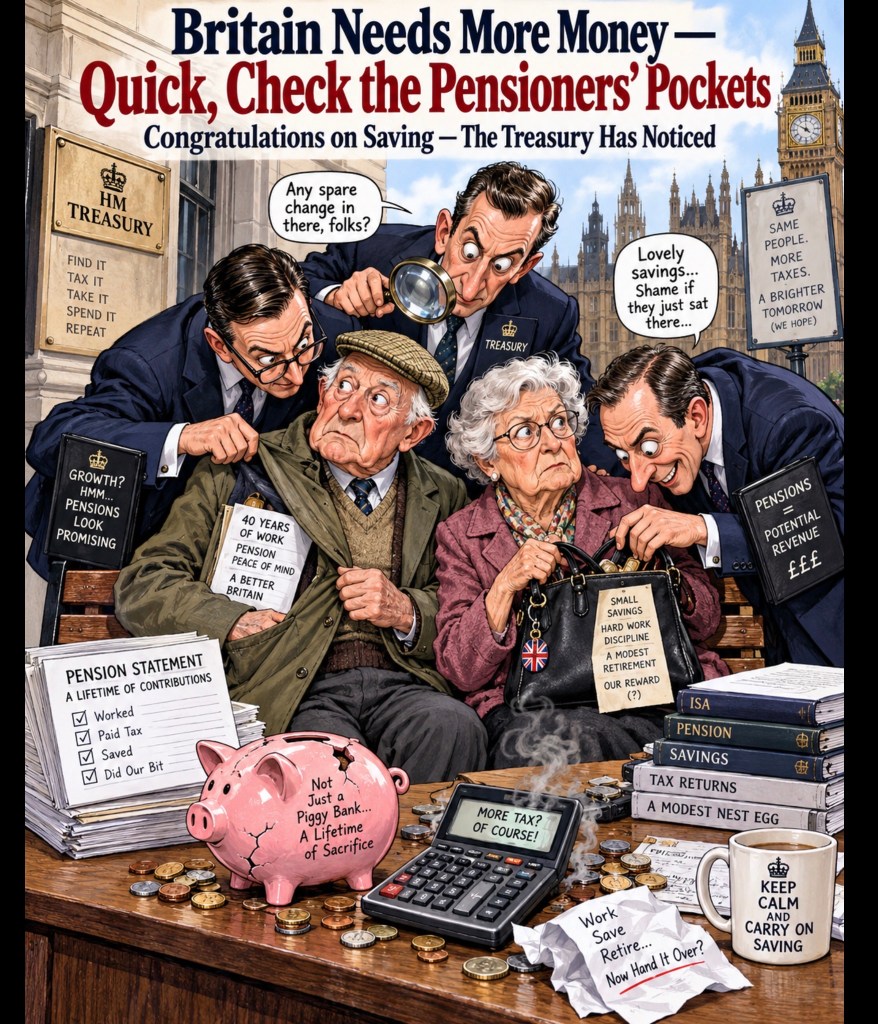
💷👀Britain needs more money. Again. The national wallet is apparently making that worrying little squeaking noise it makes shortly before somebody in Westminster starts looking around for a fresh pair of pockets. Borrowing is expensive, the Budget is approaching, the sums are getting uncomfortable, and somewhere inside the Treasury a calculator is presumably smoking gently on a windowsill. Then comes the inevitable glance across the country towards a generation that has spent forty or fifty years working, paying tax, paying National Insurance, paying mortgages and trying to put something aside for retirement. Suddenly the pensioners start looking remarkably interesting.
🎯 Congratulations on Saving — The Treasury Has Noticed
There is something wonderfully backwards about the way successful retirement planning can eventually be treated. Spend your working life earning a wage, paying your dues, buying a home and building a pension, and society applauds your responsibility. Reach retirement with some savings and an income you can actually live on, however, and the applause begins to sound suspiciously like somebody opening a till.
More than one million pensioners are now estimated to be paying income tax at the 40% or 45% rates, more than double the number five years ago. Much of that increase has come not because pensioners suddenly discovered an oil field beneath the conservatory, but because tax thresholds have been frozen while pensions and other nominal incomes have continued to rise. The numbers go up, the thresholds stay where they are, and more people quietly slide into tax bands that once looked comfortably beyond them.
That is the genius of fiscal drag. Nobody needs to walk up to a podium and announce that income-tax rates are going up. Nobody needs to unveil a giant red box labelled “SURPRISE TAX INCREASE.” The percentages can sit exactly where they were while inflation, pension increases and frozen allowances quietly do the heavy lifting. It is taxation by stationary signpost: the road keeps moving underneath you until one morning you discover you have crossed into another band.
Of course, the argument should never be that pensioners ought to pay no tax whatsoever. Income is income, and people with substantial means can reasonably be expected to contribute. The more interesting question is why retirement wealth so easily becomes shorthand for untapped government revenue, as though the house, pension and savings appeared overnight courtesy of a game-show jackpot rather than decades of earnings, deductions, restraint and financial planning.
A Treasury spreadsheet can show the value of somebody’s pension pot, the equity in their house and the income arriving each month. What it cannot show quite so neatly is the forty years spent getting up for work, the mortgage interest, the tax already paid, the National Insurance already collected, the holidays not taken, the cars kept for another three years and the money repeatedly put aside because every government for generations has told people that responsible citizens should prepare for their own retirement.
Then retirement arrives and the message risks changing rather dramatically. Thank you for being responsible. Thank you for saving. Thank you for reducing your dependence on the state. Now, about those savings. 👀💰
That is where the politics becomes dangerous. If every fiscal squeeze produces another conversation about pension allowances, property wealth, inheritance, pension tax relief or frozen thresholds, younger workers may eventually draw a perfectly rational conclusion. Why sacrifice disposable income today to build assets that merely make you a more attractive tax target tomorrow?
Governments naturally need revenue. Hospitals, schools, defence, roads, social care and public services do not fund themselves through positive thinking and ministerial press conferences. But there is a difference between designing a broad and transparent tax system and repeatedly discovering that the people who did what they were encouraged to do have become exceptionally convenient to squeeze.
Frozen thresholds make that squeeze particularly easy to disguise because there is no dramatic moment at which somebody receives a letter saying, “Congratulations, your tax rate has been increased.” Instead, incomes rise in pounds while purchasing power struggles to keep pace, and the tax system quietly claims a larger share. The pension may look bigger on paper, but the supermarket, energy company, insurer and council have all noticed inflation too.
The political temptation is obvious. Pensioners often possess assets accumulated over decades, and assets look very impressive when viewed from Whitehall. A paid-off house can appear to be a mountain of wealth until you remember that the owner cannot normally remove the kitchen extension and use it to pay the electricity bill. A pension fund can look enormous until you remember that it may need to provide an income for twenty or thirty years. Savings can look like spare cash until you remember that they are frequently the emergency fund, care fund and everything-goes-wrong-at-once fund.
Perhaps the real question is not whether pensioners should contribute. They already do, and many have contributed throughout their adult lives. The question is what sort of message Britain wants to send about prudence. If hard work, home ownership, pension saving and financial independence are repeatedly treated as invitations for additional extraction, the state risks turning responsible behaviour into something approaching a financial practical joke.
🔥 Challenges 🔥
So where should the money come from when the Treasury books start groaning? Should pensioners who have built larger retirement incomes simply accept that success means paying more, or has fiscal drag become an increasingly convenient way of raising revenue without openly increasing headline tax rates? And at what point does encouraging people to save for retirement collide with repeatedly finding new ways to tax the result? 💷🤔
Tell us what you think in the blog comments. Are pensioners being unfairly targeted, or should accumulated retirement wealth carry a greater share of the burden when public finances are stretched? Bring the argument, bring the sarcasm and bring the calculator. 👇💬
Comment, like and share the post if you think Britain needs a proper debate about who pays when the Treasury needs another few billion. 🔥📣
The best comments will be included in the magazine. 🎯📰


Leave a Reply