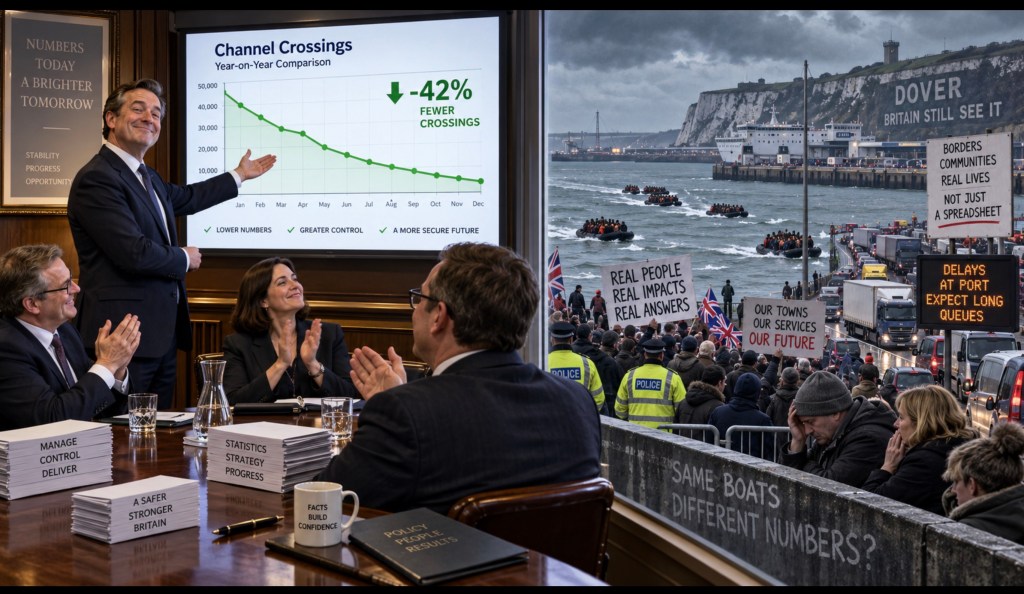
There is a peculiar danger in politics when the spreadsheet says one thing and the electorate feels something entirely different. The Government can point, perfectly legitimately, to its preferred measure and say that small-boat crossings are down this year. On 25 August, the Home Office said exactly that, adding that July recorded the lowest July figure since 2020. On paper, that is progress. In Westminster, somebody has probably already found a particularly enthusiastic shade of green for the PowerPoint slide. (Home Office Media)
The problem is that voters do not live inside PowerPoint presentations.
🚤 Westminster Has a Spreadsheet. Dover Has a Window.
People can still see boats arriving. They can still see arguments about asylum accommodation, removals, enforcement, hotels, legal challenges and the enormous machinery required to operate the asylum system. At Dover this weekend, they could also see protests spilling onto roads around the port and disrupting cross-Channel traffic. Whatever somebody thinks about those protesters, the spectacle hardly resembles a country in which the political temperature surrounding immigration has quietly returned to room temperature. (Reuters)
That is where repeating “the numbers are down” starts becoming politically hazardous. It may be statistically correct while simultaneously sounding like an answer to a question the public did not ask. A voter worried about whether the state has effective control of the border is unlikely to be reassured by being informed that one particular column on one particular chart is pointing in a more encouraging direction.
This does not mean the Government is lying, and casually throwing that accusation around would weaken the argument rather than strengthen it. Governments of every colour have always possessed an extraordinary talent for locating whichever statistic looks best under studio lighting. 📊 If twelve measures are miserable and the thirteenth has improved, you can safely bet which one will arrive at the press conference wearing a tie.
That is the distinction that matters. Small-boat crossings can decline over a particular comparison period while thousands of people continue making the journey. The asylum system can remain under substantial pressure. Voters can continue believing that border control is inadequate. Ministers can simultaneously point to genuine areas of improvement. None of those propositions automatically cancels out the others.
Politics becomes dangerous when governments start behaving as though proving one statistic automatically disproves the public’s broader concern.
Germany has just delivered a rather spectacular reminder of what happens when established political parties fail to understand the difference between telling people what the figures say and understanding what voters think those figures mean. In Saxony-Anhalt on Sunday, exit polls and projections put the AfD at roughly 44% — more than double its previous share — while Chancellor Friedrich Merz’s CDU suffered an extraordinary reverse, falling to around 18.5%. (wplg)
Whatever anyone thinks of the AfD — and there is plenty to debate — dismissing an electoral movement of that size by assuming millions of voters are merely stupid, wicked or hypnotised by the internet is not political analysis. It is political anaesthesia. Something is driving those voters, and governments that refuse to investigate why because they dislike the answer may eventually discover that voters are perfectly capable of investigating alternatives themselves.
Britain’s political establishment should pay attention.
People do not experience government through monthly spreadsheets. They experience it through what they see in their towns, what they hear from their neighbours, what appears on their payslips, what happens when they need housing or public services, what they watch occurring on television and, increasingly, what appears on the phone in their hand twenty-four hours a day.
That does not mean perception is always accurate. Social media can distort reality spectacularly. Individual incidents can be presented as national trends. Images can travel around the country faster than context ever will. But politicians cannot defeat perception merely by announcing that perception has failed a statistics exam. 🎓
If ministers repeatedly tell people that things are improving while a substantial part of the electorate believes the opposite, the disagreement eventually ceases to be about immigration numbers.
It becomes a disagreement about whether voters trust the people explaining those numbers.
And that is a much more serious problem.
Once people begin to believe that politicians, institutions and sections of the media are showing them only the carefully cropped portion of reality that supports a preferred narrative, another cheerful statistic does not necessarily restore confidence. Sometimes it has precisely the opposite effect. Every polished graphic becomes another reason for suspicion. Every minister declaring “progress” sounds like somebody standing beside a leaking roof proudly announcing that rainfall has fallen 12% since Tuesday. ☔
That is why the political lesson from Germany is bigger than Germany, and the lesson from Dover is bigger than another weekend of demonstrations.
A government can win an argument with a spreadsheet and still lose the argument with the electorate.
And when that happens often enough, voters eventually stop arguing about the numbers altogether.
They start asking who they can trust.
🔥Challenges🔥
So which matters more when judging whether Britain’s borders are under control: the official statistics, what people can physically see happening, or some combination of both? And at what point does repeatedly highlighting favourable figures stop reassuring voters and start convincing them that Westminster simply isn’t listening?
💬 Put your view in the blog comments — especially if you disagree. Like it, challenge it, share it, or dismantle the argument completely. Just bring something better than a slogan.
The best comments, counterarguments and verbal hand grenades will be included in the magazine. 🎯📝


Leave a Reply