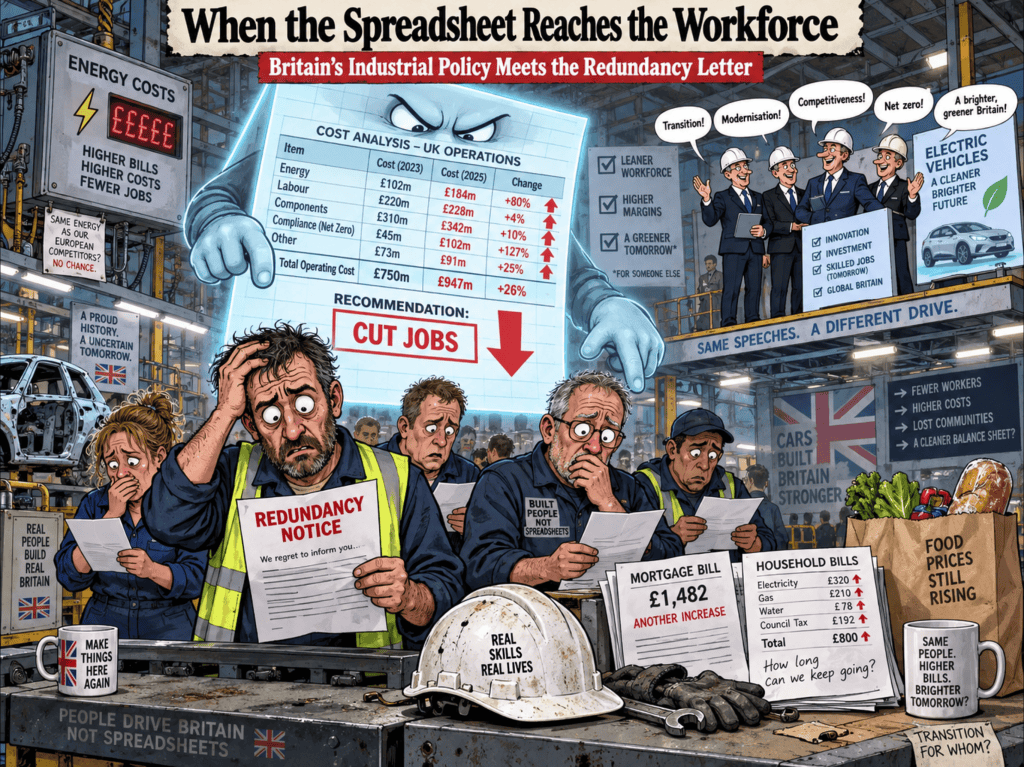
⚡🏭The redundancies are starting, and this is the moment when government policy stops living comfortably inside Whitehall strategy documents and begins arriving through the letterboxes of working people. Car manufacturers are studying their costs, examining weakening demand, calculating energy bills and looking at where the market is heading. Eventually, after all the presentations, forecasts and reassuring corporate language, somebody opens the spreadsheet and decides that jobs have to go.
⚡ Green Dreams, Redundancy Notices and the Great British Industrial Squeeze
Politicians and executives can call it restructuring, transition, competitiveness, efficiency, modernisation or strategic realignment. The language always sounds wonderfully clean when printed in a press release. Unfortunately, the person losing a £35,000 or £45,000 salary does not experience “strategic realignment.” They experience unemployment, mortgage anxiety, cancelled plans and the sudden discovery that Tesco remains strangely unwilling to accept “industrial transformation” as payment for the weekly shop.
For years, governments have talked about net zero, energy policy, electric vehicles and industrial transformation as though they were grand national projects whose costs would simply dissolve somewhere inside the economy. Targets were announced, strategies were published, ministers appeared beside charging points wearing hard hats that had clearly never encountered anything heavier than a television camera, and Britain was repeatedly promised a dazzling new era of green prosperity. 🌱🚗
The awkward problem is that costs do not disappear because somebody has printed them on recycled paper. Somebody eventually pays them, and workers are beginning to discover exactly where that bill can land.
Britain’s industrial electricity costs have become a serious competitiveness problem for energy-intensive manufacturers. Factories trying to sell into international markets are expected to compete against overseas facilities with cheaper power, lower production costs and, in some cases, substantial government support. Westminster can produce as many speeches about “green growth” as it likes, but a car factory still needs electricity, a component supplier still needs margins and an engineering company still needs customers willing to buy what it produces.
A production line cannot run on ministerial enthusiasm. A supplier cannot pay wages with a 2035 target. A manufacturer cannot indefinitely compete with factories abroad while paying substantially more for one of the basic ingredients of modern industrial production: energy. Eventually, the arithmetic becomes less interested in political ambition and more interested in survival.
That is when the spreadsheet reaches the workforce. 📉
And the damage does not stop with the names appearing on the first redundancy announcement. Large manufacturers sit at the centre of entire local economic ecosystems. Contractors depend on them, engineering firms depend on them, logistics companies depend on them, maintenance businesses depend on them, component manufacturers depend on them, and the cafés, pubs, shops and restaurants surrounding major industrial sites depend on the wages those businesses generate.
Remove enough secure, well-paid industrial jobs from a town and the damage begins moving outward. One redundancy programme becomes fewer shifts at a supplier. Fewer shifts become less spending in local businesses. Less spending becomes another struggling employer. Before long, something described in a corporate press release as “streamlining operations” begins looking suspiciously like an entire community getting poorer.
That is why treating these announcements as ordinary corporate restructuring misses the larger issue. These are precisely the jobs British governments repeatedly claim they want to protect and expand: engineering, technology, manufacturing, skilled trades and high-value industrial employment.
Yet Britain simultaneously maintains an economic environment in which producing physical goods can be painfully expensive. There is a contradiction sitting squarely in the middle of industrial policy, dressed in a high-vis jacket and pretending nobody can see it. 👷♂️⚡
The government tells manufacturers to invest in Britain while manufacturers study the electricity bill. Ministers celebrate ambitions for electric vehicle production while factories calculate whether those vehicles can be produced competitively here. Politicians promise thousands of green jobs tomorrow while workers discover that perfectly real industrial jobs are disappearing today.
That gap between political promise and economic experience is where the danger begins.
Working-class voters rarely experience economic policy through charts presented at Treasury briefings. They experience it through overtime disappearing, shifts being cancelled, factories reducing headcount and sons, daughters, partners and neighbours suddenly wondering whether their employment will exist twelve months from now. Once those things begin happening, arguments about industrial strategy stop being theoretical remarkably quickly.
They become personal.
If household energy bills remain high while industrial employers complain about electricity costs, people notice. If factories shrink while ministers insist Britain is experiencing an industrial renaissance, people notice. If skilled workers lose secure employment while politicians celebrate jobs that may or may not appear several years from now, people notice that too.
And people vote.
The political risk is that the communities encountering these pressures first are not populated by think-tank economists debating elegant models of transition. They are populated by engineers, technicians, production workers, drivers, contractors, small-business owners and families whose livelihoods are connected to Britain’s ability to manufacture competitively.
For them, the argument will not necessarily be about whether environmental goals are worthwhile. It will increasingly be about whether the government designed the transition intelligently enough to prevent British industry becoming collateral damage.
Because once voters begin connecting expensive energy, weakening manufacturing competitiveness and disappearing secure employment with decisions being made in Westminster, the government may discover that the largest cost of industrial policy was never printed on an electricity invoice.
It was printed on the ballot paper. 🗳️⚡
🔥 Challenges: How Many Factories Before Westminster Notices?
This is where the debate gets uncomfortable. Britain says it wants industrial growth, competitive manufacturing, electric vehicle leadership and thousands of skilled green jobs, but can those ambitions survive if the cost of producing things here keeps pushing employers towards cuts?
What is happening where you live? Are factories reducing shifts? Are engineering firms struggling? Are energy costs making British industry less competitive, or is something else driving the decline? Drop your experience and your argument in the blog comments. The people living through this transition should have at least as much say as the people designing it from conference rooms. 💬🏭
👇 Comment, like and share this post. If Britain is serious about rebuilding manufacturing, this conversation cannot stay trapped inside Westminster.
The best comments, arguments and observations will be included in the magazine. 🎯📝


Leave a Reply