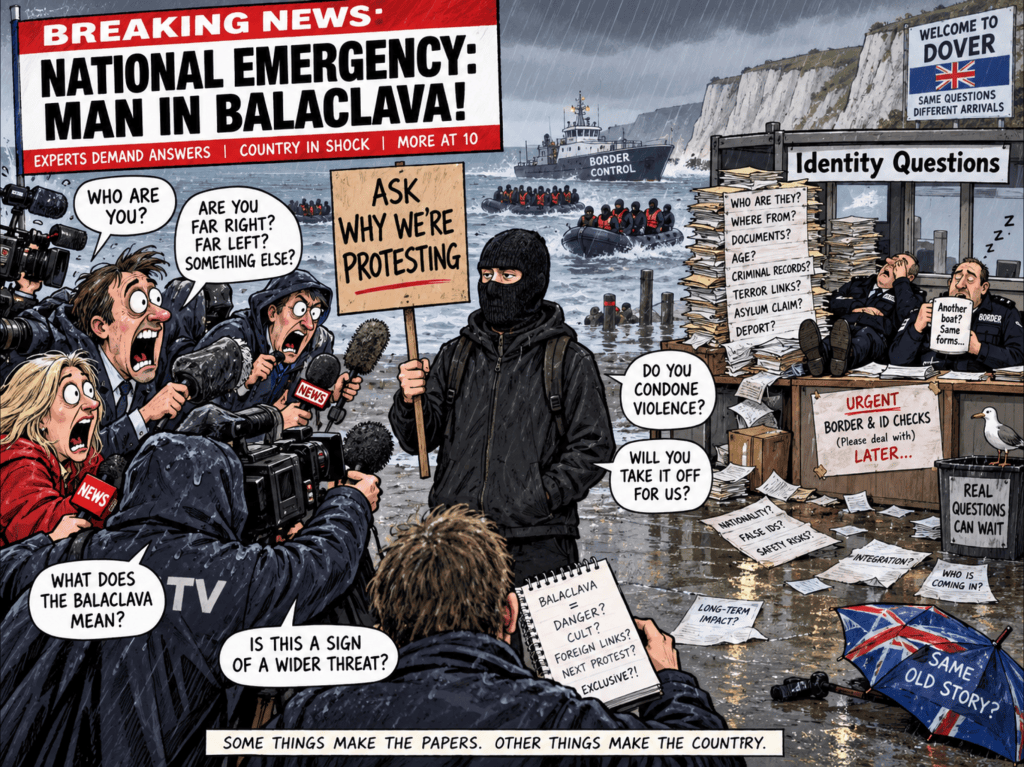
🎭🇬🇧Apparently Britain has discovered the real national emergency. Not undocumented journeys, uncertain identities, missing paperwork or unanswered questions about who has entered the country. No, the true menace stalking the land is Dave from Dover wearing a £12 black balaclava because he does not fancy having his face plastered across tomorrow morning’s newspapers. 🚨
The moment a protester covers his face, sections of the media appear ready to summon Sherlock Holmes, MI5 and possibly Batman. Who is this shadowy figure? Why is he wearing black? What sinister intentions lurk beneath the polyester? Has anyone checked whether the balaclava was purchased legally? Meanwhile, the protesters themselves are standing there asking whether the state knows with confidence who is coming into Britain, where they came from, what documents they have and how they arrived.
🎭 Identity Matters — Apparently Only When It’s Nigel Behind a Snood
There is something wonderfully absurd about watching anonymity suddenly become a national obsession when the anonymous person happens to be standing on the Kent coast holding a placard. A covered face becomes suspicious, threatening and worthy of dramatic television narration, even if the person underneath it is doing little more dangerous than standing beside a metal barrier in drizzle.
Yet when the wider political argument turns to immigration, identity can suddenly become a subject requiring extraordinary delicacy, caveats and verbal gymnastics. Asking whether authorities can confidently establish somebody’s identity, nationality, background or route into the country can be treated as though somebody has wandered into polite society wearing muddy boots.
Nobody needs to pretend that everyone arriving in Britain is dangerous. That would be ridiculous. But it is equally ridiculous to behave as though asking who people are is somehow an outrageous concept in a country that requires you to prove your identity to collect a parcel, open certain bank accounts or occasionally convince a nightclub doorman that you really are thirty-eight. 📦
If peaceful protesters cover their faces because they do not want to be photographed, identified, tracked online, harassed or transformed into tomorrow’s designated national villain, perhaps the balaclava is not the most interesting part of the story. Perhaps the interesting part is why they are protesting.
But that would require discussing the political issue rather than the wardrobe.
And wardrobe journalism is so much easier. Black clothes? Sinister. Balaclava? Terrifying. Hood up? Practically an insurrection. Never mind what anyone is actually saying; zoom the camera in on the eyeholes and cue the ominous background music. 🎥
The contradiction writes its own punchline. A British protester conceals his identity for an afternoon and suddenly everybody urgently wants to know exactly who he is. Yet protesters questioning whether the government knows exactly who has entered Britain can find themselves portrayed as though the very question is distasteful.
Apparently identity is absolutely crucial — right up until somebody asks whether the same standard should apply at the border.
🔥 Challenges 🔥
So which is it? Does knowing who somebody is matter, or does it only become a national emergency when the unidentified person is wearing a balaclava in Dover? Is the mask genuinely the issue, or is it simply a convenient distraction from an immigration debate that politicians and broadcasters would rather approach wearing oven gloves? 🧤🔥
Drop your take in the blog comments. Is this sensible concern, spectacular hypocrisy, media theatre, or another glorious episode of Britain arguing about the packaging while refusing to open the box? 💬
Comment, like and share if you think the debate deserves more scrutiny and fewer costume reviews. 👇🔥
The best comments will be included in the magazine. 🎯📝


Leave a Reply