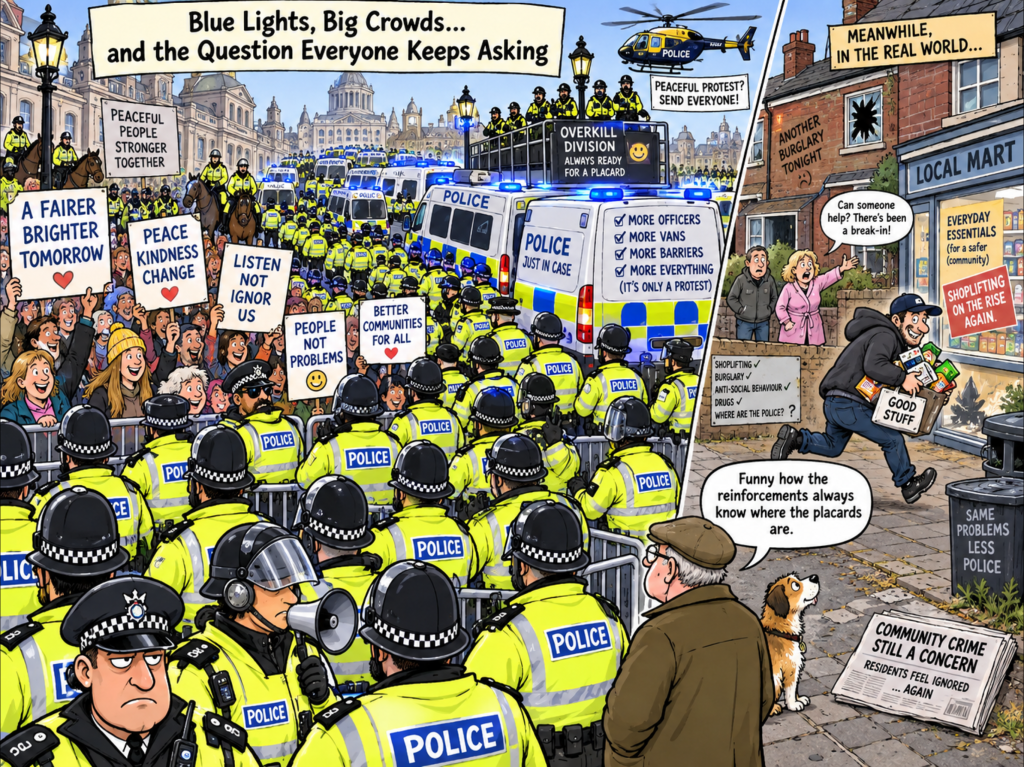
🚓👀When peaceful protesters gather with placards, chants and the occasional badly spelled banner, the police can sometimes appear in numbers that make it look as though the entire force has discovered teleportation. Vans arrive, officers line the street, barriers appear from nowhere, and suddenly there is enough fluorescent yellow on display to guide aircraft safely into Heathrow.
🚨 Funny How the Reinforcements Always Know Where the Placards Are
That visibility creates an awkward question for the public. If large numbers of officers can be mobilised to stand opposite people demonstrating peacefully, why does that same overwhelming presence so often seem absent when communities are struggling with shoplifting, burglary, violent offenders, sexual offences and other serious crimes?
For residents who have watched local shops repeatedly targeted, waited hours after reporting a burglary, or heard neighbours complain about persistent antisocial behaviour, the contrast can be difficult to ignore. It can create the impression that the state is better equipped to manage a crowd holding cardboard signs than to confront the people actually making communities feel unsafe.
Of course, policing is more complicated than counting uniforms on a street corner. Different units have different roles, protests often require advance planning, and serious crimes may involve investigations that are largely invisible to the public. But public confidence is shaped by what people see as well as by what happens behind office doors, computer screens and evidence files.
And what people sometimes see is extraordinary. A peaceful march can produce rows of officers, police vans, liaison teams and public-order units, while a high street plagued by theft can leave shopkeepers wondering whether the emergency response is being delivered by carrier pigeon. 🐦📦
That image is damaging because policing depends heavily on public trust. People want to believe that resources are being directed toward the threats that matter most to everyday life. When citizens see a huge uniformed presence around protesters but feel abandoned when their homes, businesses or neighbourhoods are targeted by criminals, frustration is hardly surprising.
The question is therefore not whether protests should be policed. Clearly, large gatherings sometimes require officers to keep people safe, manage traffic and prevent disorder. The question is whether the wider public is receiving the same visible sense of urgency when dealing with crime that directly affects their lives.
Because when the police seem easier to find beside a placard than beside a crime scene, people are inevitably going to start asking whether the priorities have become badly scrambled. 🚔🤔
🔥 Challenges 🔥
What does policing look like where you live? Have you seen huge numbers of officers deployed to demonstrations while your own area struggles with theft, burglary, violence or repeated antisocial behaviour? Or do you think the comparison is unfair because protest policing and criminal investigations require completely different resources?
Tell us what you have seen firsthand, because public confidence cannot be repaired by slogans, press releases or another photograph of somebody in a high-vis jacket looking extremely concerned. 💬
👇 Comment on the blog, like the post and share it with someone who has been asking the same question.
The best comments, arguments and sharpest observations will be featured in the magazine. 🎯📝


Leave a Reply